
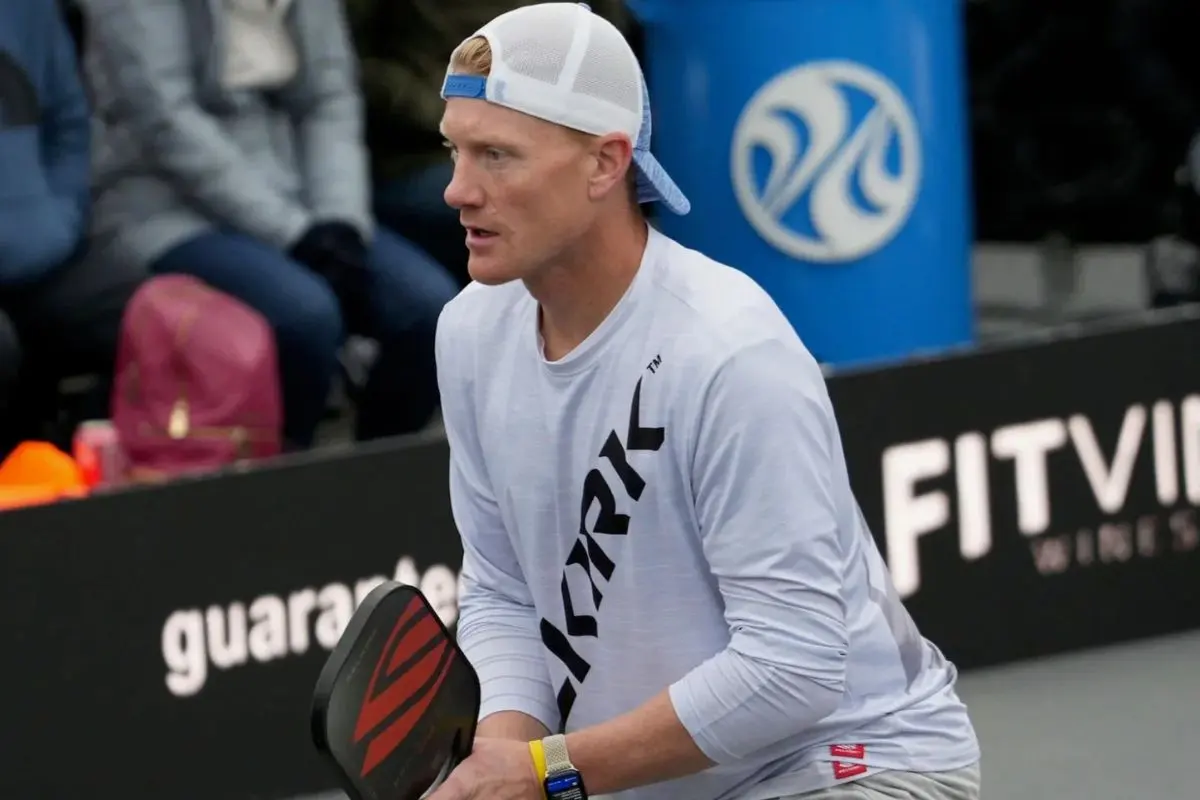
John Cincola Shares the Hidden Mechanics of Dinking: Professional pickleball player John Cincola recently shared an educational video on Instagram, dissecting the mechanics of dinking. His detailed analysis explored the roles of the shoulder, elbow, and wrist in executing this fundamental pickleball technique. By providing clarity on how each joint contributes to the shot, John Cincola aimed to help players refine their dinking skills and improve control during gameplay.
Understanding the Role of the Shoulder
John Cincola began his breakdown with the shoulder joint, highlighting its prominence in traditional dinking advice. “This is the common one we hear we should be using for dinking,” he said. The widely taught method involves locking both the wrist and elbow and relying solely on the shoulder for movement.
While effective for maintaining consistency, John Cincola’s analysis suggested that exclusive reliance on the shoulder may limit versatility in dinking, particularly in situations requiring more distinct touch or quick adjustments.
Exploring the Elbow as a Hinge
Next, John Cincola shifted focus to the elbow joint, which he referred to as a “hinge.” Incorporating the elbow into dinking allows players to add control and adaptability, particularly when the situation demands more precise shot placement.
He explained that the elbow’s hinge-like motion can contribute to a more fluid and flexible dinking style, offering an alternative to the rigid shoulder-driven approach. This insight encourages players to think beyond conventional techniques and experiment with different mechanics to find what works best for their game.
The Impact of the Wrist on Paddle Control
John Cincola then discussed the role of the wrist, the closest joint to the pickleball paddle. He emphasized that movements originating from the wrist have a greater impact on the paddle than those from the shoulder or elbow.
“In general, the closer you get to the paddle, the more a hinge is going to have impact on that,” he noted. This principle shows the wrist’s critical role in fine-tuning shot precision and spin. However, John Cincola cautioned against overusing the wrist, as its high sensitivity to movement can lead to inconsistency if not controlled properly.
Balancing Mechanics for Optimal Dinking
John Cincola’s breakdown highlights the need for balance and adaptability in dinking mechanics. By understanding how each joint contributes to the shot, players can tailor their approach based on specific gameplay scenarios.
For example, using the shoulder for foundational stability, the elbow for added flexibility, and the wrist for precision creates a dynamic toolkit that players can employ depending on the demands of the moment.
News in Brief: John Cincola Shares the Hidden Mechanics of Dinking
Professional pickleball player John Cincola recently shared an educational video on Instagram, breaking down the mechanics of dinking. He explained the roles of the shoulder, elbow, and wrist in executing the shot, emphasizing that while the shoulder provides stability, the elbow offers flexibility and the wrist allows for fine control and precision.
Cincola encouraged players to balance these joint movements for improved shot placement and adaptability. His insights offer valuable guidance for players aiming to refine their dinking technique, highlighting the importance of understanding and mastering each joint’s contribution to the shot for greater control and consistency.
ALSO READ: John Cincola’s Secret to Power Drives That Will Leave the Opponents Behind