
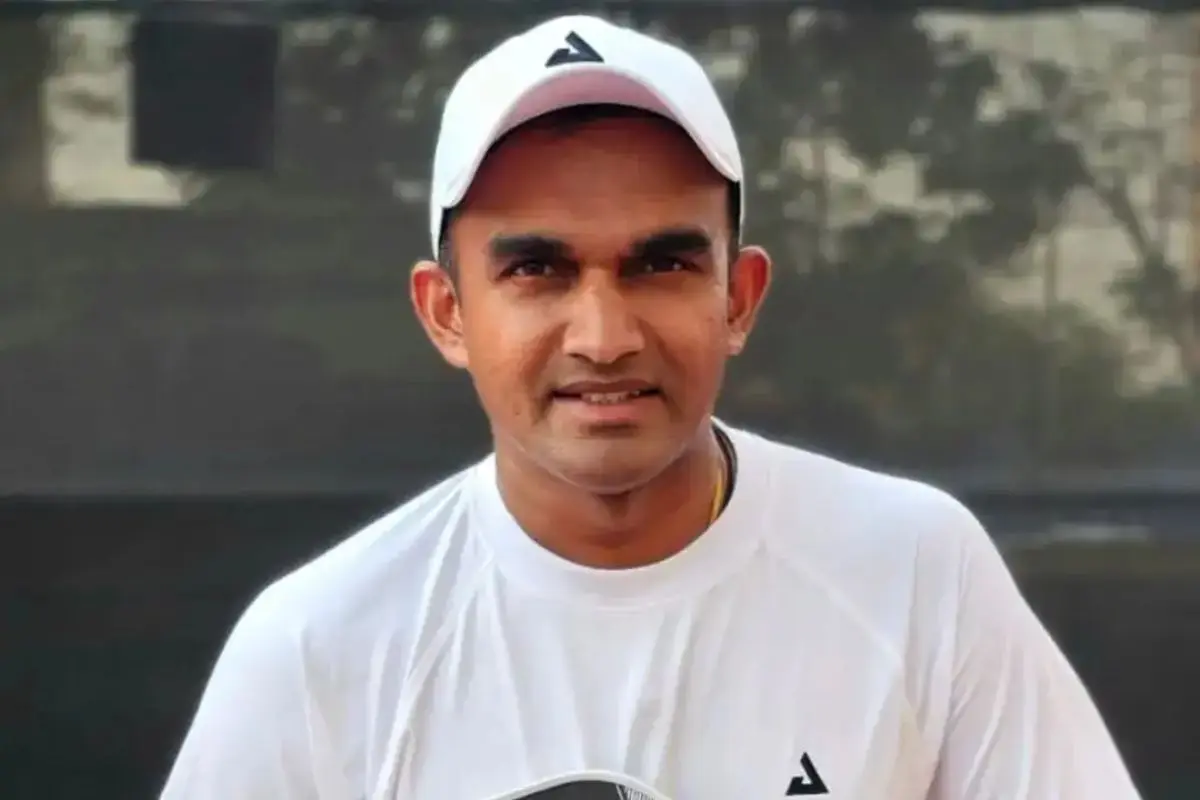
Dhiren Patel Pickleball Revolution India: India’s national pickleball coach, Dhiren Patel, says the sport is no longer just a game but a movement that is reshaping fitness, careers, and competition. Patel, who became India’s first certified pickleball coach, believes the game is giving players new opportunities, healthier lifestyles, and bigger rewards.
A Coach’s Journey into Pickleball
Dhiren Patel spent more than 18 years coaching tennis in India and the United States. While in South Carolina, he discovered pickleball and earned his certification with the Professional Pickleball Association (PPA). “I am the first one to become a certified pickleball coach in India,” Patel said.
He recalled, “I was staying in South Carolina at the Hilton Head Island, and was teaching at the Van Der Meer Tennis Academy. But after my tennis coaching stint ended, I came to know about a sport called pickleball and a certification course for it. So, I jumped into that, and because of my tennis background, I easily completed the course.”
A Fast-Growing Culture
Patel now works at the National Centre for Excellence in Ahmedabad, managed by the Indian Pickleball Association (IPA). He oversees three academies and has seen the sport’s rapid growth. “In just the last year, more than 250 courts have come up in Ahmedabad alone. Courts are booked even at four in the morning,” he said.
“Young people who once spent late nights in cafés are now on pickleball courts. You will never find a pickleball court in the city empty. That is nothing short of a revolution.”
He explained how Gujarat, Rajasthan, and Maharashtra are leading the wave, with Delhi, Hyderabad, and Bengaluru catching up fast. Many tennis players are switching sports. “They were done with their luck in tennis. Now, they are seeing their future in pickleball because it is easy for them to adapt,” Patel added.
What Makes Pickleball Different
Patel explained the contrasts between pickleball and tennis. “The biggest difference is the court size. On one tennis court, you can fit four pickleball courts.”
He added, “For tennis players, it feels like a bread-and-butter switch. They have been covering a huge ground all their lives, and suddenly, success feels easier on this smaller stage.”
He stressed that the sport demands skill, not just equipment. “In tennis, you have the racquet strings to bite the ball, to spin it. In pickleball, it is a plastic ball and a wooden fibre paddle – no friction. If you want to create spin, you need skill, not equipment. And while in tennis, a serve can be an unreturnable weapon, in pickleball every serve comes back. That is why we say the point begins only after two shots.”
Training the Next Generation
In Ahmedabad, Patel trains players from under-12 kids to adults in their 50s. His students include top juniors like Dev Shah, Rakshikha Ravi, and Purvansh Patel. “It is something very special,” he said.
His training approach is focused on agility and quick movements. “The ball bounces low. If you do not move quickly, you will lose the point. So, I push every category to get faster, sharper. For the advanced players, it is drills – serve-and-volley, approach shots, volleys at the net. The idea is to make them adapt,” Patel explained.
Indians on the World Stage
Patel highlighted India’s rising stars. Armaan Bhatia won two titles in the US this year – the APP Newport Beach Open and the APP New York City Open. He also signed with the United Pickleball Association of America (UPA) to join the PPA Tour. India’s No. 1, Aditya Ruhela, is another name to watch.
Patel himself continues to compete, winning gold at the US Open in the 35-plus category. He has also held Asia’s top ranking in his age group for more than two years.
Prize Money Driving the Growth
One of the main factors fueling pickleball’s popularity is prize money. “The Dubai Open is coming with a $50,000 prize pool,” Patel said. “In India, we have already had tournaments with $100,000 prize money.”
The RISE Up Championship, a PWR 1000 event in Chennai, will feature a Rs 25 lakh prize pool, showing how fast the sport is growing in India.
“Yes, pickleball is competing with tennis,” Patel admitted. “But the reality is, pickleball gives you a chance. With tennis, if your grip is wrong, the ball flies wayward. In pickleball, even with a wrong grip, you can still keep the ball in play. So, there is a bit of flexibility. That is why it is exploding in India.”
Beyond Competition: A Healthier Nation
For Patel, the biggest impact is not only on rankings or prize money but also on health. “India is getting healthier by playing pickleball,” he said. “People are realising they need to move, to play, to sweat. And pickleball gives them the right mix of balance to stay fit while not hurting themselves.”
News in Brief: Dhiren Patel Pickleball Revolution India
India’s national coach, Dhiren Patel, says pickleball is becoming a movement in the country. With rising prize pools, rapid growth in courts, and international success from players like Armaan Bhatia and Aditya Ruhela, the sport is attracting former tennis players and fitness seekers alike, driving a cultural shift across India.