

The Pittsburgh Pirates have faced a turbulent stretch recently, marked by both encouraging moments like Paul Skenes’ Cy Young-caliber performance and disappointing outcomes, including another losing season. Mitch Keller, on the other hand, has experienced uncertainty about his place in the team despite being in the early years of a five-year contract. With the Pirates strengthening their offense without parting ways with Keller, he now stands as the crucial X-factor for Pittsburgh’s ambitions in the 2026 season.
As the Pirates build around a youthful and largely inexperienced core, Keller’s steady presence is becoming increasingly vital. Although the team remains a work in progress, this period might be their most promising opportunity to contend since 2018. Keller’s ability to deliver consistent results on the mound could shape the Pirates’ trajectory and their hopes for success in the near future.
Keller’s Dependable Performance Over Time
Mitch Keller has earned recognition for his remarkable consistency. Since his breakthrough in 2022, his season-end statistics show limited variation. Over the past three seasons, he has pitched at least 175 innings annually, maintaining an earned run average (ERA) consistently between 4.19 and 4.25. His other key metrics, such as Fielding Independent Pitching (FIP), wins above replacement (fWAR), and home runs per nine innings (HR/9), have also remained stable, underscoring his reliability atop the Pirates’ pitching rotation.
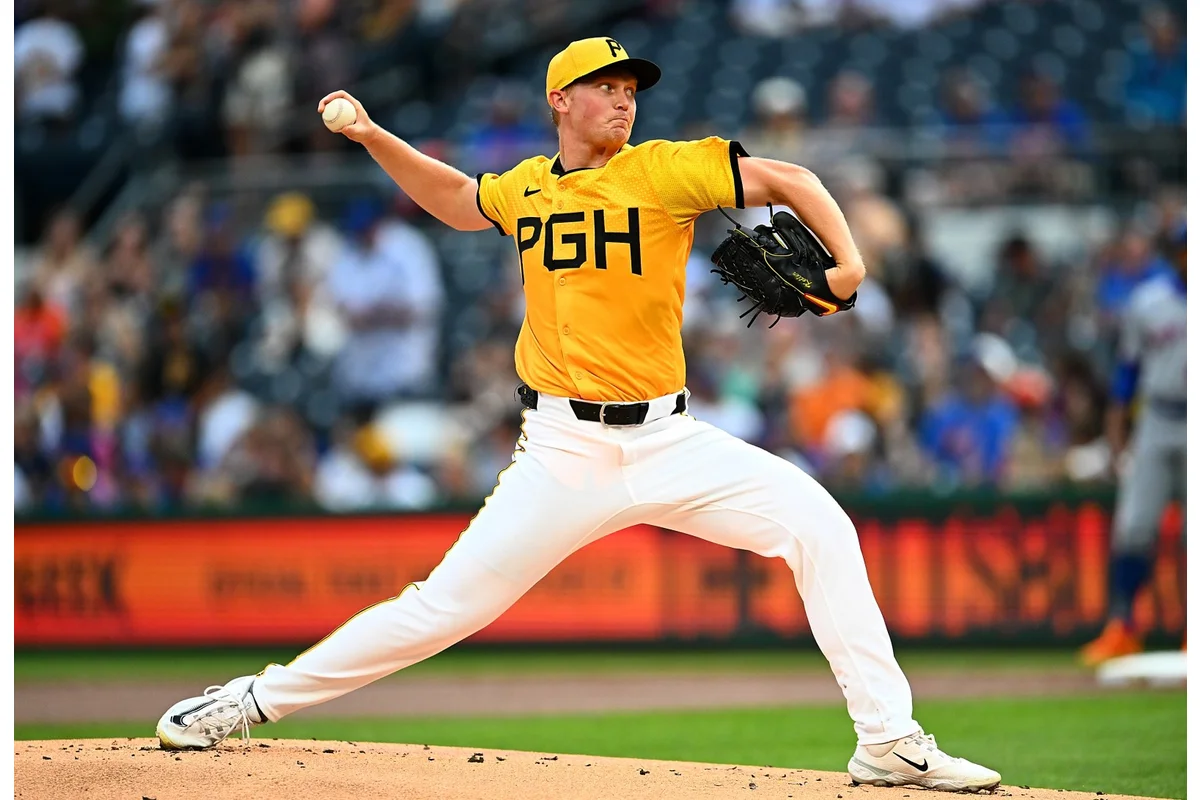
Keller’s 2023 season was a career highlight: he earned his first All-Star selection and surpassed 200 strikeouts for the first time, setting a franchise record with 210 strikeouts by a right-handed pitcher in a single season. He also holds records for the most strikeouts at PNC Park and the longest streak of games with at least eight strikeouts. Despite a slight regression from that peak, Keller remained a dependable starter in 2025, posting a 4.19 ERA, 150 strikeouts, and a 2.5 fWAR across 32 starts, along with his lowest HR/9 rate since 2022.
Consistency like Keller’s is invaluable for a rotation laden with emerging pitchers, as it offers the team a reliable baseline. Instead of needing him to perform like a superstar every outing, the Pirates benefit most by having a pitcher they can count on season after season.
Guiding a Budding Pitching Rotation
Beyond his individual stats, Keller’s leadership will be crucial for the Pirates’ young pitching staff in 2026. The rotation is expected to feature numerous unseasoned arms, and Keller’s role as a veteran mentor will help these players adjust to the major league’s demands and develop successful routines. For Pittsburgh to be competitive next year, their starters must perform consistently at a high level.
Dealing with the ups and downs of a major league season can be challenging, especially for less experienced players who often struggle with mental toughness through difficult stretches. Keller’s experience navigating early career failures makes him uniquely qualified to help the young pitchers cope and succeed.
Keller’s own path was far from smooth: he had a rough debut, surrendering six runs in his first inning pitched in the majors and ending his rookie year with an ERA over 7.00. The 2020 season showed some promise, but he again struggled in 2021 with a 6.17 ERA over 100.2 innings. However, his commitment to improvement, including extensive work with Tread Athletics, allowed him to refine his pitching arsenal and reach his potential.
These lessons hold significant value for prospects like Bubba Chandler, Braxton Ashcraft, Hunter Barco, and Thomas Harrington—all expected to compete for starting roles in 2026. Keller shares similarities with Chandler, as both were once considered top-20 prospects in baseball, and his guidance should help ease their transition.
Keller’s influence on the clubhouse and mentoring young pitchers could be a defining factor in the Pirates’ 2026 campaign, even if those contributions don’t show up in the box scores.
Boosted Offensive Support Could Elevate Keller’s Impact
Keller’s effectiveness has often been hampered by weak run support during recent seasons, which has placed additional pressure on him to deliver outstanding performances to keep the Pirates competitive. This environment forced Keller to carry a heavy load, but relying on starters to consistently pitch at an elite level without offensive backing makes winning a daunting challenge.
In 2025, the Pirates’ offense ranked near the bottom in runs scored during Keller’s starts, averaging only 3.7 runs per game, the sixth-lowest among qualified starters. This scarcity of run production was reflected in Keller’s disappointing 6-15 win-loss record, which did not align with his solid individual performance.
Looking ahead to 2026, the arrival of power hitters Brandon Lowe and Ryan O’Hearn promises to transform the Pirates’ lineup, adding nearly 50 home runs collectively. These additions should relieve some of the pressure on Keller by providing greater offensive support, allowing him to pitch with less hesitation and possibly improve his results on the mound. With better run backing, Keller may feel freer to attack hitters decisively, potentially leading to an even stronger campaign.
Keller’s Central Role in the Pirates’ Future
Mitch Keller’s value to the 2026 Pittsburgh Pirates extends well beyond his pitching statistics. He is positioned as a cornerstone for a young team aiming to break through and put together a competitive season. His steadiness and veteran presence could form the foundation for meaningful progress, both on the field and within the clubhouse.
As the 2026 season unfolds, it will be important to watch how integral Keller’s contributions become. It is easy to envision a future where the Pirates’ successes are closely tied to Keller’s ability to lead, mentor, and perform effectively, reinforcing his status as the indispensable X-factor for Pittsburgh’s hopes.
