
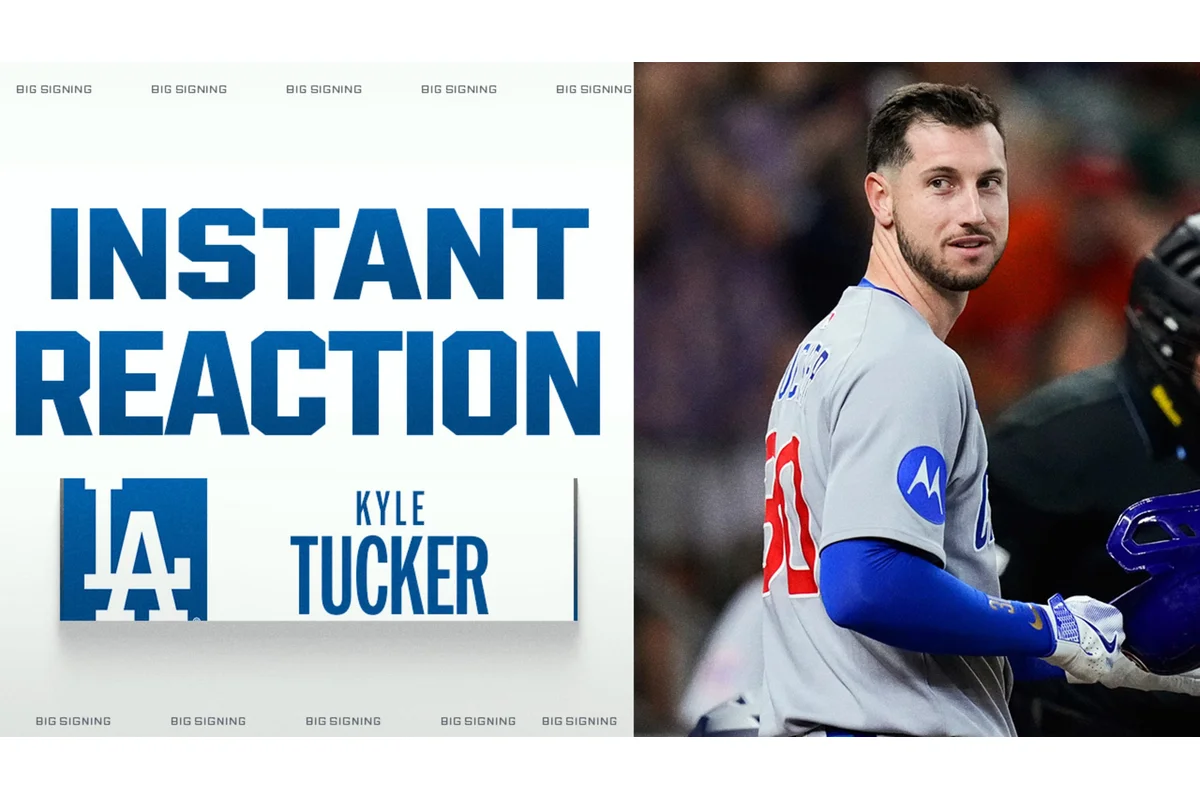
The Los Angeles Dodgers, aiming to maintain their dominance as two-time reigning champions, have reached a tentative four-year agreement with outfielder Kyle Tucker valued at $240 million. The contract, which features $30 million in deferred payments, carries an approximate luxury tax annual value of $57.1 million. Tucker, aligned with Excel Sports Management, received a $64 million signing bonus, nearly $54 million paid upfront. Not officially finalized pending a physical exam, the Dodgers will need to clear a 40-man roster spot to accommodate the new addition. This signing highlights the ongoing pursuit of elite talent in baseball’s most competitive landscape.
Kyle Tucker’s Role in a Potent Dodgers Lineup
Turning 29 this weekend, Tucker is set to join an already formidable Dodgers lineup that includes stars such as Shohei Ohtani, Freddie Freeman, Mookie Betts, Will Smith, Max Muncy, Teoscar Hernández, and Tommy Edman. His arrival strengthens the team’s outfield options, projecting alongside Hernández and Andy Pages as primary outfielders, while versatile infielder Edman can cover center field duties when needed. This depth enhances Los Angeles’ chances in the highly competitive National League West.
Roster Strategy and Avoidance of Lengthy Commitments for Prospects
The Dodgers currently hold four top-tier outfield prospects within their farm system, prompting the organization to avoid binding long-term deals. Instead, they opted for Tucker’s high annual value contract that remains flexible with opt-out clauses after the second or third season. By securing Tucker on terms that reflect some of the highest average annual values (AAV) in MLB history, the Dodgers have balanced short-term competitiveness without compromising future control over promising young players.
Historic Salary Context and Comparison to Top Contracts
With a headline $60 million AAV before deferrals, Tucker’s deal ranks as one of the most lucrative in baseball history. Though Shohei Ohtani’s 10-year, $700 million deal carries a $70 million AAV, its substantial deferrals adjust that figure closer to $46 million annually, making Tucker’s adjusted $57.1 million AAV the highest in the sport. This surpasses Juan Soto’s 15-year, $765 million contract, previously considered the record holder at $51 million per season. The Dodgers’ agreement sets fresh standards for financial commitment in free agency.
Kyle Tucker’s Career Trajectory and Performance Overview
Although acknowledged as a premier free agent this offseason, Tucker is regarded as just outside the elite tier headed by Aaron Judge, Shohei Ohtani, and Juan Soto. Selected fifth overall by the Houston Astros in 2015, Tucker’s breakout occurred in the shortened 2020 season after limited appearances in prior years. His early MLB tenure was marked by consistent power, hitting 29 to 30 home runs across three full seasons while refining his batting approach. This steady progression placed him among the upper echelon of hitters in the league.
2024 Season Highlights and Injury Challenges
Tucker began the 2024 campaign impressively, boasting a .266/.395/.584 slash line with more walks than strikeouts. However, a foul ball struck his right leg, initially diagnosed as a shin contusion but later confirmed as a fracture that sidelined him for nearly three months. He rebounded strongly in September, demonstrating resilience and strong performance upon returning to play.
Trade to the Cubs and Mixed Results in Chicago
Postseason, the Astros entertained trade offers for Tucker, unwilling to match his extension demands. They finalized a trade sending Tucker to the Chicago Cubs in exchange for Isaac Paredes, Hayden Wesneski, and prospect Cam Smith. In Chicago, Tucker’s season started well with a .284/.359/.524 stat line and 12 homers by early June but suffered a right thumb injury from a dive. The injury involved a minor fracture that initially did not warrant placement on the injured list but may have affected his batting effectiveness during a midseason slump.
Mid-Season Performance Slump and Recovery Attempts
Following an outstanding stretch in late June where Tucker slashed .311/.404/.578 over 25 games, his performance notably declined in July, hitting just .189/.325/.235 with a single homer in six weeks. The fractured thumb was publicly disclosed in mid-August, with Cubs officials asserting Tucker’s full recovery by that time. Manager Craig Counsell imposed a three-game mental break late August to aid Tucker’s reset, after which he was reintegrated into the lineup.
Late-Season Injury and Season Finale
In early September, Tucker strained his left calf, resulting in an additional three-week absence towards the end of the 2024 season. Despite these setbacks, he wrapped the regular season posting a .266/.377/.464 slash line over nearly 600 plate appearances and followed with a .259 average and one home run during eight postseason games, helping the Cubs reach the National League Division Series.
Analysis of Tucker’s Consistency and Offensive Profile
While some Cubs fans expressed frustration over the uneven second half, Tucker’s overall output aligned with his career norms. His lifetime wRC+ of 136 indicates offensive production well above league average, mirrored in his cumulative .273/.358/.507 batting line over multiple seasons. The 2024 campaign, influenced by injuries, appears anomalous. Recognized as a top 10 to 15 hitter in MLB, Tucker combines contact ability with above-average power and plate discipline, showing no difficulty hitting pitchers regardless of handedness. He projects as a reliable 25 to 30 home run hitter when fully healthy.
Defensive Abilities and Considerations
Although Tucker earned a Gold Glove Award in 2022, his defensive metrics and sprint speed have declined slightly as he matured. Current assessments suggest his fielding remains serviceable, primarily in right field, allowing the Dodgers flexibility to shift Hernández to left field if desired. Defensive limitations likely influenced contract negotiations, steering teams away from lengthy deals despite his offensive value.
Competition for Tucker’s Services and Final Signing Details
The Cubs extended a qualifying offer to Tucker but did not prioritize re-signing him. Interest reportedly concentrated among the Dodgers, New York Mets, and Toronto Blue Jays. The Mets offered four years at $55 million annually but hesitated on a long-term commitment, while the Blue Jays showed interest in a longer contract at a lower average payroll. Ultimately, the Dodgers secured Tucker, marking their second major free agent addition after signing Edwin Díaz to a three-year, $69 million deal. The Dodgers sacrificed several draft picks, including their third- and sixth-round selections, to finalize these acquisitions.
Contract Structure, Financial Impact, and Tax Implications
Though the salary breakdown remains undisclosed, reports indicate the Dodgers pay approximately $54 million of the signing bonus upfront. Estimates place the Dodgers’ total cash payroll near $428 million for the upcoming season. Tucker’s $57.1 million luxury tax AAV propels the Dodgers above the $395 million threshold, exposing them to a 110% tax rate on spending exceeding $304 million. This results in an extraordinary projected tax liability exceeding $62 million in the first year alone. The Dodgers’ payroll and tax commitments underscore their aggressive spending, pressing toward a potential three-peat, a feat last accomplished by the Yankees from 1998 to 2000.
Broader League Implications and Labor Negotiation Context
Tucker’s contract exemplifies the escalating financial commitment among large-market teams, prompting debate over the feasibility of salary caps in Major League Baseball’s next collective bargaining discussions. The MLB Players Association remains firmly opposed to caps, expecting future negotiations to be as contentious as the 2022-23 lockout that delayed the season by 99 days. These developments highlight the ongoing tension between competitive balance efforts and market-driven spending in the sport.
Dodgers’ Future Outlook and Divisional Prospects
With Tucker added to a decorated roster, the Dodgers aim to sustain their status as NL West heavy favorites and strong playoff contenders. However, recent near-misses in the World Series demonstrate that championships remain elusive despite talent. Last year’s defeat hinged on razor-thin margins, emphasizing the relentless pressure on the organization to maintain excellence without complacency.
Other Teams’ Offseason Moves and Player Market Activity
Following their unsuccessful pursuit of Tucker, the Blue Jays are likely to renew efforts to re-sign shortstop Bo Bichette, who has engaged in talks with the Philadelphia Phillies. The New York Mets, still lacking a left fielder after trading Brandon Nimmo for Marcus Semien, might redirect their focus from Bichette toward contesting the Yankees for Cody Bellinger. Though willing to offer significant short-term contracts, the Mets’ front office remains cautious about long-term deals this winter.
Reporting on the Signing and Media Sources
The initial report of Tucker’s agreement with the Dodgers came from Jeff Passan of ESPN, with subsequent contributions from Jon Heyman (New York Post), Robert Murray (FanSided), Ari Alexander (Boston 7 News), and Jesse Rogers (ESPN), all providing details on contract length, opt-out clauses, deferrals, AAV, and signing bonus structure. This multi-source coverage confirms the historic nature of the deal and the Dodgers’ commitment to reinforcing their championship-caliber roster.
BREAKING: Star outfielder Kyle Tucker and the Los Angeles Dodgers are in agreement on a free agent contract, sources tell ESPN.
— Jeff Passan (@JeffPassan) January 16, 2026
Kyle Tucker is headed to the Dodgers on a short term deal.
— Jon Heyman (@JonHeyman) January 16, 2026
Free-agent outfielder Kyle Tucker and the Los Angeles Dodgers are in agreement on a four-year, $240 million contract, according to sources familiar with the deal. It includes an opt out after year two.
— Robert Murray (@ByRobertMurray) January 16, 2026
Kyle Tucker's four-year, $240 million contract with the Los Angeles Dodgers includes opt-outs after the second and third seasons, sources tell ESPN.
An enormous windfall for the best free agent available. And the champs get even better. @ByRobertMurray was on top of the money.
— Jeff Passan (@JeffPassan) January 16, 2026
Tucker’s Dodgers deal has $30M in deferrals out of the $240M
— Jon Heyman (@JonHeyman) January 16, 2026
Source: There are $30 million in deferrals of the $240 million in Kyle Tucker’s deal.
I’m told the NPV is $57.1 million AAV. I believe that’s the largest ever when you factor in all deferrals. pic.twitter.com/yD6foUygvH
— Ari Alexander (@AriA1exander) January 16, 2026
Tucker’s deal includes $64 million in a signing bonus, $54 million of it is upfront, per a source.
— Jesse Rogers (@JesseRogersESPN) January 16, 2026
