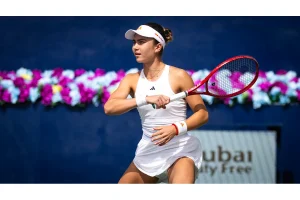
Nao Hibino Bio
Nao Hibino (Japanese: 日比野 菜緒, Hepburn: Hibino Nao; born 28 November 1994) is a Japanese professional tennis player. She has been ranked as high as world No. 56 in singles and No. 43 in doubles by the Women’s Tennis Association (WTA), and she has captured three singles titles and three doubles titles on the WTA Tour. Hibino has also collected a strong trophy haul on the ITF Women’s World Tennis Tour, building a versatile career on hardcourts and clay.
A right-handed player with a two-handed backhand, Hibino stands 1.63 m (5 ft 4 in) tall and is based in her hometown of Ichinomiya, Aichi, in central Japan. She is coached by Eiji Takeuchi, who has worked with her since 2012, and she is sponsored by Le Coq Sportif for apparel while using a Yonex VCore 100 racket. Over the years she has represented Japan in the Fed Cup/Billie Jean King Cup and at the Olympic Games.
Early Life and Background
Hibino was born on 28 November 1994 in Ichinomiya, a city in Aichi Prefecture, Japan. She grew up in a tennis-loving family, surrounded by the sport from a young age. Her mother introduced her and her brother to tennis when she was 10, and she also has an older sister, with whom she often goes shopping and walks the family dogs when she is home from tour.
Her first name, Nao, is a tribute to former top-20 Japanese player Naoko Sawamatsu, while her brother’s name honors another Japanese star, Shuzo Matsuoka. In 2015, after her breakthrough on tour, she relocated to Kobe to sharpen her training, and she has spoken of dreaming of playing on Wimbledon’s Centre Court ever since she was a young girl. Outside of tennis, she enjoys reading, sampling local cuisine when she travels, and visiting famous landmarks in the cities she plays.
Path to Professional Tennis
Hibino began competing on the ITF Junior Circuit in January 2009 at the age of 14. Her early breakthrough came in Australia, where she won her first junior singles title at the Grade-4 Gallipoli Youth Tennis Cup in Queensland, defeating a young Ashleigh Barty in the final. She also lifted her first junior doubles title at the same event, signaling an early comfort with both disciplines.
By 2011, she was competing at the Grade-1 level and made her junior Grand Slam debut at the Australian Open, reaching the second round in singles. That same year she captured her first Grade-1 doubles title at the Mitsubishi-Lancer International Championships in Manila, and in 2012 she wrapped up her junior career having won four singles and five doubles ITF Junior Circuit titles. As a junior she reached a career-high ranking of No. 54, providing a clear foundation for her move into the professional ranks.
Nao Hibino Career
Early Career (2012–2014)
Hibino began playing on the ITF Women’s Circuit in May 2012, just after turning 17. She won back-to-back $10,000 titles in Tokyo and Mie in her opening weeks, which moved her onto the WTA rankings for the first time at No. 974. By September she had added her first ITF doubles title in Kyoto and entered the doubles rankings as well.
Over the next two seasons she steadily climbed the ITF ladder, reaching a $50,000 doubles final at the 2013 Kangaroo Cup in Gifu and winning a $25,000 title in Tsukuba later that year. In 2014 she advanced to a singles and doubles final at the $25,000 Fergana Challenger and made her WTA Tour main-draw debut in doubles at the Japan Women’s Open alongside Riko Sawayanagi. Her singles ranking rose to a then-career-high No. 204 in July 2014, setting the stage for a breakthrough season the following year.
WTA Tour Breakthrough (2015–2017)
The 2015 season marked Hibino’s real arrival. After a series of ITF results, including titles in Kurume, Stockton, and Lexington, she received a wildcard into the Japan Women’s Open and won her first WTA main-draw match. The following week she lifted her maiden WTA singles trophy at the Tashkent Open, defeating Donna Vekić in the final, a result that pushed her into the top 100 for the first time. She ended 2015 at No. 66 in singles.
From 2016 onward she spent most of her time at WTA Tour level. In 2016 she reached her career-high singles ranking of No. 56, played all four Grand Slams in the main draw, and made her Olympic debut at the Rio Games. In 2017 she won her first WTA doubles title at the Monterrey Open with Alicja Rosolska, reached the Malaysian Open singles final, and posted her first Grand Slam main-draw singles win at the US Open over CiCi Bellis. Her doubles ranking peaked at No. 43 in July 2017.
Resurgence and Prague Title (2018–2023)
Results became more inconsistent in 2018 and 2019, and she spent time outside the top 100 in singles. A turning point came at the 2019 Japan Women’s Open in Hiroshima, where she won both the singles and doubles titles, defeating top seed Hsieh Su-wei along the way and becoming part of the first all-Japanese WTA singles final in 22 years. She also reached a WTA 1000 doubles semifinal at the Pan Pacific Open later that year.
In 2020 she recorded her first top-10 win, over Elina Svitolina at the Hua Hin Championships, and reached the Internationaux de Strasbourg semifinal. After a quieter 2021 and 2022, in which she still competed at the Tokyo Olympics, Hibino enjoyed a banner 2023. As a lucky loser at the Prague Open, she won her third career WTA singles title by defeating fourth seed Linda Nosková in the final, and she also lifted the doubles trophy at the same event with Oksana Kalashnikova, becoming champion in both draws.
Recent Years (2024–2025)
Hibino continued to grind through qualifying draws in 2024. At the Indian Wells Open she qualified and stunned Venus Williams in the first round in three sets before falling to 17th seed Veronika Kudermetova. Later she returned to the US Open main draw after a three-year absence, and in October she finished as runner-up in doubles at the Hong Kong 125 Open alongside Makoto Ninomiya.
At the 2025 French Open she qualified and defeated compatriot Moyuka Uchijima, recording her first Grand Slam match win in nearly four years. By mid-2025 her WTA singles ranking sat around No. 243, with her career prize money reported at US$3,852,126. She remained an active representative for Japan on the international stage.
Playing Style and Strengths
Hibino prefers an aggressive baseline game but is comfortable mixing in defense when needed. She uses a two-handed backhand to redirect pace and a strong forehand to structure points, and she is also effective at the net, often finishing points with well-timed volleys. A signature element of her style is her use of the drop shot, which she can deploy to break up rhythm on both hardcourts and clay. Although she has had her strongest results on hardcourts, her favorite tournament remains Wimbledon, played on grass.
Notable Events and Milestones
Among her signature moments, Hibino’s 2015 Tashkent Open title stands as her WTA breakthrough, while her 2019 Japan Women’s Open sweep marked a personal renaissance and a piece of Japanese tennis history. Her first top-10 win over Svitolina in Hua Hin in 2020, her lucky-loser run to the 2023 Prague Open title, and her 2025 French Open qualifying win over Uchijima round out a list of career-defining performances.
Nao Hibino Career Wins
Across her career, Nao Hibino has accumulated three WTA Tour singles titles and three WTA Tour doubles titles, complemented by 10 ITF singles and 11 ITF doubles titles. She has also been a finalist in several WTA and ITF events, reflecting consistency across surfaces and disciplines.
WTA Tour Highlights
Her first WTA singles title came at the 2015 Tashkent Open with a win over Donna Vekić. She added a second at the 2019 Japan Women’s Open in Hiroshima, defeating Misaki Doi in an all-Japanese final, and a third at the 2023 Prague Open by beating fourth seed Linda Nosková. In doubles, her first WTA title came at the 2017 Monterrey Open with Alicja Rosolska, followed by the 2019 Japan Women’s Open with Doi and the 2023 Prague Open with Oksana Kalashnikova.
Other Wins and Performances
Beyond the WTA level, Hibino has built a strong ITF résumé, highlighted by multi-title weeks at events such as the 2015 Lexington Challenger, where she won both singles and doubles. She has also reached finals in WTA 125 events and recorded a Fed Cup/Billie Jean King Cup record that has contributed significantly to Japan’s national team efforts.
Nao Hibino Family
Family Background and Tennis Lineage
Hibino comes from a tennis-loving family in Ichinomiya, Aichi. Her mother introduced her and her brother to the sport when they were children, and the family connection to Japanese tennis history is reflected in her given name, a tribute to Naoko Sawamatsu, a former top-20 player. Her brother is named after another Japanese tennis icon, Shuzo Matsuoka, and she also has an older sister.
Personal Life
When not on tour, Hibino treasures time at home with her family in Ichinomiya. She often goes shopping with her older sister and walks the family dogs, and she enjoys reading in her spare time. On the road, she makes a point of trying local foods and sightseeing at famous places in the cities she visits, hobbies that help her unwind between tournaments.
2025 Season Performance
Hibino’s 2025 campaign has been defined by persistence through qualifying. She began the year ranked outside the top 200 in singles and worked her way into main draws through three-set qualifying wins. A highlight came at the 2025 French Open, where she qualified for the main draw and defeated compatriot Moyuka Uchijima in the first round for her first Grand Slam match win in nearly four years.
Outside of the majors she has continued to play a mix of WTA Tour events, ITF Circuit stops, and WTA 125 events to rebuild her ranking. Her doubles campaign, paired at times with long-time compatriot Makoto Ninomiya, has been a useful avenue for momentum. By mid-2025 her WTA singles ranking had climbed back to around No. 243.
Looking ahead, Hibino’s focus will be on stringing together main-draw wins at WTA events to push deeper into the top 150 and chase a return to the top 100. With her coach Eiji Takeuchi, a settled base in Japan, and renewed confidence from her 2023 Prague title, she remains a steady and experienced presence in Japanese women’s tennis.