
USA Pickleball (USAP) is the sport’s official national governing body in the United States, setting and enforcing the rules, approving equipment, sanctioning thousands of tournaments, and driving grassroots growth that has helped pickleball explode from a backyard pastime into a nationwide phenomenon with tens of millions of players. It operates as a nonprofit, member-based organization headquartered in Surprise, Arizona, coordinating everything from local club play to national championships while working with pro tours, schools, and international partners.
Origins and Evolution
USA Pickleball began in 1984 as the United States Amateur Pickleball Association (USAPA), created by Sid Williams, Bryon Olson, and other early adopters in Tacoma, Washington, to bring order and consistency to a rapidly spreading but loosely organized game. They published the first official pickleball rulebook in March 1984, formalizing key concepts like underhand serving, the non-volley zone (“kitchen”), and scoring so players across different regions could compete under the same standards. That same year, the group organized the inaugural National Doubles Championships in Tacoma, marking the sport’s transition from driveways and cul-de-sacs to formal tournaments.
Sid Williams served as the association’s executive director until 1998, laying the groundwork for national reach through clinics, printed materials, and early ambassador-style volunteers. Frank Candelario took over from 1998 to 2004, guiding the association through the initial wave of senior and community-center adoption. In 2005, as interest grew, the organization restructured as the USA Pickleball Association, aligning more clearly with other national governing bodies in U.S. sport. By 2020, amid explosive participation growth and mainstream media attention, it rebranded simply as USA Pickleball (USAP), modernizing its image and branding to match its expanded role.
Governance, Membership, and Organizational Structure
USAP operates as a nonprofit with a board of directors overseeing strategic decisions and multiple committees handling specialized domains such as rules, officiating, equipment, and competition. A full-time staff, led by an executive director, manages day-to-day operations from its headquarters in Surprise, Arizona.
Key elements of its structure include:
-
Board of Directors: Sets policy, approves major rule changes, and steers long-term strategy, including Olympic and international ambitions.
-
Rules Committee: Reviews proposals annually, drafts language, and publishes the official rulebook and change documents.
-
Referee and Officiating Division: Trains, tests, and certifies referees at various levels, providing handbooks, clinics, and evaluations.
-
Membership Program: Individual members (around or above 100,000) typically pay annual dues (e.g., about $35 per year) and receive benefits like liability insurance at sanctioned events, access to ratings, early/priority registration for certain tournaments, and communication about rule changes.
-
Ambassador Network: Thousands of volunteer ambassadors across cities and regions help promote the sport, liaise with parks departments, and organize local leagues and beginner programs.
USAP also offers club and facility memberships for organizations that run leagues or host frequent play, providing them with promotional support and inclusion in national court locators and resources.
Rules: The Official USAP Rulebook
The USA Pickleball Official Rulebook is the sport’s central reference, updated annually with a formal process that includes feedback from players, referees, and organizers. While professional organizations like Major League Pickleball may apply slight format variations, most tournaments and recreational play in the U.S. rely on USAP rules.
Core elements include:
-
Court and Equipment: Defines a 20 ft by 44 ft court, 7 ft non-volley zone on each side of the net, and specifications for nets, paddles, and balls.
-
Serving:
-
Underhand serve with the paddle making contact below the server’s waist.
-
One foot behind the baseline at contact.
-
Diagonal service to the opposite service box.
-
The rulebook permits a traditional toss-then-hit serve as well as a drop serve, where the server drops the ball and hits it after it bounces, simplifying timing for beginners.
-
-
Double-Bounce Rule:
-
After the serve, the receiving side must let the ball bounce once before returning.
-
The serving side must then also let the return bounce once before playing it.
-
Only after these two bounces can either side volley (hit out of the air).
-
-
Non-Volley Zone (Kitchen):
-
Players may not volley while standing in the non-volley zone or touching the line.
-
If momentum carries a player into the zone after a volley, it is a fault even if the ball was struck legally.
-
-
Scoring:
-
USAP maintains the scoring framework (traditionally side-out scoring) and in recent rulebooks clearly supports rally scoring formats where appropriate, though classic side-out scoring remains standard in many events.
-
Games typically go to 11, 15, or 21 points, always win by 2.
-
-
Faults and Dead Balls:
-
Lists actions like hitting the ball out of bounds, failing to clear the net, volleying in the kitchen, double-hitting, or hindering opponents.
-
-
Timeouts and Conduct:
-
Standard allocation of timeouts per game (commonly 2 per team per game of 60 seconds each).
-
Technical warnings and technical fouls can result in point or game penalties for serious misconduct.
-
Recent and ongoing rulebook updates refine language around line calls, clarify wheelchair-specific adaptations (such as allowing two bounces), introduce concepts like a serve time limit, and tighten definitions for new playing styles and equipment interactions.
Equipment Testing and Certification
A critical USAP responsibility is equipment certification—ensuring paddles and balls behave within defined power, spin, and acoustic thresholds so that technology does not overwhelm skill. This became more important as manufacturers began pushing materials (carbon fiber, gritty surfaces, internal cores) to gain competitive advantages.
USAP’s process generally includes:
-
Submission: Manufacturers submit paddle and ball models for certification, often multiple samples of each.
-
Laboratory Testing:
-
Bounce and Deflection (PBCoR): Measurement of how “lively” a paddle is, typically by examining coefficient of restitution (how much energy is returned to the ball). Paddles that exceed defined limits are denied approval.
-
Surface Texture: Ensuring the paddle face is not overly rough or sandpaper-like, which would produce excessive spin and shot manipulation.
-
Durability and Consistency: Checking that performance remains within limits over normal use and that production models match tested samples.
-
Sound Testing: In some contexts, checking for excessive noise (especially in noise-sensitive communities).
-
-
Approval List: Approved paddles and balls appear on an online database. Tournament directors and referees can check this list to ensure players use legal equipment.
By 2025, thousands of paddle models and multiple ball types had been tested and listed. USAP also began partnering with independent measurement companies to implement on-site checks at major events, particularly after controversies over paddles potentially exceeding spin or power thresholds.
Tournament Structure and Event Pyramid
USAP sanctions a broad hierarchy of events that together create a pathway from local recreational competition to national championship play:
-
Local and Regional Tournaments:
-
Sanctioned events held by clubs, municipalities, or private organizers.
-
Offer skill-based divisions (e.g., 3.0, 3.5, 4.0, 4.5, 5.0+) and age divisions (e.g., 19+, 35+, 50+, 60+).
-
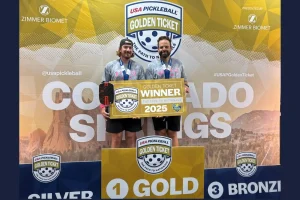
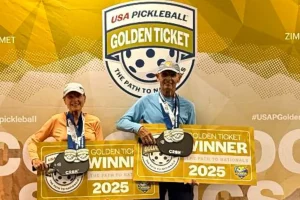
Earn players ratings experience and sometimes “Golden Tickets” for Nationals.
-
-
Regional Championships:
-
Spread across multiple geographic regions in the U.S.
-
Larger draws, more courts, and higher concentration of advanced and senior players.
-
-
Diamond Amateur Championship:
-
A high-level event for amateurs who qualify through regional and local tournaments.
-
Divisions for different age and skill levels, focusing on non-professional players who are serious competitors.
-
-
Indoor Nationals:
-
Focuses on indoor surfaces and conditions, often in colder-weather cities.
-
-
USA Pickleball National Championships:
-
The crown jewel of the USAP calendar.
-
Typically held over multiple days at a major venue (for example, at large tennis/pickleball complexes in cities like Dallas or San Diego).
-
Features divisions for:
-
Professional players (singles, doubles, mixed).
-
Amateur skill and age groups.
-
Juniors (youth age brackets).
-
Senior divisions and sometimes wheelchair or adaptive categories.
-
-
Entry is often prioritized through Golden Tickets earned at qualifying events, then opened to other members if space allows.
-
Attracts thousands of competitors and large spectator crowds, with streaming and media coverage.
-
Recent National Champions (Pro Focus)
While Nationals include hundreds of medalists across divisions, the professional singles titles are especially high-profile:
-
Men’s Pro Singles:
-
Women’s Pro Singles:
-
Dominated in recent years by Anna Leigh Waters, who has claimed multiple titles between 2021 and 2025, reinforcing her status as one of the sport’s greatest players despite her young age.
-
Amateur, junior, and age-bracket titles vary widely each year, highlighting the depth and diversity of the competitive landscape.
Ratings, Ambassadors, and Grassroots Growth
USAP supports a skill rating system that typically ranges from 1.0 (beginner) to 5.0+ (top amateur/elite). These ratings help organize fair matches and tournament brackets. Through its partnership with universal rating systems (like DUPR), competitive results from sanctioned events feed into widely used global player rating databases.
The ambassador program is another cornerstone of growth. Ambassadors:
-
Advocate for new courts at parks and community centers.
-
Host introductory clinics and open play sessions.
-
Liaise with schools to integrate pickleball into physical education.
-
Help standardize local rules in line with the national rulebook.
This network has been central to the dramatic increase in dedicated pickleball courts and venues around the country.
Why USA Pickleball Matters
USAP’s four decades of governance transformed pickleball from a local curiosity into a disciplined, codified sport able to sustain both massive grassroots participation and increasingly professionalized elite play. By setting consistent rules, ensuring equipment fairness, supporting a nationwide competitive structure, and investing in youth and community programs, USA Pickleball underpins the sport’s 21st-century boom.
Even as pro entities like the PPA, MLP, and other organizations develop their own event brands and minor rule variations, USAP’s rulebook remains the primary reference for most of organized play in the U.S. Its standards, certifications, and tournaments make it the backbone of American pickleball—an essential platform for any long-term ambitions such as Olympic inclusion and international federation growth.