
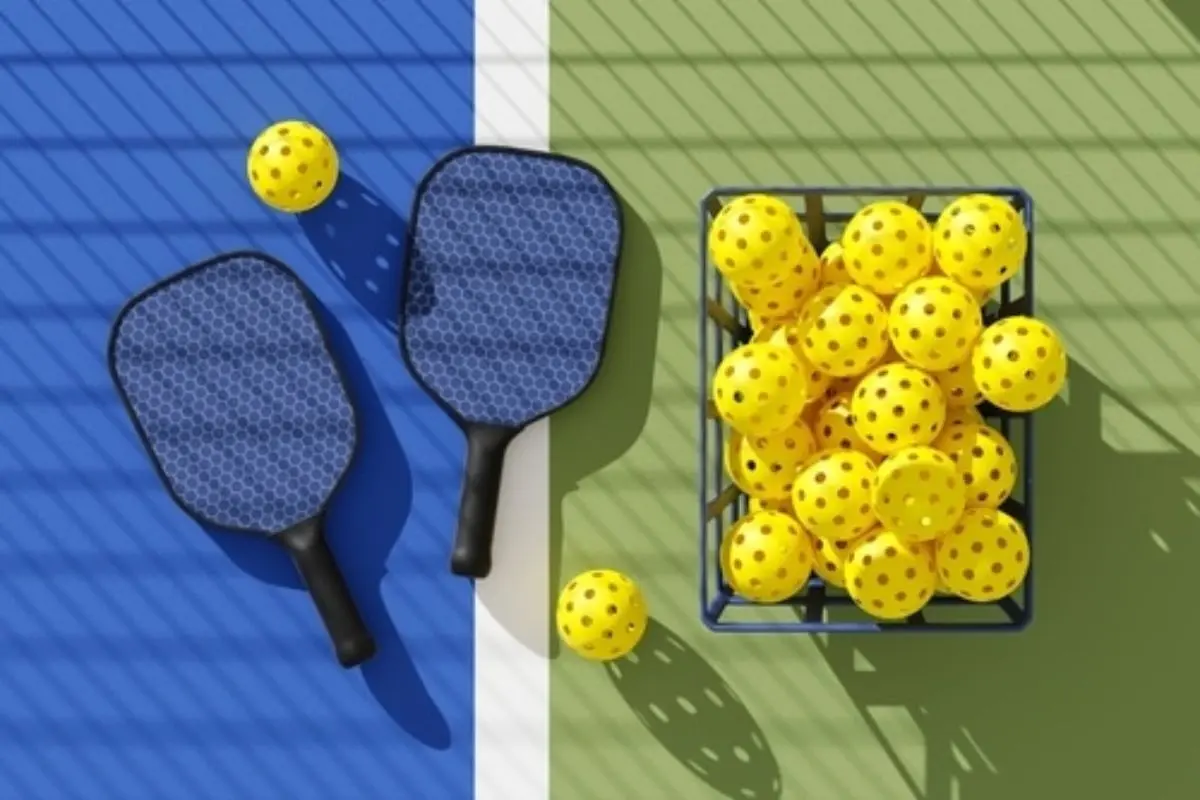
Pickleball vs Padel Comparison: Pickleball and padel are two racquet sports gaining popularity worldwide, especially in countries like the US and India. Though similar in some ways, these sports have distinct differences in court sizes, rules, and equipment. Here’s a breakdown of how they compare.
Court Dimensions
Pickleball courts are much smaller than padel courts. A pickleball court measures 20 by 44 feet, the same size as a badminton court, and is often set up on one side of a tennis court. The net height is 36 inches at the poles and 34 inches at the center. This compact size allows multiple pickleball courts to fit on a single tennis court.
Padel courts are larger, measuring 66 by 33 feet, almost the size of a tennis court. The net height is similar to pickleball, but padel courts are fully enclosed with glass or plastic walls. These walls allow players to use the walls during play, creating a more dynamic game.
Rules of Play
One major difference is the “Non-Volley Zone” in pickleball, known as “The Kitchen.” This zone extends 7 feet from the net, where players cannot hit the ball out of the air. This rule encourages patience and strategy, as opposed to quick net play seen in other racquet sports.
Pickleball games are typically played to 11 or 15 points, with a two-point margin needed to win. The scoring system includes singles and doubles, but doubles is the most common. Players serve underhand, and each player gets only one serve opportunity.
Padel, on the other hand, is played with two serves per player, similar to tennis. The game follows the standard tennis scoring system (15-30-40) to determine points. Padel is played in sets, and doubles is the most common format. The enclosed walls allow players to use them to return the ball, adding an extra layer of strategy and exciting shots.
Equipment
The paddles used in both sports are solid-faced, but there are differences. Pickleball paddles are smaller than tennis racquets and were initially made from wood but are now mostly composite or carbon fiber. The balls used in pickleball are plastic with holes, and indoor and outdoor versions differ in the number of holes for aerodynamics.
Padel paddles are also solid-faced and about the same length as pickleball paddles. Padel uses a decompressed tennis-like ball that bounces less than a standard tennis ball. There are two types of padel balls: regular and speed, with slight differences in performance depending on the weather and playing surface.
While both sports share some similarities, like solid-faced paddles and racquet-based gameplay, they have unique rules and setups that make each sport distinct. Pickleball’s smaller court and non-volley zone promote patience, while padel’s use of walls adds a strategic element. As both sports continue to grow, their differences will shape how they develop in the coming years.
News in Brief: Pickleball vs Padel Comparison
Pickleball and padel are rapidly growing racquet sports worldwide. While pickleball features smaller courts and a non-volley zone, padel is played on larger, enclosed courts with walls. Both sports have unique rules and equipment, and each offers a distinct playing experience.
ALSO READ: Fairgrounds Expands Pickleball and Padel in Toronto—Inside the Exclusive New Club