
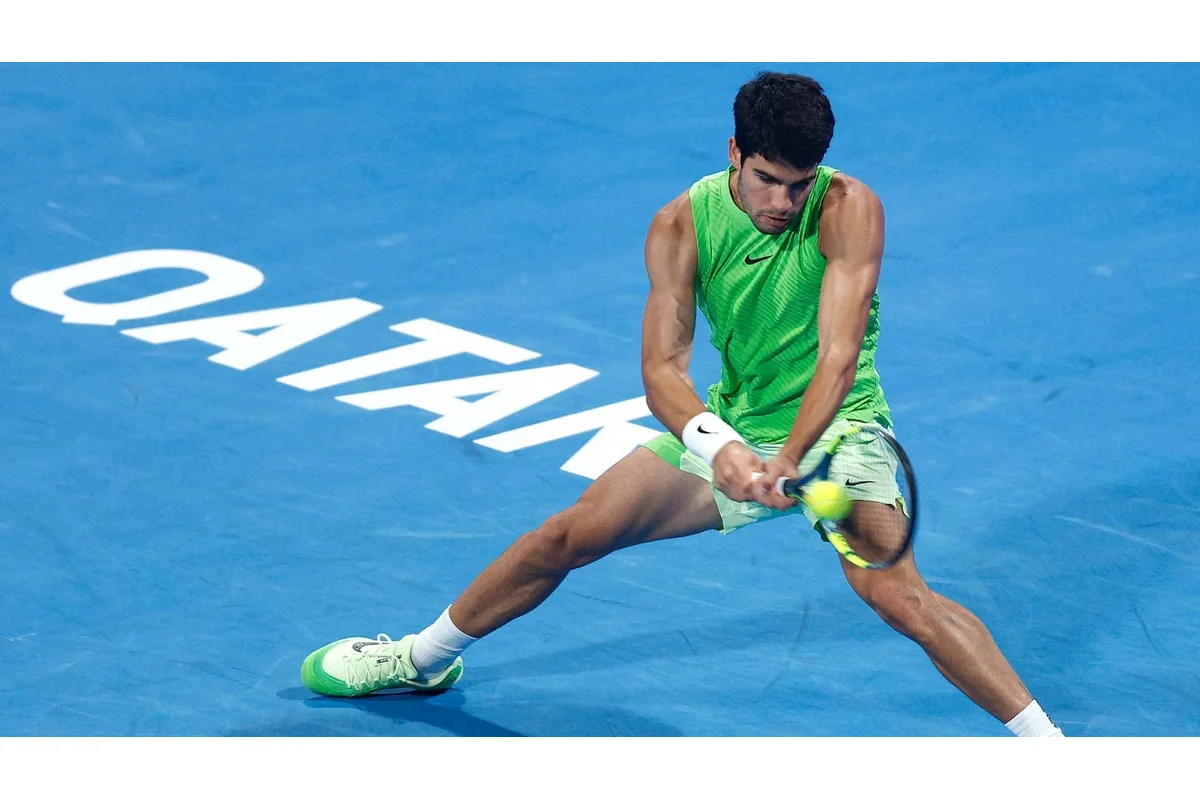
During the Qatar Open quarterfinals in Doha on February 20, 2026, Carlos Alcaraz engaged in a tense dispute with the chair umpire concerning a serving clock violation. After saving a crucial break point against Karen Khachanov and celebrating, the Spanish star faced a time violation when he approached his towel before serving again, igniting a heated exchange between player and official. This incident highlighted ongoing friction related to the tennis shot clock rule, stirring debate over its implementation.
Alcaraz, visibly frustrated, argued that the umpire failed to properly stop the serve clock as required. The chair umpire insisted,
“I did. I stopped time at 25 seconds when it started. Then you got the towel. Then I started the clock again.”
Still unconvinced, Alcaraz pressed for more details, asking,
“How much time did you stop the clock? Tell me,”
to which she explained,
“Carlos, I stopped it til you reached there. I stopped it at 25 seconds until you actually reached the towel.”
Alcaraz challenged the ruling, stating,
“Alright. So I’m not allowed to go to the towel,”
but the umpire replied firmly,
“I stopped it till you reached the area there where you asked the kid to get the towel… I can’t cancel it.”
Growing frustrated, Alcaraz repeated,
“I’m not allowed to go to the towel. I’m not allowed,”
and the umpire replied,
“Yes, I understand. But I can’t do anything.”
This back-and-forth occurred despite Karen Khachanov himself reportedly approaching the umpire to request that the violation be dismissed. Ultimately, the decision stood, but the incident visibly unsettled Alcaraz, who was later seen disputing with the official again during the change of ends.
Match Progress and Alcaraz’s Reaction to the Time Rule
The match itself remained fiercely competitive. Khachanov took the first set 7-6(3), but Alcaraz rallied to claim the second 6-4 and raised his level further in the final set, winning 6-3. This victory advanced the world No. 1 to the semifinals, where he will face Andrey Rublev. Despite prevailing, the Spaniard expressed significant dissatisfaction not only with the umpire’s call but also with the governing rule.
Reflecting on his frustration, Alcaraz told reporters:
“Honestly, I think the time rule is absurd. After a very demanding point, finishing at the net, sprinting to my towel, I practically had no time left. She (the chair umpire) told me she stopped the clock when I was on my towel, but from then until I called for the balls and prepared to serve, I had no time to spare. To me, that makes no sense. Besides, the crowd was still shouting and cheering, which also caused delays. I looked at the clock when there were three or four seconds left, and I didn’t have enough time to serve, but she still gave me a warning.”
Alcaraz further advocated for a more lenient interpretation of the serving clock, emphasizing the need for flexibility in intense matches. He added,
“The ATP says it wants to attract more people, to broaden its audience. If they don’t allow us time to recover between points to offer the best possible level, everything goes too fast, and it’s difficult to engage the crowd.”
He urged officials to consider extending the time allowed between points to maintain the quality and excitement of play.
Lighthearted Moments and Reflection on Tough Opponents
Outside the court tensions, Alcaraz also shared some lighter exchanges with opponents after matches. Following his intense battle with Khachanov, the Russian playfully inquired,
“You never get tired? You never get tired?”
to which Alcaraz jokingly responded, “I try not to.” Khachanov then urged,
“One time, get tired. One time.”
This rivalry marked their sixth meeting with Alcaraz undefeated at 6-0, despite Khachanov’s tenacious effort.
Alcaraz praised the close competition, noting,
“It was a really close and tight match. In the first set, I had a few break points, and I couldn’t make them. One set point and I couldn’t make it, so it was really tough.”
He added,
“I think Karen was playing great, but I knew I’d had my chances. I just didn’t take them in the first set, so it was time to keep going and try to keep fighting. Wait for my chances and try to take them in the second set. I’m just really proud about the way that I [fought].”
Discussing his ongoing development, Alcaraz emphasized the value of repeatedly facing challenging opponents like Khachanov and Arthur Rinderknech, saying,
“The truth is, especially against Rinderknech (5-0) and Khachanov (6-0), the matches have always been tough and very close. Since I have certain opponents who serve as a reference point for me to improve, they perhaps see me the same way: as a mirror to see what they can do better. That makes me happy, because tennis is about evolving, about progressing…”
Alcaraz’s Winning Streak and Future Prospects at the Qatar Open
Fresh from his Australian Open triumph, Carlos Alcaraz continues an impressive run in 2026 with an unblemished 10-0 record this season. His victory in Doha extends his undefeated record in tour-level quarter-finals to 12-0 since a loss to Jiri Lehecka in Doha last year. The win secured his first ever semi-final appearance at the Qatar Open, representing a significant milestone in his career.
As Alcaraz prepares for a challenging match against Andrey Rublev, the spotlight on his playing style, mental toughness, and ability to thrive under pressure grows ever brighter. His sustained dominance highlights a potential trajectory toward further major titles and continued growth as the sport’s leading figure.
Implications of the Serving Clock Incident for Tennis Regulation
Alcaraz’s confrontation with the chair umpire over the serving clock violation underscores the ongoing tension between tennis players and officials regarding the enforcement of time-related rules. The current regulations aim to speed up matches and enhance spectator engagement but have provoked frustration among players who feel the rules sometimes hinder optimal performance and fair rest between points.
This incident could fuel further debate among players, officials, and governing bodies about how to balance pacing and player comfort. Alcaraz’s outspoken criticism amplifies calls within the tennis community for revisiting or adjusting the serve clock rule to allow greater flexibility, especially during physically taxing rallies where momentary delays are natural.
As tennis continues evolving, this episode may influence future policy discussions, potentially leading to rule adjustments that better accommodate player needs without compromising match flow or audience experience.
