
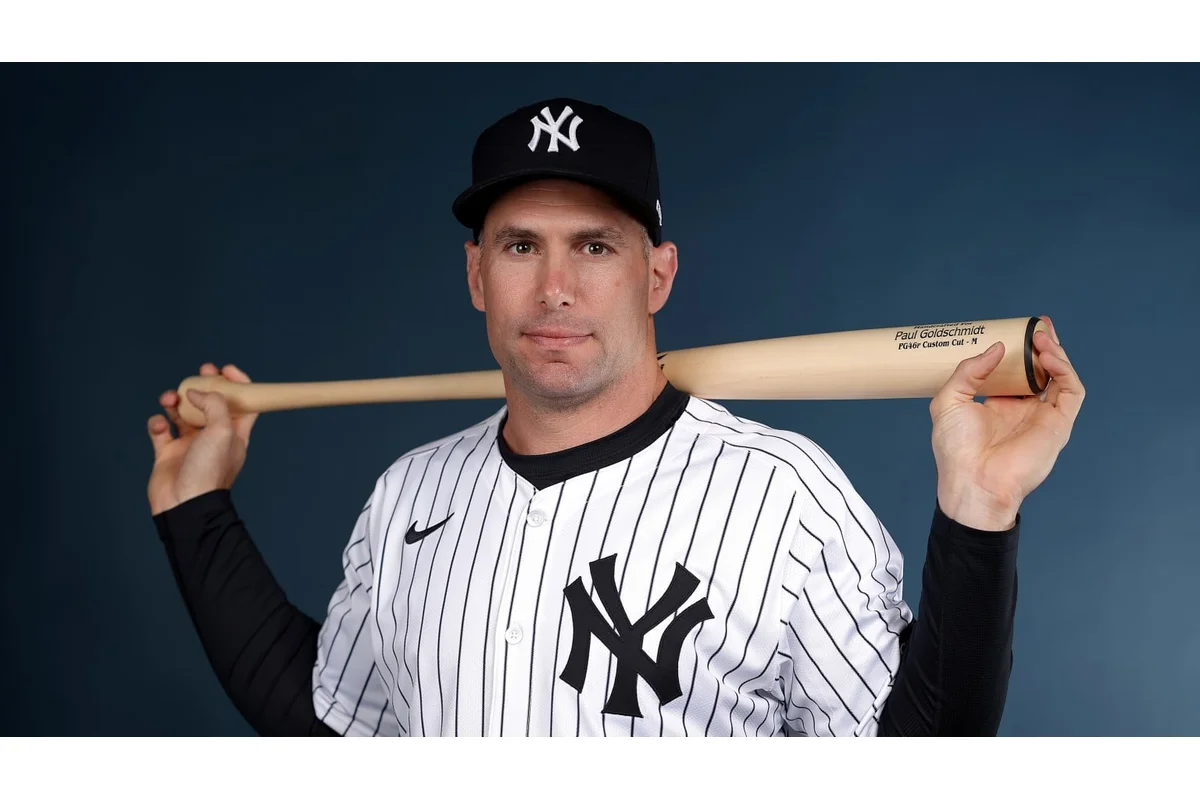
The New York Yankees reached an unexpected agreement with Paul Goldschmidt on Friday afternoon, signing the veteran first baseman to a one-year contract worth $4 million, as originally reported by ESPN’s Jeff Passan. This deal comes after a period of reflection about his career trajectory and future in baseball.
Reflecting on Goldschmidt’s Peak and Recent Decline
Three years ago, Goldschmidt was at the height of his career, having secured the National League MVP with an outstanding offensive performance that helped lead the St. Louis Cardinals into the playoffs. At that point, he had earned MVP votes for eight consecutive seasons and accumulated a career Wins Above Replacement (WAR) total of 52, marking him as one of the game‘s elite players. With two years left on his contract then, Goldschmidt might have contemplated retiring while still near his peak, potentially finishing strong before moving towards a Hall of Fame career.
However, the seasons that followed did not favor him. In 2023, his performance dipped gently with 3.4 WAR as the Cardinals faltered, ending last in the National League Central for the first time in over three decades. The following year was harsher: Goldschmidt posted a slash line of .245/.302/.414 with a 100 weighted Runs Created Plus (wRC+), the lowest in his career, while the Cardinals shifted toward rebuilding, making his future with the team uncertain. In search of a better situation, Goldschmidt signed a one-year, $12.5 million free-agent deal with the Yankees, aiming to revive his form.
Adapting to a Platoon Role in New York
In 2025, Goldschmidt’s statistics closely mirrored his previous year, with incremental improvements despite reduced playing time. His wRC+ rose slightly to 103, largely due to a notable drop in strikeout rate from 26.5% to 18.7%, although his power numbers diminished as he exchanged extra-base hits for more contact. Toward the end of the season, the Yankees utilized him primarily as a platoon hitter, capitalizing on his strengths against left-handed pitchers. Goldschmidt’s career batting splits reveal a pronounced advantage against southpaws, boasting a .422 weighted On-Base Average (wOBA) vs. lefties compared to .361 against righties over nearly 9,000 plate appearances. In 2025, this split became even more conspicuous, with his performance against lefties outpacing righties by 51%, suggesting that his role as a situational hitter has become definitive.
Transitioning from Star to Role Player
Now at age 38, Goldschmidt’s status within the game has shifted from being one of the premier players to a specialized role player. While he faced a similar number of left-handed pitchers in 2025 as in 2024, his plate appearances against right-handers decreased by 120, reflecting a likely continuation of this trend in 2026. This adjustment marks a significant change for a player who led Major League Baseball in plate appearances from his full-time rookie season in 2012 through 2024. The questions surrounding his future role are complex: Should he accept a reduced place within the team hierarchy, moving from leading figure to valuable support player? And how will this affect his sense of identity and competitiveness on and off the field?
The Challenge of Legacy and Milestones
Goldschmidt remains driven by the pursuit of legacy achievements, especially related to Hall of Fame credentials. According to baseball analyst Jay Jaffe, Goldschmidt has surpassed the JAWS benchmark for first basemen but requires more cumulative statistics to secure an undeniable place in Cooperstown. Hitting either 400 home runs or reaching 2,500 career hits would solidify his Hall of Fame case. Unfortunately, with current projections, Goldschmidt is significantly behind these milestones—approximately 28 home runs and 210 hits short—making it unlikely he will reach these marks in the 2026 season. Similarly, his incremental contributions to career WAR have flattened.
The Elusive Quest for a World Series Championship
A championship ring might be the most coveted prize remaining for Goldschmidt. Despite multiple postseason appearances, he has yet to play in a World Series game. Early in his career, his Diamondbacks teams never progressed past the National League Division Series, and the Cardinals saw limited playoff success during his tenure, failing to advance beyond the wild card rounds. The Yankees, meanwhile, made the World Series a year prior to Goldschmidt’s arrival but were eliminated in the 2025 American League Division Series. Winning a ring remains an elusive ambition and a powerful motivation for the veteran.
The Shift in Status and Motivation
For the first decade of his career, Goldschmidt was an unequivocal star, often the central figure on his teams with his name headline-worthy. Even if he had won a championship earlier in his decline, his role would have been prominent. Now, however, he functions as a role player on a contract comparable to that of Amed Rosario, who also serves as a platoon player. This descent from top-tier status to a supporting role is a challenging transition for any player used to being a cornerstone.
Strategic Fit for the Yankees and Impact on Team Dynamics
Despite these personal challenges, Goldschmidt’s return is a significant gain for the Yankees, whose lineup features six left-handed hitters, enhancing the need for a right-handed platoon bat. His proven success against lefties fits the team’s strategy, considering their short right-field porch and the aim to balance right- and left-handed hitting around star slugger Aaron Judge. Consequently, the Yankees are ideally positioned to utilize Goldschmidt’s platoon advantages extensively.
Moreover, signing Goldschmidt provides the Yankees with roster flexibility. Ben Rice, projected as the primary first baseman, can also spend more time at his natural position of catcher, having played 229 innings there last year. Manager Aaron Boone highlighted that Goldschmidt’s role will help Rice transition more frequently behind the plate without sacrificing offensive capacity.
Value of the Deal and Market Comparisons
Goldschmidt’s contract is notable for its modest $4 million price tag, which is relatively low for a player with his offensive proficiency against left-handed pitching. Most similar players demand higher salaries and typically do not accept part-time roles because their splits are less pronounced. For comparison, Marcell Ozuna, who projects similarly against lefties but outperforms Goldschmidt against right-handers, signed for $12 million. Given the Yankees’ roster construction heavy with left-handed hitters, Goldschmidt’s unique skill set justifies the low-cost arrangement and aligns well with the team’s needs.
Personal Reflections on Playing and Purpose
Goldschmidt’s motivation in returning to the Yankees may stem from more than financial gain. Having accumulated nine-figure career earnings, monetary incentives likely play a minor role. Instead, the opportunity to be valued and needed may hold deeper significance, even as his role narrows from star to specialist. This sense of fitting perfectly within a team’s configuration can bring fulfillment, contrasting the challenges of adjusting to reduced prominence. It underscores a broader theme about how athletes confront aging and evolving roles in professional sports.
First baseman Paul Goldschmidt and the New York Yankees are finalizing a one-year contract, sources tell ESPN. Goldschmidt, 38, returns to the Yankees after hitting .274/.328/.403 for them last season.
— Jeff Passan (@JeffPassan) February 6, 2026
