
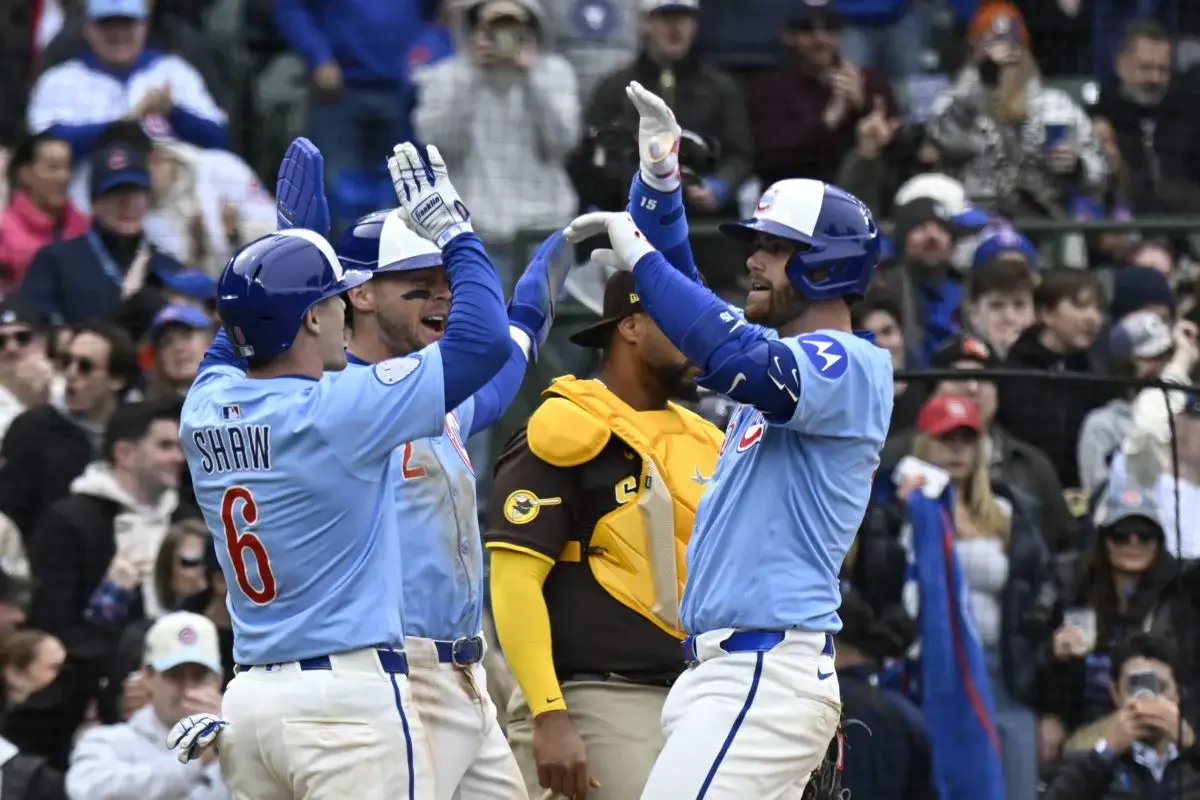
The Chicago Cubs have steadily rebuilt their roster since the 2016 championship era by investing heavily in young talent. This approach has brought players like Cade Horton, Pete Crow-Armstrong, Michael Busch, and Matt Shaw, who were prospects just two years ago, into the spotlight. Veterans such as Ian Happ, Nico Hoerner, Daniel Palencia, Justin Steele, and Miguel Amaya have also come through the Cubs’ farm system and spent their careers on the team’s north side.
These players have now developed into key contributors as the Cubs push toward contention, aiming to compete strongly in the World Series. Meanwhile, a fresh group of prospects is ready to make their mark by 2026, offering hope for sustained competitiveness and growth.
Moises Ballesteros: A Promising Hitter with Versatile Roles
Moises Ballesteros is arguably the most advanced among the Cubs’ upcoming players, making his MLB debut in 2024 with appearances in 20 games. His longest stint was in September, when he stepped in for Kyle Tucker, sidelined by a right calf strain. Despite limited opportunities—just 46 plate appearances—Ballesteros impressed with an outstanding slash line of .333/.465/.564 and a .999 OPS, including two home runs.
Signed at age 17 as an international free agent in 2021, Ballesteros has steadily climbed through the minors, improving at every level. In 2022, he posted an .812 OPS between Rookie and Low-A, then maintained above .820 OPS across three levels in 2023, finishing in Double-A Memphis. The momentum continued in 2024 with an .825 OPS between Double-A Memphis and Triple-A Iowa. His 2025 season started explosively in Iowa, highlighted by a .420 batting average and a 1.128 OPS in April.
For the full season, he recorded a .316/.385/.473 slash line with a .858 OPS, earning him a spot at No. 60 on Just Baseball’s Top 100 Prospects list. Though officially a catcher, Ballesteros is unlikely to see much time behind the plate due to Carson Kelly and Miguel Amaya sharing duties. Instead, he is expected to serve as a designated hitter (DH), filling the void left by Kyle Tucker and likely alternating at DH with Seiya Suzuki, who is anticipated to shift primarily to right field.
His splits reveal a distinct platoon dynamic: in 2025, Ballesteros hit .230/.296/.281 against left-handed pitching compared to a potent .346/.418/.547 line versus right-handers. This disparity may shape how the Cubs deploy him in 2026, but regardless, high offensive expectations rest on his shoulders heading into the season.
Kevin Alcantara: Center Field Talent Facing a Critical Test
Kevin Alcantara has also tasted the major leagues, appearing in 13 games between late 2023 and 2024. Acquired from the Yankees in the 2021 Anthony Rizzo trade, Alcantara burst out of the gate in Rookie Ball with a .331/.415/.609 line. Since then, he has consistently posted around an .800 OPS annually as he progressed through the Cubs’ system.
Defensively, Alcantara is a plus outfielder in center field and exhibits excellent baserunning skills. However, his offensive profile is complicated—while his OPS against left-handed pitchers was an impressive .984 in 2025, it dropped significantly to .762 versus righties. One persistent issue has been his high strikeout rate, particularly against breaking balls from right-handed pitchers, where he struck out nearly 30% of the time in 2025.
Standing 6-foot-6 and possessing a lanky frame, Alcantara’s swing mechanics contribute to this challenge. If he cannot reduce his strikeouts substantially, his ability to thrive in the majors will be limited. At 23 years old, he still holds tremendous upside, arguably the highest in the Cubs prospect pool, but with nearly 2,000 minor-league at-bats and ongoing swing-and-miss problems, 2026 could be decisive for his future role.
Should he take a significant step forward, Alcantara may well fill the right field void created by Tucker’s departure, but the pressure is mounting for him to refine his offensive game.
Jaxon Wiggins: Power Pitching Prospect with High Ceiling
Right-handed pitcher Jaxon Wiggins is an intriguing arm in the Cubs’ system who advanced rapidly through three minor-league levels in 2025, culminating at Triple-A Iowa. His velocity is eye-catching, regularly sitting in the high 90s and peaking at 100 mph, complemented by a sharp slider in the upper 80s and an effective changeup.
Wiggins’ statistics across these levels were impressive: a 2.19 ERA with a .161 batting average against over 78 innings, coupled with 97 strikeouts (11.19 K/9). However, control issues resulted in over four walks per nine innings, hampering his overall effectiveness. Health has been a concern, with the Cubs shutting him down mid-season for workload management, connected to his previous Tommy John surgery at the University of Arkansas.
With clean, repeatable mechanics and top-tier stuff, Wiggins is projected to develop into a potential No. 2 or 3 starter in the near future. While Cade Horton’s limited Triple-A starts suggest Wiggins could also be ready to make the jump in 2026, the current Cubs rotation is crowded with five established starters plus Justin Steele potentially returning mid-season.
An exceptional start to 2026 would be necessary for Wiggins to secure a place on the major-league staff that year.
Jonathon Long: Offensive Weapon Challenged by Position Depth
Selected in the ninth round of the 2023 draft, Jonathon Long has emerged as a strong offensive performer in the Cubs’ system, signing for just under $180,000. His 2025 campaign with Triple-A Iowa was particularly notable, posting a .305/.404/.479 slash line while showcasing discipline at the plate. These efforts earned him the Buck O’Neil Cubs Minor League Player of the Year award.
Despite his hitting prowess, Long’s position at first base is blocked by Michael Busch, who holds the starting role and is under team control through 2029. At 24 years old, Long’s opportunities on the major-league roster could be limited unless he is shifted to a designated hitter role or involved in a trade to address other needs. His bat remains an asset, but positional depth creates uncertainty around his immediate future.
James Triantos: Prospect at a Crossroads After Mixed Results
James Triantos, the Cubs’ 2021 second-round pick, is another player approaching 2,000 minor-league at-bats with varied outcomes. From 2021 through 2024, he maintained an OPS above .700 and occasionally demonstrated power, but last year in Triple-A Iowa, his performance dipped to a .258/.315/.369 slash line over 102 games. Issues with pitch selection—chasing out of the strike zone and taking too many in it—have limited his impact.
Triantos faces a critical 2026 season as his ground-ball rate sits at 56% with a .294 BABIP, and after five minor-league seasons without a major-league debut, prospects for immediate promotion look slim. Added infield depth, including Matt Shaw’s presence, further reduces his chances unless injuries open opportunities. His long tenure in the system suggests the window may be closing on the potential for a major-league breakthrough soon.
Additional Prospects Worth Noting
Beyond these key names, other players in the Cubs’ farm system might influence the future roster, even if their chances for big-league appearances in 2026 are limited. Pedro Ramirez, a high-floor, switch-hitting infielder, has consistently posted an OPS near .750 but lacks the elite upside that would fast-track him to the majors. In 2025, the 21-year-old spent the full season in Double-A Memphis, compiling a .291/.346/.386 slash with eight home runs and 73 RBIs. Depth in the infield likely delays his arrival in Chicago.
Jack Neely, acquired from the Yankees in 2024 as part of the Mark Leiter Jr. trade, showed promise with sub-3.00 ERAs in 2023 and 2024. However, 2025 was challenging, with a 6.23 ERA and a walk rate exceeding eight batters per nine innings across 30.1 innings pitched. Neely will aim to rebound in 2026 with hopes of earning a rotation spot for the Cubs.
Looking Ahead: The 2026 Outlook for Cubs’ Top Prospects
The 2026 season presents a crucial juncture for many of the Chicago Cubs top prospects. Players like Moises Ballesteros and Kevin Alcantara face high expectations to solidify roles and contribute consistently at the major-league level, while Jaxon Wiggins’ development and health could accelerate a pitching staff makeover. Jonathon Long and James Triantos confront positional roadblocks and must capitalize on opportunities or risk stagnation.
With the Cubs aiming to contend aggressively, how these prospects translate their minor-league success into MLB impact will be pivotal. The crowded depth chart and existing veterans raise the stakes, making 2026 a potential breakout year for some, but a make-or-break moment for others. Monitoring their progress during spring training and early in the season will reveal who steps forward as key pieces in Chicago’s pursuit of future championships.
