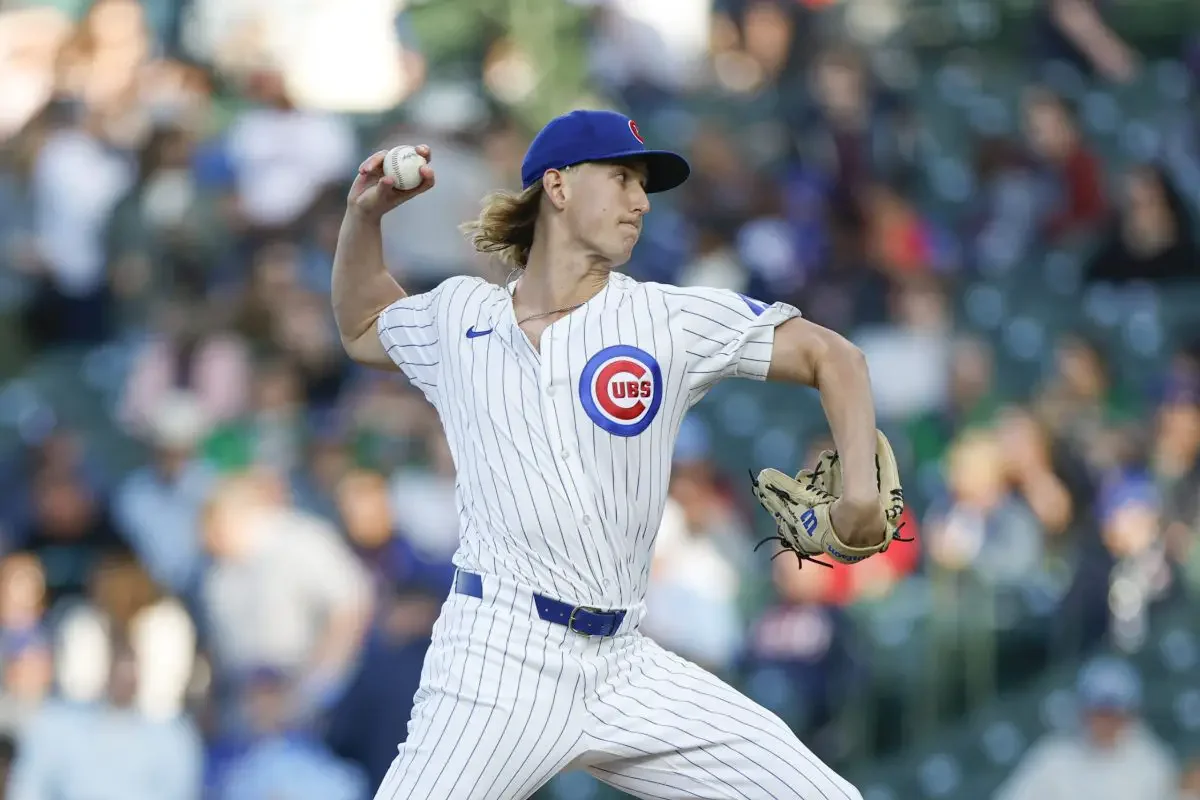
Ben Brown’s new sinker shows promise in pitching arsenal. [Image Source: MLBSTATIC]
Right-hander Ben Brown, a 26-year-old pitching prospect from East Setauket, New York, is adding a new pitch to his arsenal that could reshape his role within the Chicago Cubs organization. After a challenging 2025 season where he recorded a 5.92 ERA and allowed 18 home runs over 106 1/3 innings, Brown introduced a new sinker this offseason aimed at boosting his effectiveness against hitters in the majors.
This development comes shortly after Brown’s major league debut and follows a previous profile highlighting his analytical approach and power pitching tools. Along with his existing 96-mph four-seam fastball, 87-mph curveball, and 90-mph kick-changeup, the newly designed two-seamer has the potential to help Brown refine his mechanics and pitch mix.
The Journey Behind Ben Brown’s New Sinker
Brown revealed that his new pitch began taking shape during offseason training in Nashville. Seeking advice and knowledge from peers, he focused heavily on developing this two-seamer, which he has already started to employ in live-game settings. Speaking at Cubs camp, Brown stated,
“I started pitch-designing it during the offseason,”
“I threw probably 15 of them [over two scoreless innings against the Kansas City Royals] the other day and it went well.”
One influential figure in Brown’s development was Clay Holmes of the New York Mets, who helped introduce him to the grip and approach for throwing a sinker. Holmes is known for throwing a high percentage of sinkers and combines strong analytical insight with excellent communication. Brown credited Holmes’s coaching, saying,
Image of: Ben Brown
“Clay Holmes introduced me to the grip,”
and praised his teaching, adding,
“He’s a really bright baseball mind. He just does a really good job of communicating and teaching. He’s one heck of a coach as well as a player. One thing he did is help me to kill spin efficiency.”
How Brown’s Sinker Differs from Holmes’s Approach
While inspired by Holmes, Brown highlighted the differences between their sinkers. Holmes’s pitch features a more seam-shifted profile characterized by vertical and horizontal break of roughly -2 and 20 respectively. Brown explained that Holmes’s unique arm angles and supination give him a remarkable ability to manipulate the baseball. Brown described his own sinker as having more upward ride and slightly less lateral run, citing a recent measurement of seven vertical and 17 horizontal movement.
He emphasized the goal in contrasting the movement of his sinker with the ride of his four-seam fastball to create a clearer distinction between his pitches. This adjustment targets fooling hitters who had success hitting Brown’s heater last season, which was a major reason for seeking a new offering.
Addressing Vulnerabilities in His Pitching Arsenal
During the 2025 season, Brown heavily relied on his four-seam fastball, throwing it on 55.6% of his pitches (978 total). However, batters hit an alarming .315 average against it along with 11 home runs and a .566 slugging percentage. Brown openly acknowledged the pitch’s struggles, reflecting,
“Obviously, it got hit pretty hard last year,”
and added,
“I needed to make some adjustments.”
In addition to adding the new sinker, Brown is working to improve his four-seam fastball by enhancing its spin efficiency. By refining spin efficiency, he aims to increase off-arm-angle movement, potentially generating a cut-ride effect similar to the one he has achieved on his sinker.
About this process, Brown said,
“I’m trying to kill efficiency on my four-seam, which should help,”
describing how better spin efficiency allows a pitch to move more unpredictably. He continues to view this as a work in progress, expecting it to yield positive results moving forward.
Maintaining Confidence in His Secondary Pitches
Brown continues to feel confident about his curveball, which was used nearly 40% of the time last season. The pitch produced respectable results, holding opposing hitters to a .252 batting average and a .413 slugging percentage. Brown indicated that no major changes have been made to this pitch since it “feels good” as is.
Meanwhile, his change-up, utilized sparingly in just 4.5% of his pitches, is also progressing. Brown started to work on a kick-changeup halfway through last season and has since had the opportunity to fine-tune it over the offseason. He commented,
“It’s in a pretty good spot right now,”
signaling optimism toward his evolving arsenal.
Outlook for Brown’s Role with the Cubs in 2026
As the 2026 season approaches, Brown’s starting point remains uncertain. The most probable scenario involves beginning the year in the Triple-A Iowa rotation, allowing further development before potentially joining the Cubs’ major league staff. Given the improvements to his pitch mix, including the sinker influenced by Clay Holmes, Brown looks poised to contribute significantly once he solidifies his mechanics and command.
This new pitch and his dedication to refining his overall game embody a critical step for Brown to move past his previous struggles and establish himself as a valuable arm for the North Side. His passion and methodical approach make him a player to watch as the Cubs seek pitching improvements in the coming months.