
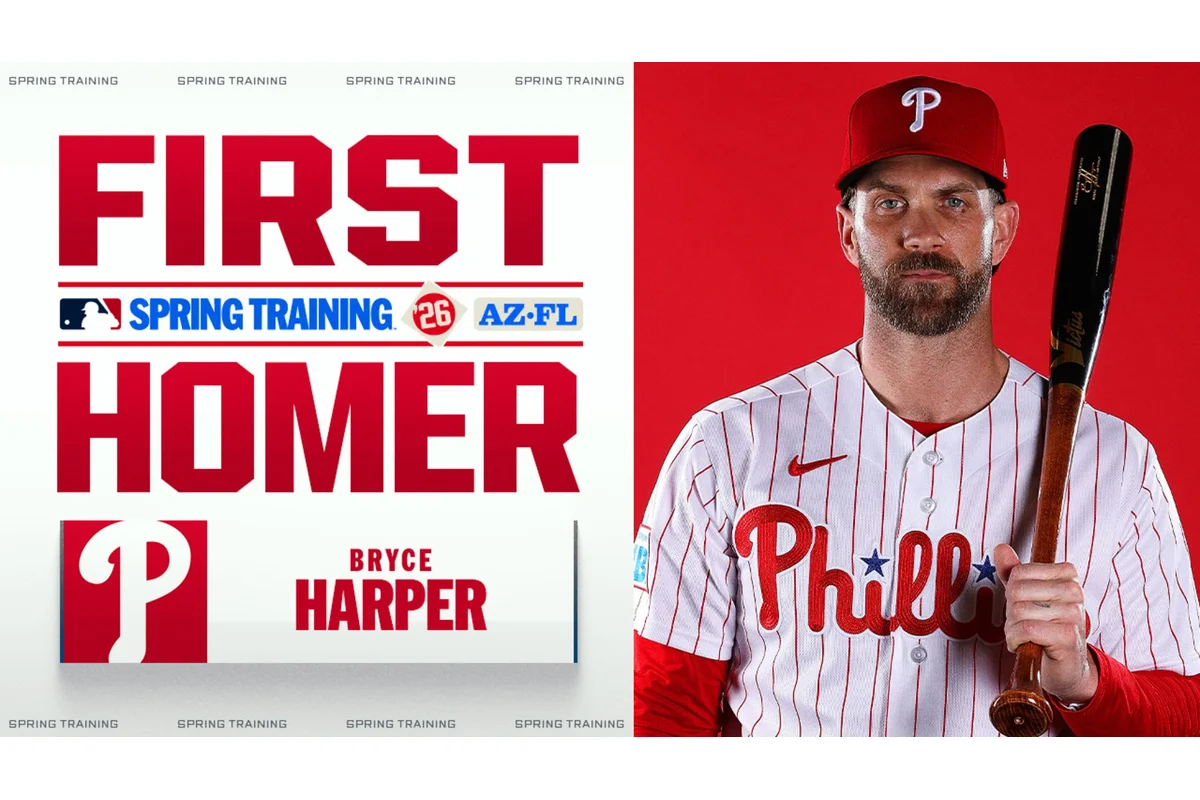
Bryce Harper has built a reputation filled with both criticism and praise throughout his baseball career, emerging as one of the most compelling figures in MLB by 2024. His journey from being labeled “not elite” to establishing himself as a key player for the Philadelphia Phillies highlights his resilience and talent in the sport.
Tracing Bryce Harper’s Rise from Doubt to Dominance
Harper’s name is associated with an impressive collection of accolades, including two National League MVP awards, an NL Rookie of the Year title, and multiple Hank Aaron Awards. He has also earned the NLCS MVP, Roberto Clemente Award, and has been selected as an eight-time MLB All-Star. Among his other honors are four Silver Slugger Awards, leading the NL in home runs, RBIs, OPS, and on-base percentage, alongside numerous Player of the Month and Player of the Week recognitions. His top performances have secured spots on both the All-MLB First and Second Teams, and he is a former Home Run Derby champion.
Before turning professional, Harper’s early promise was evident with awards such as Baseball America Player of the Year, the Golden Spikes Award in 2010, and recognition as the top overall prospect from several outlets. His time at the College of Southern Nevada and achievements in the minor leagues earned him labels like Baseball and USA American Minor League Player of the Year, setting high expectations prior to his major league debut in 2012.
Harper’s Record-Breaking Achievements and Age Milestones
Harper entered the record books as the youngest National League MVP since 1947 at age 22. He also became the youngest MLB player to hit two home runs on Opening Day in 2013 and was among the youngest to reach 100 career home runs. Additionally, he distinguished himself by achieving 300 home runs early in his career and reaching 100 home runs and 75 stolen bases before age 25.
Career milestones for Harper include surpassing 300 home runs, over 1,500 hits, 1,000 RBIs, and 1,000 runs scored, maintained a career OPS above .900, and posted multiple seasons with 30 or more home runs and an OPS over 1.000. His 2015 season with the Washington Nationals stands out as one of the franchise’s best offensive campaigns, marking the fastest player in the team’s history to reach 100 home runs at that time. After becoming a Phillie, Harper played a pivotal role in the 2022 NL pennant win and set the team’s postseason home run record with six in that year’s playoff run.
The “Not Elite” Controversy and Harper’s Response
Despite his impressive résumé, Harper faced controversy when Phillies’ President of Operations Dave Dombrowski publicly questioned whether the outfielder could regain his MVP-level performance after a subpar season. This sparked widespread discussion and the popularization of the “Not Elite” label on social media. Harper, who performed 30% better than league-average hitters despite the criticism, responded defiantly by wearing a “Not Elite” t-shirt during his batting workout sessions.
Dombrowski later called his own comment “wild,” especially since it breached the team’s usual practice of handling such matters privately within the clubhouse. Harper maintained that he motivates himself and that outside opinions do not drive him, also noting no feelings of disrespect. The public nature of the criticism was the main issue, not the sentiment itself. Reflecting on Harper’s performance, his agent Scott Boras remarked,
You put gas in the tank, and the Harperi/meaning a Ferrari, works/takes off.
– Scott Boras, Agent
The Early Years: From Childhood Prodigy to National Spotlight
Bryce Harper’s talent surfaced early in life, as he hit his first home run at age seven in a ten-and-under World Series. By age twelve, he was widely recognized for his hitting, pitching, fielding, and media savvy. Remarkably, by eighth grade, Harper had already received a college baseball offer from Texas.
At thirteen, Harper played alongside high school athletes because of his advanced skill and physical stature—standing 6’1” and weighing 170 pounds. By fourteen, the young phenom was represented by Scott Boras, marking an unusual step for such a young player.
His national prominence soared when he appeared on the cover of Sports Illustrated at just sixteen, earning nicknames like “The Chosen One” and “The LeBron James of Baseball.” Harper’s freshman year high school stats were extraordinary, boasting a .590 batting average and home runs measuring nearly 570 feet in his home field. Scouts ranked his bat speed amongst the top ten percent of major league players. As Tom Verducci of Sports Illustrated noted,
Bryce Harper is the most exciting prodigy since LeBron.
– Tom Verducci, Sports Illustrated
Confidence, Controversy, and College Success
Harper completed his GED after sophomore year with a 3.5 GPA and immediately enrolled at the College of Southern Nevada, where his debut attracted over 2,000 fans, requiring police presence. Known for his confident and often cocky demeanor, Harper frequently responded to opponent taunts with home runs and theatrics. His competitive edge sometimes led to confrontations, including ejections for gestures towards umpires and opponents.
Reported criticisms of his attitude surfaced early; as one comment put it,
He’s just a bad, bad guy,
and another stated,
It’s equally difficult to find one who doesn’t genuinely dislike the kid.
Despite such criticism, Harper’s freshman year in college was spectacular, earning the Golden Spikes Award by hitting 31 home runs with 98 RBIs and a .443 average using a wooden bat. His passion was apparent during the College World Series when frustration led to an on-field ejection after he marked a pitch location with his bat. While some viewed him as cocky, those close to him described Harper as humble but fiercely competitive.
After being drafted at seventeen, his “Chosen One” nickname became widespread. In the minors, following near-injury from a pitch, Harper hit a home run on the next pitch and celebrated provocatively, even attracting warnings from opponents. His fiery response to an opposing catcher was direct:
F**k you, I hit the ball 500 ft, I can do what I want.
A Record Contract and Philadelphia’s Adoption
Enterting the major leagues at age nineteen, Harper faced early criticism and was even booed by some fans. His passionate style included memorable incidents such as sustaining 10 stitches after hitting himself with a broken bat and heated exchanges with umpires. When asked about legal drinking age rules in Toronto, Harper dismissed the inquiry as, That’s a clown question, bro.
Shortly after, a critical article titled
This Is Why You Should Hate Bryce Harper
was published just two months into his career. Despite this, Harper secured a landmark 13-year, $330 million contract with the Phillies in 2019, establishing him as one of the highest-paid players and a beloved figure for Philadelphia.
Upon returning to Nationals Park as a Phillie, Harper was met with intense booing and signs calling him a TRAITOR. He answered with stellar performance, going 3-for-5 and hitting a 458-foot home run with a bat flip, a moment that deepened the rivalry and marked a turning point in fan perception. Though Nationals supporters felt betrayed, Harper’s contributions helped the Phillies win the game and solidified his place within Philadelphia’s baseball community.
Ongoing Impact and Determination
Despite the divided opinions regarding his personality, Harper remains a central figure in the sport, demonstrating unwavering dedication to his team and city. His continued high-level play challenges notions of him being overrated, reinforcing his standing not only as a skilled athlete but as a passionate competitor focused on victory. Harper has expressed his commitment plainly, stating,
If you’re not ready to play, don’t come.
The Philadelphia fanbase, undoubtedly, is prepared and eager to support their star.
