
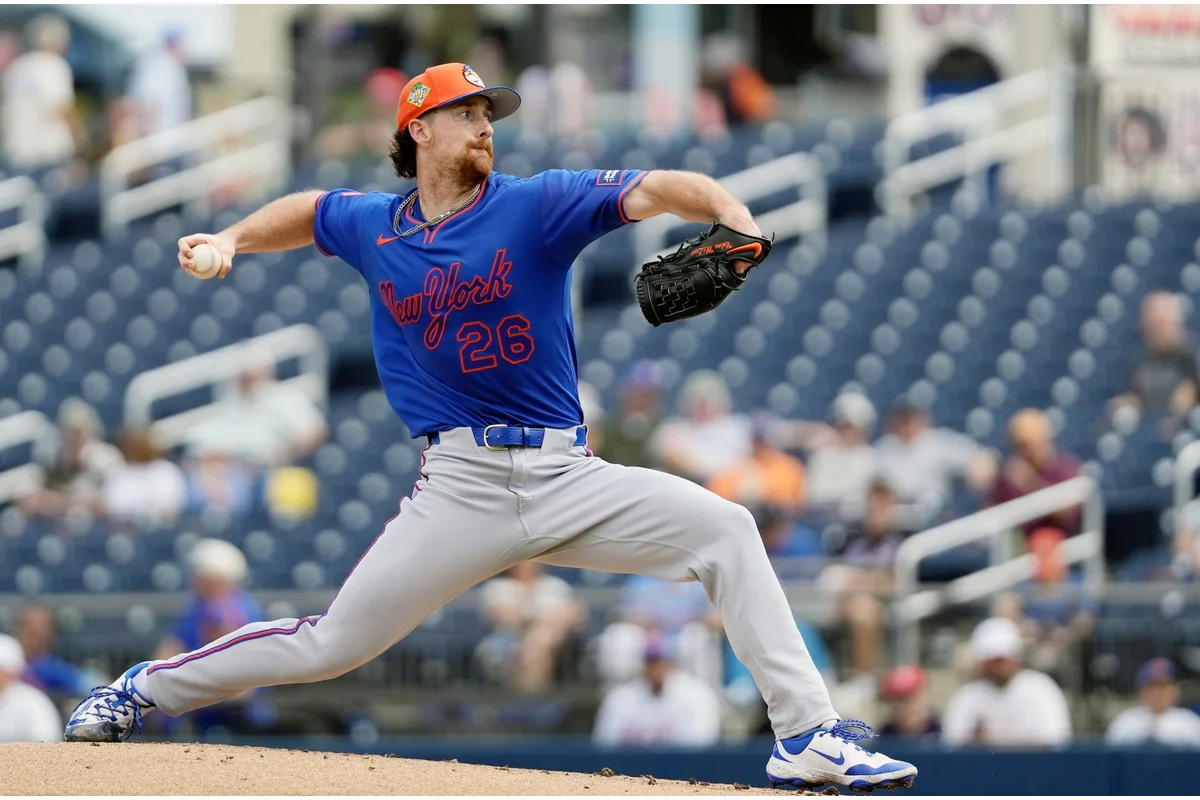
Tyler Rogers has quietly become a standout figure among Major League Baseball pitchers, not for flashy speed or power but because of his exceptional pitching command. In the 2023 season, Rogers threw 77⅓ innings with an impressive 1.98 ERA, maintaining a career ERA of 2.76 over eight seasons. His strength lies in his ability to limit walks at an extraordinarily low rate, walking only seven batters last season, a 2.3% walk rate that ranks among the best in the league.
Unlike star pitchers such as Shohei Ohtani, Tarik Skubal, or Bobby Witt Jr., who excel with high velocity and powerful hitting, Rogers’ approach is more subtle, almost like an accountant suddenly placed on the mound. His mastery derives from pinpoint control and an unusual pitching style that belies the conventional expectations for dominance.
Examining Rogers’ Control During High-Pressure Counts
A key puzzle in Rogers’ pitching command is revealed when examining how he performs during three-ball counts, moments when pitchers typically struggle. Analysis of 26 pitches Rogers threw with three balls showed many were in hittable locations, with a command grade of just 42 out of 100, indicating average or even below-average placement. In fact, Rogers allowed slightly more walks in three-ball counts than the league average.
This raises an important question: how does Rogers maintain the second-lowest walk rate in the majors if his late-count command is unremarkable? The answer lies in how he controls the count before it reaches three balls, avoiding giving hitters free passes by minimizing non-competitive pitches early.
Minimizing Wasted Pitches: The Key to Rogers’ Low Walk Rate
Walks stem from three factors: reaching a three-ball count, throwing a ball outside the strike zone, and the batter not swinging. Rogers smartly limits the first factor by rarely falling behind in counts. His command in 0-0 counts is remarkable, as he places many pitches efficiently around the low arm-side corner of the strike zone. This location is advantageous for a sinkerball pitcher, allowing him to keep hitters guessing and off balance.
Rogers’ “Waste Miss Percentage” — a statistic measuring the proportion of pitches that are poorly located, outside the strike zone, and easily taken by batters — is just 22% in 0-0 counts. This is notably low compared to the league average near 33%, and far better than many elite pitchers who waste closer to 40% of their first pitches.
Because of this precise command, he achieves a 1-0 count on batters only 27% of the time, significantly less than the league average of 38.1%. Even on the second pitch, Rogers remains efficient, maintaining about a 20% waste rate, which helps him avoid falling behind in the count. This disciplined approach denies hitters easy balls to take, reducing walk opportunities early in at-bats.
Evolution of Rogers’ Pitch Usage and Approach
Reviewing Rogers’ pitching trends from 2020 to 2023 shows that his early-count pitch locations were more typical, with a higher proportion of waste pitches. But in 2024, he drastically reduced his waste rate to 24% by making a key adjustment: he stopped relying on his slider as a first-pitch offering. Previously, Rogers mixed sinkers and sliders evenly to start at-bats, but his command on sliders was weaker, with around 40% of them being waste pitches.
In 2025, he threw only 52 sliders in 0-0 counts, down significantly from 141 in 2023, focusing almost exclusively on his sinker. This reduction in the usage of a less reliable pitch early in counts shows Rogers’ intent to maximize strike-throwing and control, even though it sounds risky because his fastball sits at a modest 82-83 mph and he essentially offers hitters a predictable pitch.
The Exceptional Effectiveness of Rogers’ Sinker
Rogers’ sinker defies expectations despite its relatively slow velocity. Hitters swinging at it rarely miss, but the true trouble arises after contact. Unlike ordinary sinkers that primarily deceive batters because they appear to rise less than fastballs, Rogers throws his sinker “upside down” with significant downward movement—double that of any other sinker in the league. This causes hitters to make weak contact, frequently resulting in groundballs or easy outs rather than the fly balls that usually lead to extra-base hits.
Batters generated fly balls on just 9.8% of their contact against Rogers’ sinker. This downward movement fundamentally disrupts modern offensive strategies, which often rely on elevating the ball for power. Rogers’ ability to suppress slugging on this pitch is remarkable, ranking him fourth-lowest in weighted on-base average on sinkers over the last five years, behind only José Soriano, Zack Wheeler, and Sandy Alcantara.
League average wOBA against sinkers is about .350, with slugging percentages around .500, yet Rogers keeps these numbers much lower, highlighting his exceptional skill in controlling quality of contact.
Rogers’ Unique Strategy: Accepting Balls in Play Over Strikeouts
Traditional pitching wisdom emphasizes advancing counts to two strikes and then forcing strikeouts. Rogers, however, registers a putaway percentage (the rate of converting two-strike situations into strikeouts) in the 28th percentile league-wide, indicating he’s less reliant on strikeouts than his peers. His career average remains similar, reflecting a conscious strategy rather than a deficiency.
Because Rogers’ sinker induces weak contact and limits extra-base hits, he can afford to pitch to contact and rely on defense rather than seeking strikeouts. This challenges conventional approaches, since many pitchers try to avoid ball-in-play scenarios to decrease hitters’ chances of success.
How Rogers Defies Conventional Pitching Norms
Rogers’ approach turns much of conventional pitching strategy on its head. Typically, pitchers throw secondary pitches early in counts to induce swings and get to two strikes without allowing balls in play. They nibble around the edges to avoid throwing strikes too early.
For Rogers, walks are the greatest threat because free baserunners are far more damaging when strikeouts are scarce. Thus, he avoids wasting pitches altogether. Throwing an early-count slider, which he struggled to control, no longer fits this method. Instead, Rogers focuses on flooding the strike zone with a high-quality sinker that batters rarely square up effectively.
This evolution from mixing two pitches to leaning almost exclusively on his sinker came with the realization that a wasted ball is his biggest vulnerability. The tradeoff is that hitters know what’s coming but still struggle to capitalize, making Rogers a uniquely effective pitcher in the majors.
Implications for Other Pitchers and Baseball Strategy
While Rogers’ results are extraordinary, his approach may not be suitable for most pitchers. Few possess his inverted sinker or can control contact quality so well. Other pitchers rely on high velocity, breaking balls, and a variety of secondary pitches to succeed.
Nevertheless, Rogers’ refined control, combined with smart pitch selection and intent, has allowed him to slash his walk rate by nearly two-thirds without dramatically changing his fundamental style. His example highlights the power of minimizing non-competitive pitches early in at-bats, which prevents long counts and reduces the risk of free passes.
For Rogers, who remains an outlier with an unconventional but highly effective pitching style, each outing is a reminder that mastering command and understanding one’s strengths is critical, even in a game dominated by power and velocity. The baseball world will be watching to see if his style influences others or remains a rare exception.
