
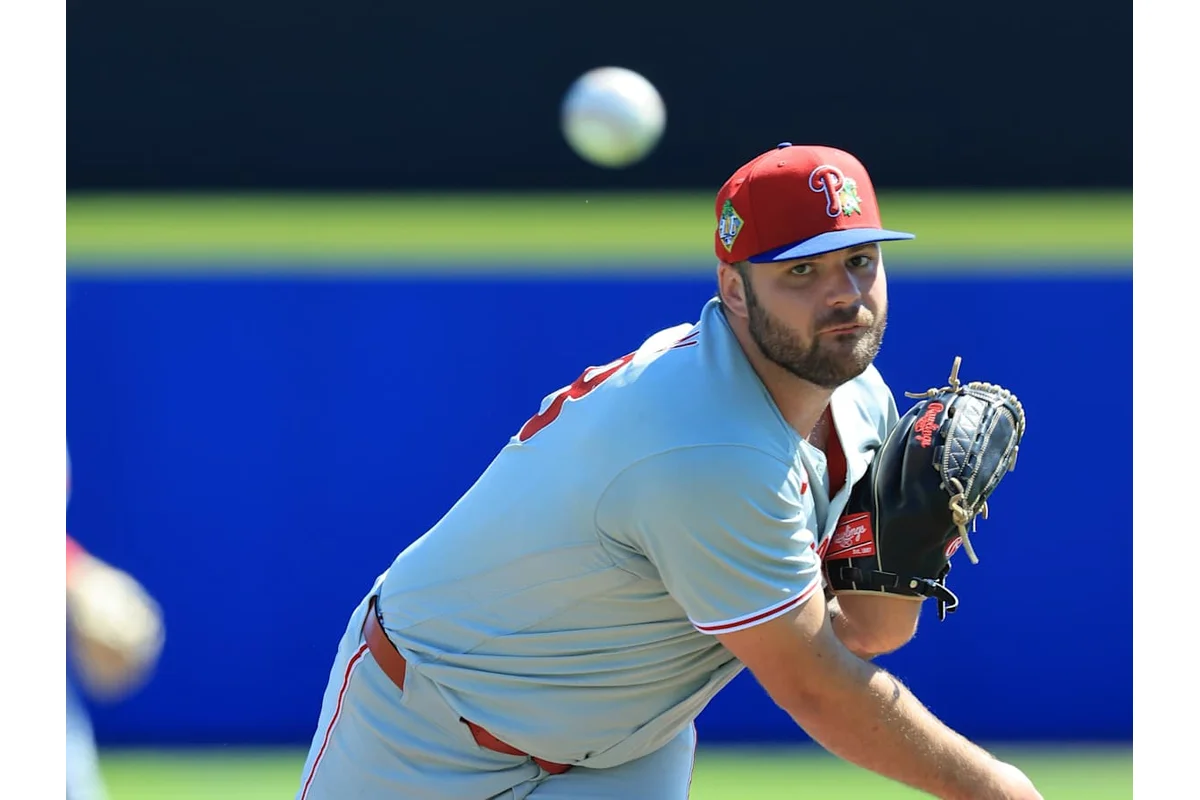
As Zack Wheeler‘s return to the Phillies approaches a likely April timeline, the team’s starting pitching depth appears to be stabilizing compared to earlier concerns. The Phillies plan to begin the season with Cristopher Sanchez, Jesus Luzardo, Aaron Nola, Andrew Painter, and Taijuan Walker in their rotation, though the exact order is not yet finalized. Wheeler’s anticipated mid-to-late April comeback could prompt the Phillies to decide whether to adopt a six-man rotation for a short stretch, move Walker to the bullpen, or send Painter down to Triple A temporarily to conserve innings.
Addressing the Need for More Than a Half-Dozen Starters
The Phillies will effectively have six established starters once Wheeler rejoins the roster, which is typically the bare minimum required over a full 162-game season. Historical data highlights this: in 2025, Philadelphia employed eight traditional starters plus two openers; in 2024, ten starters and two openers were used; and in 2023, nine starters alongside two openers appeared. Beyond the core starting five or six, the Phillies’ depth chart lists right-handers Jean Cabrera, Bryse Wilson, and Alan Rangel as the seventh, eighth, and ninth options.
However, Cabrera and Rangel have both been optioned to minor-league camp and are set to begin the season in Triple A. Rangel, in particular, struggled during Grapefruit League play with a 9.39 ERA and a .371 opponents’ batting average in four appearances. Meanwhile, the Phillies stayed in Fort Myers overnight to take on the Red Sox on Monday afternoon, where Bryse Wilson is expected to make his third spring outing and second start.
Bryse Wilson: The Most Experienced Among the Trio
Among the minor-league camp pitchers, Wilson stands out as the only player not on the Phillies’ 40-man roster but possessing the greatest major-league experience of the group. His career includes 57 starts and 106 relief appearances, many as a long reliever. Wilson has taken the mound twice this spring: a two-inning start during the Phillies’ spring opener on February 21, and two innings of relief following Aaron Nola’s first spring start on February 27.
Given that Cabrera is no longer in big-league camp and with Sanchez, Nola, and Walker participating in the World Baseball Classic, Wilson figures to start again for Philadelphia soon after Monday’s game.
“Throw the best that I can to give myself a good chance to make a team or be somebody that can be called up when there’s a hole to fill,”
Wilson said last week in the Phillies’ Clearwater clubhouse.
“I think it’s just a good opportunity to come in and get better, see how I can improve and what ways they think I can be better, and just embrace that opportunity.”
Wilson anticipates being gradually stretched out during camp as he prepares to begin the season with Triple A Lehigh Valley. The Phillies currently have no pressing need for a traditional long reliever in their bullpen, especially during April’s five-day breaks.
“Whether I build up to five or six innings is up to them but at least get up to three or four innings just so I can cover the long role if need be,”
he explained.
Wilson’s Career of Fluctuating Roles and Performance
Wilson has adjusted repeatedly between major and minor leagues, as well as between starting and relieving duties, a flexibility valued by the Phillies. The team presently favors pitchers who are optionable rather than locking in long-term guarantees.
Wilson posted solid numbers with the Milwaukee Brewers in 2023 and 2024, compiling a 2.58 ERA in 2023 and a 3.57 ERA in 2024 mostly from the bullpen. During those two seasons, he appeared in 78 of 87 games as a reliever, often pitching multiple innings in middle relief.
“In 2023, I was the long guy all year, so I threw 75 or 80 innings that season in a middle-relief role, anywhere from one to four innings,”
Wilson said.
“I think in 2023 and 2024, the hybrid thing, it was a little bit more consistent. Last year was a lot of bouncing back and forth.”
The 2025 season was more challenging for Wilson following a move to the Chicago White Sox, where he split time between the majors and Triple A. He started strong by allowing just two runs over his first ten innings but then struggled, surrendering eight home runs and hitting a .364 batting average against in his subsequent 32⅓ innings across ten outings.
“I don’t think I adjusted as well as I should have to it,”
Wilson admitted.
“But I see myself as a guy who can throw a lot of pitches and cover a lot of innings and do it in a quality way. But just embracing the role, do whatever the team wants me to do.”
Refining Control and Pitch Selection During Spring
In his two spring contests, Wilson has allowed six baserunners over four innings yet remains scoreless. His fastballs—the sinker and four-seam—have been clocked at 91-92 mph, while he has also deployed cutters, curveballs, and changeups. The sinker is Wilson’s principal pitch and was particularly effective last year, limiting opponents to a .238 batting average overall, and just .228 against right-handed hitters.
“Probably the sinker, it’s the pitch I throw the most, and I feel comfortable throwing it to righties and lefties,”
he said.
“I think kinda just the consistency and the mechanics (are the focus). The stuff’s there, it’s just about being consistent and able to execute whenever I want to, figuring out the best way to use the pitches that I have.”
Wilson’s ability to consistently command his pitches and effectively sequence them will be essential if he is to earn a role, either at Triple A with the Lehigh Valley IronPigs or as a depth option for the Phillies’ major league roster. His versatility and experience could prove valuable, especially as the Phillies manage their pitching staff through the early season challenges and Wheeler’s anticipated return.
