
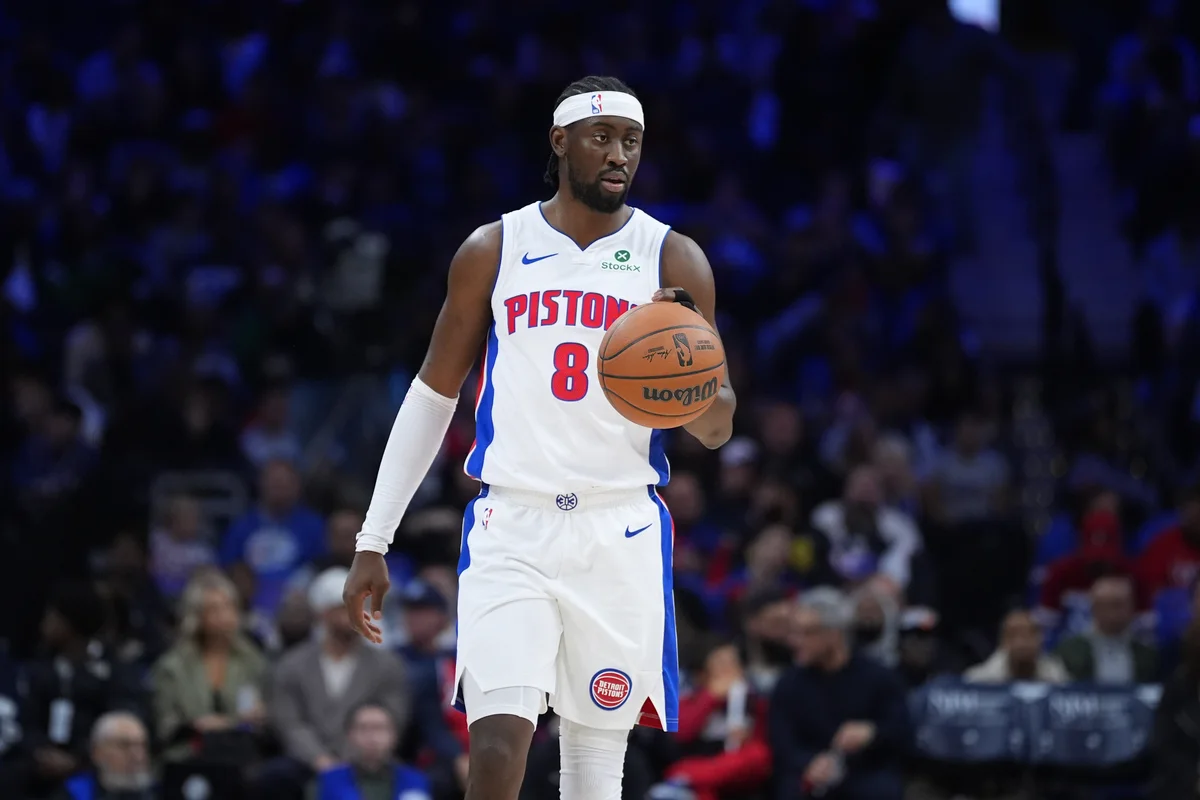
The Detroit Pistons chose to remain inactive during the recent trade deadline despite being one of the top teams in the Eastern Conference this season. With many rivals, except the Cleveland Cavaliers, not making major moves, Detroit saw little reason to alter their roster drastically. Aside from exchanging Jaden Ivey—who was expected to leave in the offseason anyway—for Kevin Huerter, the Pistons preserved their core lineup heading into the final stretch of the season. However, this decision does not guarantee long-term stability for all players, especially Caris LeVert.
Uncertain Future for Caris LeVert in Detroit’s Lineup
Caris LeVert was widely viewed as a potential trade asset before the deadline. His skill set does not perfectly align with Detroit’s needs, and his $14.1 million salary for the current season makes him an appealing option for teams seeking a mid-level contract player. The Pistons had opportunities to enhance their roster by pairing LeVert with draft picks for a more significant impact player but instead opted to keep the group intact for now, as directed by General Manager Trajan Langdon and the front office.
Looking ahead to the offseason, LeVert is expected to return to trade discussions. With his contract expiring and a $14.8 million salary for next season, he could draw considerable interest from other teams. His performance this season, however, has not been convincing enough to secure his position in Detroit.

Performance Struggles and Role Limitations
LeVert has struggled with shooting efficiency, posting a true shooting percentage of just 53.6%. Offensively, his involvement has diminished, recording the second-lowest usage rate of his career at 18.1%, while his turnover rate reached a career-high of 15.9%. Despite these challenges, LeVert has provided reliable contributions on both ends of the floor. He is capable of creating scoring opportunities for himself and teammates and can defend multiple positions effectively. Although he remains a veteran presence suitable for a rotation role, his contract may not match the value he currently offers.
Moreover, the Pistons’ roster construction lessens the need for an on-ball player with inconsistent shooting ability. Emerging players like Ron Holland and Ausar Thompson offer fresh perimeter depth, and the team’s success increasingly depends on versatile, accurate shooters who can operate off the ball. While LeVert cannot be classified as a poor shooter, he does not present a strong scoring threat from outside either.
Competition from Kevin Huerter and Reduced Playing Time
If Kevin Huerter, Detroit’s recent acquisition, regains his previous shooting form, he is likely to push LeVert out of the rotation, given his ability to space the floor effectively. Huerter’s versatility and proficiency as an off-ball shooter align better with the Pistons’ tactical approach compared to LeVert’s style. Currently, LeVert averages a career-low 19.8 minutes per game, a figure that may decline further if Huerter solidifies his role.
Such a reduction in playing time and impact could make maintaining LeVert’s contract difficult to justify, ultimately leading to his departure in the offseason. This trajectory indicates that despite surviving the trade deadline unscathed, LeVert’s days with the Pistons are likely limited.
