
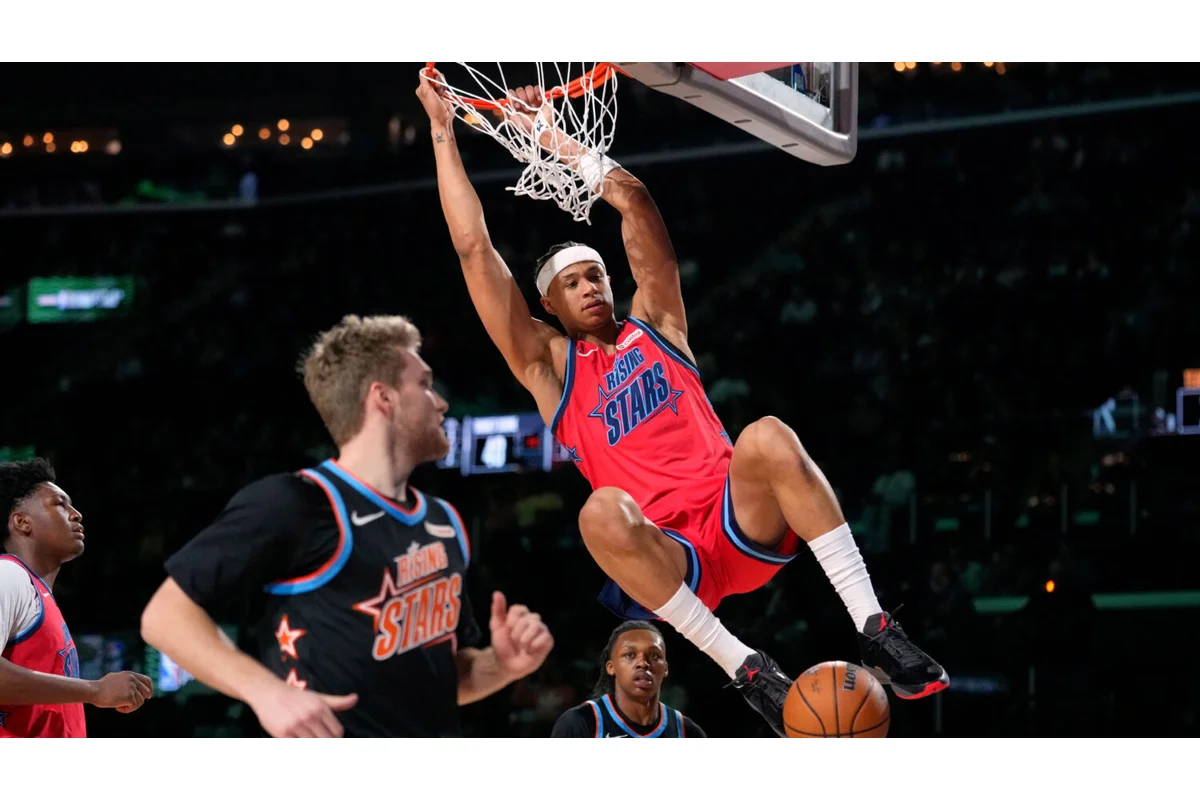
Carter Bryant has steadily gained prominence in the San Antonio Spurs’ lineup, delivering his strongest NBA performances this February with averages of 9.0 points and 3.8 rebounds in just 16.7 minutes per game. With the playoffs approaching, the Spurs are increasingly relying on their rookie, suggesting Bryant may play a significant role in the crucial postseason games. However, achieving this opportunity depends heavily on improving his Carter Bryant shooting consistency.
Offensive Improvement Needed to Secure Playoff Minutes
While Bryant excels as an energetic contributor off the bench, showing relentless effort on both ends of the court, his offensive game requires refinement to hold up in high-pressure situations. His defensive abilities—including strong ball pressure, frequent steals, and blocks—make him a valuable asset. Additionally, Bryant ranks fourth on the Spurs in total rebound percentage, trailing only Victor Wembanyama, Luke Kornet, and Keldon Johnson. His athleticism and defensive tenacity set the foundation for a playoff-ready player.
Nevertheless, Bryant’s shooting efficiency from beyond the arc remains problematic. He is connecting on only 32.1% of his three-point attempts while taking just 1.8 shots per game this season. In the playoffs, where opponents target weaknesses relentlessly, this inconsistency could hinder his playing time. Defenders are likely to leave him unguarded on the perimeter, exploiting his shooting struggles and turning him into a potential liability for the team.
Lessons from Jeremy Sochan’s Trajectory
Bryant’s challenge is not unique for rookies, as proficient shooting is seldom a rookie trademark, especially for those expected to take on larger roles in the postseason. Jeremy Sochan’s recent departure from the Spurs illustrates the risks of not developing a reliable jump shot. As a former ninth overall pick with strong defensive skills but a subpar three-point shot, Sochan gradually lost playing time and favor with the team.
Should Bryant fail to build consistent long-range shooting, he risks a similar fate of limited minutes during critical playoff stretches. However, this outcome would be understandable given his rookie status—high pressure and expectations should be tempered for now. The real measure will come if Bryant remains a below-average shooter several seasons from now, which could restrict his future contributions significantly.
Potential Impact on Bryant’s Playoff Prospects
The San Antonio Spurs see promise in Bryant’s hustle, defensive intelligence, and rebounding, qualities that naturally fit the intensity of postseason basketball. His ability to stay on the court during playoffs will heavily depend on whether he can enhance his shooting to a dependable level. If Bryant improves his outside shot, he can become an invaluable role player who contributes on multiple fronts. Conversely, continued shooting inconsistency will likely conscript him to a bench role when playoff pressure intensifies.
