
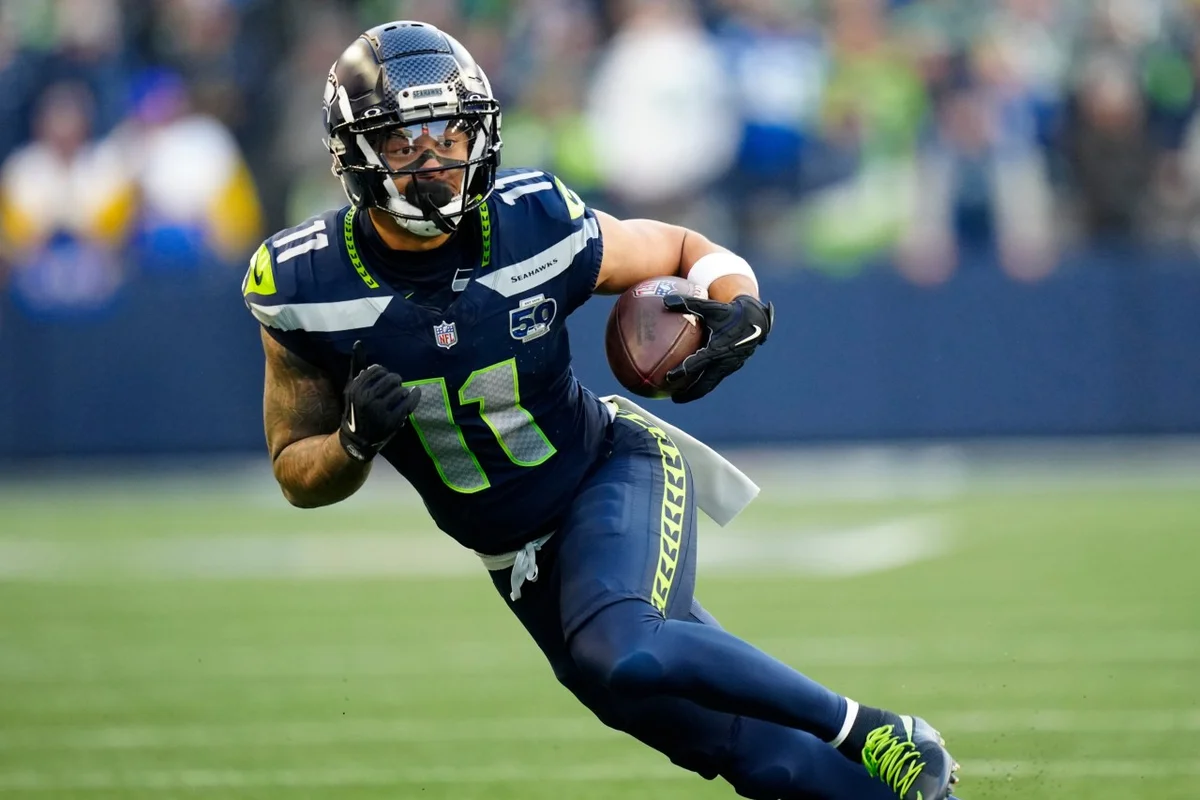
At the Seattle Seahawks’ Super Bowl 60 Opening Night, head coach Mike Macdonald was posed with a playful yet insightful question: if he were preparing his defense to stop Jaxon Smith-Njigba, what strategy would he use? His answer, delivered with a mix of humor and seriousness, was simple yet telling:
“Can I put three guys on him?”
This response reflects the challenge Smith-Njigba presents to opposing defenses. Under offensive coordinator Klint Kubiak, Smith-Njigba was not confined to a single role; he moved freely across the field—outside, inside, in motion, sometimes even lining up in the backfield—constantly forcing defenses to adjust. This dynamic approach made Smith-Njigba less of a player in one spot and more of a pervasive threat that opponents struggled to contain.
Smith-Njigba’s Impact and Statistical Dominance
Jaxon Smith-Njigba’s versatility and sharp route-running resulted in remarkable production. He led the NFL with 1,793 receiving yards and amassed 119 receptions with 10 touchdowns. His performance earned him a 94.4 WR Impact (WRi) score and an A grade from PFSN’s metrics, ranking him second only to Puka Nacua across all receivers. These numbers underscore how defenses were quietly overwhelmed by his consistent ability to create separation and capitalize on timing and leverage.
Despite defenses’ increasingly focused efforts to limit him during the playoffs, Smith-Njigba’s impact remained undeniable. His All-Pro status reflected the league-wide recognition of his talent, while Seattle’s offense continued to flourish around him.
Seattle’s Season Success and Balanced Team Performance
The Seahawks concluded the regular season with a strong 14-3 record, securing the NFC’s top seed. Their success was supported by both an exceptional defense, led by Macdonald, and an offense that grew more confident throughout the year. Under Macdonald’s guidance, the defense operated with clarity and control, but Smith-Njigba’s threat was one problem without a straightforward answer.
Addressing perceptions outside the team, Macdonald emphasized the Seahawks’ internal focus and commitment to become a championship-caliber team.
“We really don’t. I think what was important for us was to become a championship team. We weren’t that in the Spring. We were on our way, that’s what we wanted to become, but in order to get to a stage like this and win a game like this, it’s got to be real.”
On offense, Kubiak’s first year fostered cohesion quickly, enabling quarterback Sam Darnold to rise quietly into the league’s top five in passing yards. While the run game was slower to develop, it became a significant contributor down the stretch, averaging over 170 rushing yards during critical periods, helping the Seahawks maintain a balanced attack.
What Lies Ahead for the Seahawks and Smith-Njigba’s Role
The Seahawks’ impressive regular-season dominance, driven by both their top-rated defense and an offense centered around Jaxon Smith-Njigba’s unique skill set, sets high expectations for their postseason performance. Macdonald’s acknowledgment of the difficulty in containing Smith-Njigba highlights the receiver’s game-changing potential, which will likely shape opposing teams’ defensive strategies moving forward. As Seattle pursues their championship goals, the ongoing evolution of their offense, led by Smith-Njigba and supported by Darnold and the run game, will be critical to their continued success.
Coach Mike Macdonald asked here at the Super Bowl how he as a defensive mind would handle his #Seahawks All-Pro WR Jaxon Smith-Njigba.
“Can I put three guys on him?”
@thenewstribune pic.twitter.com/CwgUZsLfd5
— Gregg Bell (@gbellseattle) February 3, 2026
