
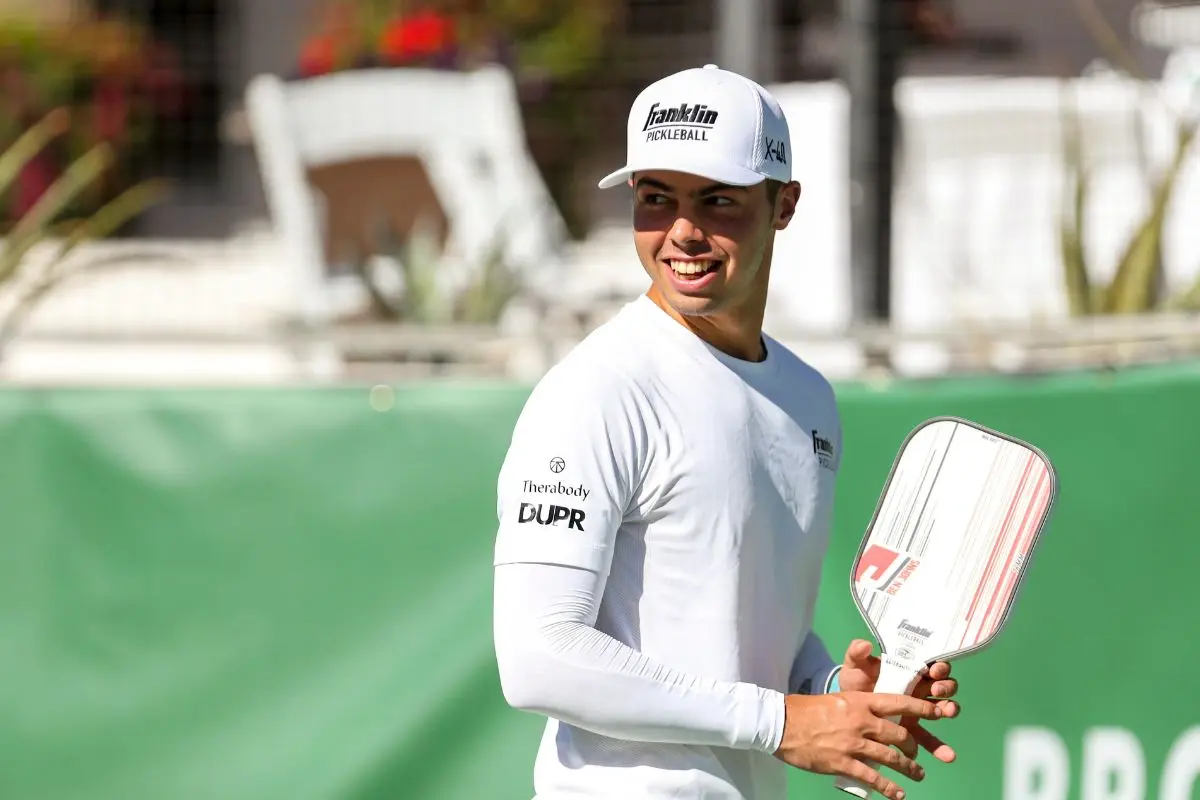
Ben Johns Pickleball Net Strategy: Ben Johns, considered the greatest pickleball player of all time, is famous for his lightning-fast reactions during quick exchanges at the net. Many assume his success comes from natural reflexes, but his real advantage lies in perfect technique and anticipation. Johns predicts shots before they happen, giving him a huge edge in fast rallies.
The Ready Position Advantage
Ben Johns holds his paddle slightly lower than most players. This position keeps it close to net height, which is where most fast shots arrive. His elbows stay just ahead of his body, giving him room to counter both forehand and backhand. His compact swings allow him to react faster without getting jammed.
Another detail is his head movement. Unlike many players who jump or shift when defending fast shots, Johns keeps his head still and balanced. This stability makes it easier to time shots and return balls cleanly.
How Pros Use Anticipation
Johns uses anticipation patterns to predict where the next ball will go. Instead of reacting blindly, he creates situations that give him a high chance of knowing where the ball will return.
One example is the “triangle effect.” If he speeds up a shot crosscourt to his opponent’s forehand, he often expects the return to come back to his backhand. By slightly shifting his paddle position, he is ready for the likely counter. While it does not work every time, it increases his odds of winning fast exchanges.
Another strategy is speeding up down the line. Johns knows that many players return this shot in the same direction, making it easier to prepare his counter. Similarly, when he attacks down the middle, his opponent often hits back late, giving Johns a predictable shot to put away.

The Role of Paddles in Fast Exchanges
Modern pros, including Ben Johns, often use “poppier” paddles. These paddles allow players to generate more power with smaller swings. “When you’re in a hands battle, it’s a lot easier to have a good counterattack or a good speed up with a poppier paddle,” the analysis explained. Using such equipment not only increases power but also reduces reaction time needed for counters.
Predicting Opponent Speed-Ups
Johns also excels at reading when opponents will speed up. Players often give away signals, such as taking a bigger backswing or adjusting their feet differently than during a normal dink. By watching for these signs, Johns prepares early for the attack.
Position also matters. If an opponent speeds up from across the court, Johns knows they cannot hit sharp angles, so he favors one side of his body to be ready. When facing a speed-up directly in front, he shifts slightly to cover with his backhand, a tactic that helps him counter almost any shot aimed at his body.
Finishing the Point
Once Johns gains control of a hands battle, he looks to end the rally quickly by targeting his opponent’s feet. Driving balls downward with power and spin prevents opponents from recovering, allowing Johns to finish points efficiently.
Why It Matters
Ben Johns’ success in hands battles is not luck or reflexes. His edge comes from technical precision, anticipation patterns, and smart positioning. For aspiring players, his approach shows that speed at the net can be trained through technique, strategy, and equipment choices—not just natural quickness.
News in Brief: Ben Johns Pickleball Net Strategy
Ben Johns dominates pickleball fast-hand battles through technique and anticipation, not just reflexes. His low paddle position, steady head, and use of anticipation patterns like the “triangle effect” give him control. Combined with poppier paddles and smart positioning, Johns’ strategy helps him stay the fastest at the net.
ALSO READ: Max Freeman Shocks Pickleball World With Daring Upset Over No. 1 Ben Johns