
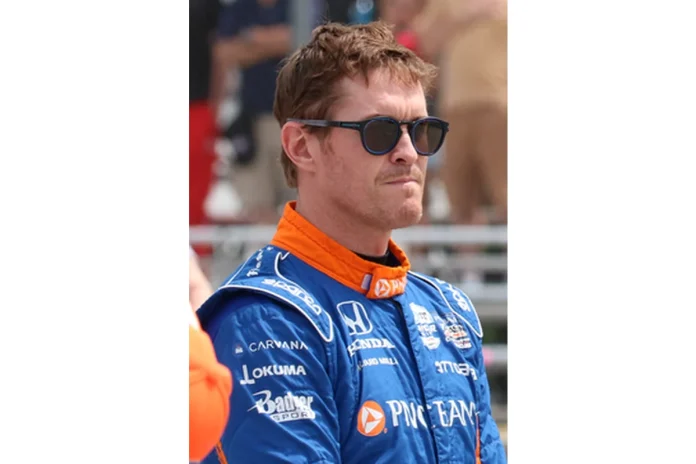
Scott Dixon Bio
Sir Scott Ronald Glyndwr Dixon KNZM (born 22 July 1980) is a New Zealand racing driver who competes in the IndyCar Series for Chip Ganassi Racing (CGR). He pilots the No. 9 Dallara DW12-Honda and is widely regarded as one of the most successful drivers in American open-wheel racing history. Nicknamed “The Iceman,” Dixon is a six-time IndyCar Series champion, with titles in 2003, 2008, 2013, 2015, 2018, and 2020.
Beyond his IndyCar success, Dixon is a three-time winner of the 24 Hours of Daytona (2006, 2015, and 2020) and a two-time Petit Le Mans winner (2020 and 2024). He also claimed the prestigious 2008 Indianapolis 500 and has finished on the IndyCar podium more than 140 times. His longevity, consistency, and tactical intelligence have made him a benchmark for modern American motorsport.
Early Life and Background
Scott Dixon was born on 22 July 1980 in Brisbane, Queensland, Australia, the youngest child and only son of New Zealand expatriates Ron and Glenys Dixon. He has two older sisters, and although born in Australia, he holds New Zealand citizenship. His family had moved from New Zealand to Australia in 1976 in search of better opportunities, settling in Townsville, North Queensland, where his parents owned a dirt speedway and raced various cars on local circuits.
After a serious accident involving his father, the family returned to Auckland, New Zealand, when Dixon was a child. He attended Manurewa Central Primary, Green Meadows Intermediate, and James Cook High School. Inspired by his parents’ racing background and the success of New Zealand legends Chris Amon, Denny Hulme, and Bruce McLaren, Dixon began karting at age seven at Auckland’s Mt. Wellington oval kart track. He went on to win thirty major karting titles across Australia and New Zealand in his age group.
Path to NASCAR
Dixon’s path to top-level open-wheel racing ran through karting and junior formulas rather than stock car racing. He progressed to car racing at age thirteen, winning the 1994 New Zealand Formula Vee Championship in his first attempt and becoming its youngest champion. He followed that by winning the New Zealand Formula Ford Class II title in 1995–1996 and the primary Formula Ford class the following season.
With backing from a small group of sponsors and his family’s Scott Dixon Motor Sport (SDMS) company, Dixon moved into the Australian Drivers’ Championship, claiming the 1998 Australian Gold Star title with five wins and seven pole positions. After a season in the American Indy Lights series in 1999 with Johansson Motorsports, he won the 2000 Indy Lights championship for PacWest Racing’s development squad. These results earned him a promotion to CART for 2001 and laid the foundation for a career in IndyCar, rather than NASCAR.
Scott Dixon Career
Early Career (1994–2000)
Dixon’s early career was defined by rapid progression through junior open-wheel categories in New Zealand and Australia. After winning the 1994 New Zealand Formula Vee Championship, the 1995–1996 New Zealand Formula Ford Class II title, and the primary Formula Ford class the following season, he entered the Australian Drivers’ Championship in Formula Holden. In 1998, he drove a Reynard 92D-Holden to five wins, five second-place finishes, and seven pole positions, beating future V8 Supercars racer Todd Kelly to the Australian Gold Star Drivers’ Championship.
Moving to the United States in late 1998, Dixon raced in the CART developmental Indy Lights series in 1999 with Johansson Motorsports, finishing fifth overall. The following year, he dominated the 2000 Indy Lights championship for PacWest Racing’s development team, winning the title with six victories and eight top-four finishes. He became the series’ second-youngest champion, behind only the late Greg Moore, and was named CART Rookie of the Year.
Champ Car / CART Era (2001–2002)
PacWest promoted Dixon to its main CART team in 2001, where he drove the No. 18 Reynard-Toyota. He made an immediate impact, winning the Lehigh Valley Grand Prix at Nazareth Speedway on just his third career start and becoming the youngest winner of a major open-wheel race at twenty years, nine months, and fourteen days. He added several top-three finishes and was named CART Rookie of the Year, finishing eighth in the drivers’ championship with 98 points.
When PacWest folded mid-season in 2002 due to financial difficulties, Chip Ganassi Racing signed Dixon to drive its third car for the remainder of the year. He adapted quickly to his new team, recording nine top-ten finishes including a season-best second at the Grand Prix of Denver. He ended the year thirteenth in the championship with 97 points, setting the stage for his long-term partnership with Chip Ganassi Racing.
IndyCar Series Breakthrough (2003–2008)
When CGR switched from CART to the IndyCar Series before 2003, Dixon won on debut at the Toyota Indy 300 at Homestead-Miami Speedway and went on to claim his first IndyCar championship in his rookie season. He added wins at Pikes Peak International Raceway and Richmond International Raceway and entered the season finale as one of five title contenders. He clinched the title with a second-place finish at Texas, beating Hélio Castroneves by a narrow margin.
After a winless 2004 season and a single victory in 2005, Dixon found form again as CGR switched from Toyota to Honda engines for 2006. He won at Watkins Glen and Nashville Superspeedway and finished the season as one of four drivers still mathematically eligible for the title. In 2008, he produced arguably his finest season, winning the Indianapolis 500 from pole position while leading 115 laps and adding victories at Texas, Nashville, Edmonton, and Kentucky to secure his second IndyCar championship.
Continued IndyCar Dominance (2009–2015)
Dixon continued to set records through the early 2010s, breaking Sam Hornish Jr.’s all-time IndyCar wins record with his twentieth victory at Mid-Ohio in 2009. He added further wins at Kansas, Milwaukee, and Richmond that season, finishing as championship runner-up to teammate Dario Franchitti. He remained a fixture at the front of the field, claiming regular victories and multiple top-three championship finishes between 2010 and 2012.
In 2013, Dixon won his third IndyCar title with four victories, including both rounds of the Honda Indy Toronto doubleheader. After a switch to Chevrolet engines in 2014, he returned to Honda power and claimed his fourth championship in 2015, tying Juan Pablo Montoya on points but winning the title on a count-back of victories. By this point, Dixon was firmly established as the most consistent driver of his generation in American open-wheel racing.
Six-Time Champion Era (2016–2020)
The 2016 season saw Dixon continue his remarkable consistency, breaking the series record for consecutive seasons with a victory (twelve) with a win at Phoenix International Raceway. He added further victories at Watkins Glen and finished sixth in the standings. In 2017, after CGR returned to Honda engines, he won at Road America and finished third in the championship, capping a season in which he also famously crashed out of the Indianapolis 500 while running at the front.
Dixon’s fifth and sixth championships came in 2018 and 2020. In 2018, he took three wins, including Detroit and Toronto, to clinch the title with 678 points. The 2020 season, shortened by the COVID-19 pandemic, saw him take four wins, including his fiftieth career IndyCar victory at Gateway, and secure the championship by sixteen points over Josef Newgarden. By the end of 2020, Dixon had cemented his legacy as one of the greatest IndyCar drivers in history.
Chip Ganassi Racing Era (2021–Present)
Since 2021, Dixon has continued to drive the No. 9 Chip Ganassi Racing entry alongside younger teammates, including Álex Palou and Scott McLaughlin. In 2021, he took a dominant win at Texas to surpass A. J. Foyt’s record for winning a race in the most seasons. The 2022 season produced wins at Toronto and Nashville, while 2023 featured victories at Indianapolis, Gateway, and Laguna Seca, helping him finish the year as championship runner-up to Palou.
In 2024, Dixon won at Long Beach and Detroit, the latter through an efficient fuel-saving strategy. He passed Mario Andretti for the all-time IndyCar podium record during the year and finished sixth in points. Entering 2025, he remains a central figure at Chip Ganassi Racing, pairing race craft and strategic intelligence with the experience of more than two decades at the top level of American open-wheel racing.
Driving Style and Strengths
Dixon is widely recognized for his exceptional race-day consistency, patience, and fuel-saving ability. Teammates and rivals have noted his capacity to maximize car performance over long stints and entire seasons, often outscoring faster cars through strategy and tire management. He generally performs better in races than in qualifying and prefers a car with a slight oversteer balance for better driveability, allowing him to make constant micro-adjustments at the wheel.
Notable Races and Milestones
Among Dixon’s signature achievements are his 2008 Indianapolis 500 victory from pole position, his fiftieth career IndyCar win at Gateway in 2020, and his record-breaking run of consecutive seasons with at least one victory. He has also triumphed at classic American road courses such as Watkins Glen, Mid-Ohio, and Road America, and his 2020 Daytona 24 Hours win with Wayne Taylor Racing remains a defining endurance racing moment.
Scott Dixon Career Wins
Across his IndyCar, Champ Car, and endurance racing career, Scott Dixon has accumulated a remarkable tally of victories. In IndyCar alone, he surpassed the fifty-win mark and added further triumphs through the early 2020s, establishing himself as the most successful active driver in the series. His win list blends superspeedways, road courses, street circuits, and crown-jewel events.
IndyCar Series Highlights
Dixon’s IndyCar Series win total reached 58 victories and 143 podiums according to his official career totals, with his first win coming at the 2003 Toyota Indy 300 at Homestead-Miami Speedway and his most recent at the 2025 Honda Indy 200 at Mid-Ohio. He is a six-time series champion (2003, 2008, 2013, 2015, 2018, and 2020) and a former Indianapolis 500 winner (2008). His victories span every major American circuit type, from Indianapolis and Texas to Watkins Glen, Mid-Ohio, Toronto, Long Beach, and Detroit.
Other Wins and Performances
Beyond IndyCar, Dixon is a three-time 24 Hours of Daytona winner (2006, 2015, and 2020) and a two-time Petit Le Mans winner (2020 and 2024). He also recorded a single Champ Car victory at Nazareth in 2001 and competed in select V8 Supercar and International Race of Champions events. In endurance racing, he has added class podiums at the 24 Hours of Le Mans, including a fourth-place overall finish in 2023.
Scott Dixon Family
Family Background and Racing Lineage
Dixon comes from a family with deep ties to motorsport. His parents, Ron and Glenys Dixon, were active racers who owned a dirt speedway in Townsville, North Queensland, and supported his early career through significant personal sacrifice. His father worked long hours importing karts and cars from Japan to fund Scott’s progression, while his mother encouraged his development from age seven.
Personal Life
Scott Dixon married former British and Welsh 800 metres champion and television presenter Emma Davies in February 2008. The couple has three children and resides in the United States. Dixon has spoken publicly about being the father of two daughters and supports CGR’s Women in Motorsport initiative. He is also an ambassador for CanTeen and Teen Cancer America, reflecting his commitment to youth causes.
2025 Season Performance
Dixon’s 2025 IndyCar Series campaign began with a second-place finish at the Firestone Grand Prix of St. Petersburg after a radio issue forced him to stay out one lap longer than planned. He added five more top-ten finishes over the next eight races, demonstrating the consistency that has defined his career. His breakthrough victory came at the Honda Indy 200 at Mid-Ohio, where he capitalized on teammate Álex Palou running wide onto the grass with six laps remaining to take the win.
The remainder of the 2025 schedule produced five additional top-ten finishes in the final seven races, including a second-place result in the second race of the Sukup IndyCar Race Weekend. Dixon finished the season third in the drivers’ standings with 452 points, reinforcing his position as one of the championship’s perennial contenders.
Throughout the year, Dixon’s partnership with the Chip Ganassi Racing engineering group continued to emphasize race-day execution and strategy over outright single-lap pace. As he looks beyond 2025, Dixon remains under contract with Chip Ganassi Racing and is widely expected to remain a leading contender in the IndyCar Series alongside the team’s younger lineup.