
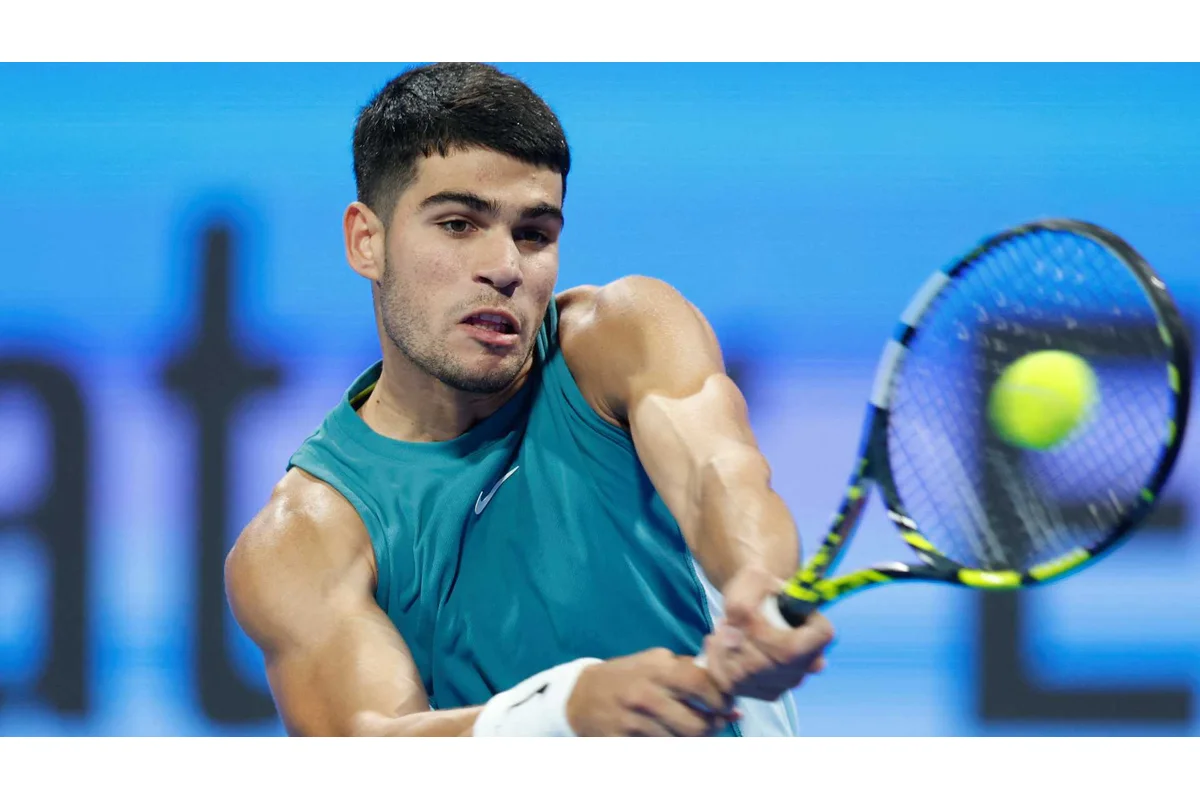
Carlos Alcaraz expressed strong frustration over the shot clock regulations after receiving a time violation during a tense match in London. The Spanish player, currently ranked world No. 1, clashed with chair umpire Marija Cicak during the ninth game of the opening set, condemning the enforced time limits as “absurd” after a physically demanding rally left him little time to prepare his next serve.
Details of the Disagreement with the Umpire
After winning a hard-fought point, Alcaraz moved to use his towel before serving, only to be penalized for exceeding the shot clock. During the confrontation, he questioned the umpire:
“So I’m not allowed to use the towel?”
Alcaraz’s frustration continued during the changeover, where Cicak explained the strict timing. She said,
“I stopped it when you were close there, but I had to start it again. I can’t let it stop constantly. I can’t invent more time.”
Despite this explanation, the seven-time Major champion remained upset, vehemently declaring,
“The rule is always s***. S***. It’s always the same. Always. Super unfair.”
Match Outcome and Alcaraz’s Continued Criticism
Despite losing the initial set to Karen Khachanov in a tiebreak 6-7(3), Alcaraz fought back to win the match 6-7(3), 6-4, 6-3. Following the contest, he reiterated his opposition to the shot clock rules during an interview with AS, describing the regulations as unrealistic. He said,
“Honestly, I think the time rule is absurd. After a very demanding point, finishing at the net, sprinting to my towel, I practically had no time left.”
He further criticized the timing, noting that although the umpire claimed to have paused the clock while he was on his towel, the countdown resumed before he could fully prepare. Alcaraz pointed out the crowd’s continued noise as an additional factor causing unacknowledged delays, making it difficult to comply with the strict 25-second recovery time.

Alcaraz Advocates for Greater Flexibility in Timing Rules
Looking at the clock when only three or four seconds remained, Alcaraz said he was caught off guard by the penalty.
“I looked at the clock… and I didn’t have enough time to serve, but she still gave me a warning. Personally, I think there should be a bit more leniency, even a reconsideration of the rule,”
he urged, emphasizing how tough matches regularly bring similar situations, which he feels are “ridiculous.”
The current rule implemented in 2024 begins the shot clock three seconds after the last point automatically, unlike previous years when umpires manually controlled the countdown. Alcaraz highlighted that many players share his dissatisfaction, as routines and speeds vary significantly between competitors.
Calls for the ATP to Reevaluate Shot Clock Enforcement
Alcaraz stressed the need for a balance between maintaining pace and allowing athletes adequate preparation time to deliver quality tennis.
“The ATP says it wants to attract more people, to broaden its audience. If they don’t allow us time to recover between points to offer the best possible level, everything goes too fast, and it’s difficult to engage the crowd,”
he stated. He suggested umpires should show more flexibility or extend the shot clock slightly, enabling players to prepare better and enhance the entertainment value.
Reflecting on previous instances, Alcaraz recalled his early objections to the automatic rule introduced in 2024. After losing to Jack Draper at London’s Queen’s Club, he voiced similar concerns:
“I finish the point at the net, and I had no time to ask for the balls. It is crazy. I have time just to ask for two balls and no bounces. I have never seen something like that in tennis.”
Impact and Future of Shot Clock Regulations in Professional Tennis
Alcaraz’s outspoken criticism underscores ongoing tension between enforcing faster game paces and ensuring players have sufficient time to recover and prepare. As one of tennis’s top players, his views carry weight and may prompt the ATP and tournament organizers to reconsider the strictness of shot clock rules. Allowing a moderate extension or more leniency could improve player performance and enhance audience engagement, striking a better balance between speed and spectacle in the sport.
