

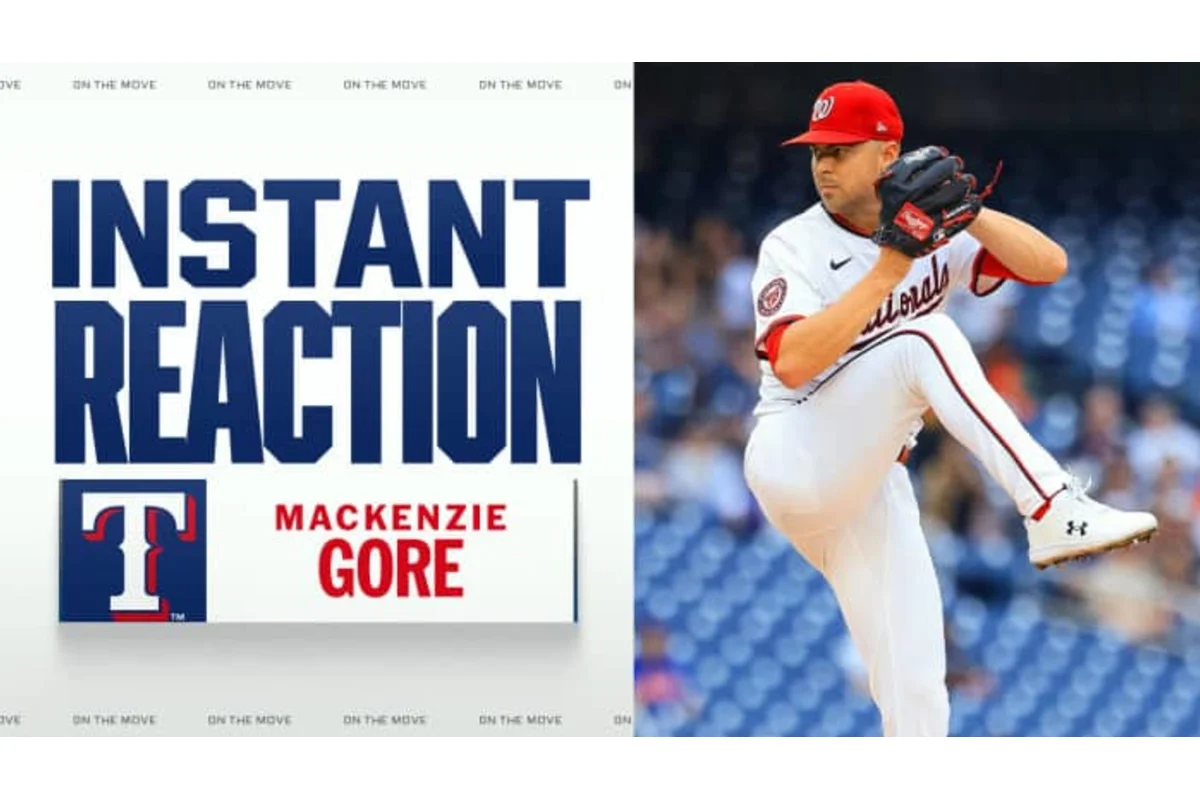
The Texas Rangers made a significant move this offseason by trading for left-handed All-Star pitcher MacKenzie Gore from the Washington Nationals, further strengthening their rotation. This trade, which involved sending five prospects to Washington, comes on the heels of a prior blockbuster move that exchanged Marcus Semien for Brandon Nimmo, signaling the Rangers’ intent to compete aggressively. The MacKenzie Gore Rangers trade could become a defining factor in their upcoming seasons as they seek to build on a potent mix of young talent and veteran experience.
Addressing the Rangers’ Starting Rotation Needs
Last season, the Rangers’ pitching rotation posted the best ERA in Major League Baseball, anchored by Jacob deGrom, Nathan Eovaldi, and promising young pitcher Jack Leiter. These three accounted for exactly half of the team’s starts, but filling the substantial gap left by departing free agents Patrick Corbin, Tyler Mahle, and Merrill Kelly remained a priority. With such heavy innings logged by their core starters, the Rangers needed additional depth to handle the long season and potential injuries.
Cody Bradford, recovering from an internal brace procedure last June, is progressing faster than expected and might rejoin the rotation by May. As a left-hander, he adds valuable depth when healthy. However, injuries to key pitchers like Bradford and Jon Gray, who both missed the entire 2025 season after spring training setbacks, underscore the necessity for the Rangers to stockpile quality arms in the rotation. This backdrop provides context for why acquiring Gore was critical to the team’s pitching strategy.
Wait a minute Rangers… Jacob deGrom MacKenzie Gore Nathan Eovaldi Jack Leiter Kumar Rocker Jacob Latz How many more rotations have a higher upside than this?— Peter Appel (@PeterAppel23) January 22, 2026
Reducing Pressure on Emerging Starters
Currently, Jacob Latz and Kumar Rocker are expected to compete for a spot in the rotation, with Latz appearing the frontrunner after a strong performance last season stretching across multiple pitching roles. Rocker, despite his high profile, faced challenges late last year, only pitching twice for Triple-A Round Rock after July 31. The reasons behind Rocker’s quiet absence in the latter part of the season remain unclear, whether physical, mechanical, or psychological issues were involved.
Adding Gore provides relief for both Rocker and Latz by lowering the stakes around filling rotation spots, allowing them to develop without overwhelming pressure. This addition also increases flexibility for the Rangers, who can afford to gradually integrate these pitchers as they adjust to major league competition.
Fitting the Team’s Need for a Strong Left-Handed Starter
The Rangers had a glaring shortage of left-handed starters last year, with only 38 starts logged by lefties. Patrick Corbin accounted for 30 of those before departing in free agency, while Jacob Latz contributed eight. Now, with Gore joining the rotation alongside a healthy Bradford and Latz, the Rangers can field a more balanced pitching staff leveraging left-handed and right-handed arms.
Historically, the presence of effective lefties like Andrew Heaney, Martín Pérez, and Jordan Montgomery on the Rangers’ roster contributed to their successful 2023 playoff run. Their strategy of pairing right-hander Eovaldi with lefty Montgomery proved effective down the stretch. The addition of Gore brings the potential to replicate and even surpass that effective dynamic.
Imagining the 2026 Rangers lineup featuring a powerful offense paired with a deep, healthy, and varied pitching staff—including Gore—is promising. Starting any series with a rotation featuring deGrom, Eovaldi, and Gore could present formidable challenges for opposing teams. Diversifying pitching looks will not only challenge hitters but also potentially boost the overall effectiveness of Texas’ right-handed starters.
Valuing Long-Term Control and Investment
While some critics might balk at the cost of five prospects sent to Washington, the nature of prospect development is inherently uncertain. Prospects, especially high school draftees like Gavin Fien—Texas’ first-round pick last summer—may require years before reaching the majors, with no guarantee they’ll ultimately succeed at the highest level.
General Manager Chris Young’s willingness to make bold moves by trading prospects reflects the Rangers’ commitment to fielding a competitive team now. As the window for stars like deGrom, Eovaldi, and Corey Seager begins to narrow, Texas is counting on players like Wyatt Langford, Josh Jung, and Evan Carter to contribute while focusing on contending immediately.
By securing Gore, the Rangers retained prized prospect Sebastian Walcott—ranked No. 13 overall by analyst Aram Leighton—preserving a cornerstone for the club’s future. Gore himself remains under team control for the next two seasons, a critical detail given the looming second-year benefits even if uncertainties like the potential 2027 lockout persist. This provides the Rangers with valuable stability in a key rotation slot.
The Potential for Gore’s Continued Development
Selected third overall in the 2017 draft out of high school, MacKenzie Gore has long been recognized as a top pitching talent. His involvement in the Juan Soto trade from San Diego to Washington underscored his value. Over the past two seasons, Gore ranked 15th in MLB with 366 strikeouts, demonstrating his ability to generate swings and misses—a rare skill set among elite pitchers.
MacKenzie Gore is one of just six pitchers under the age of 27 to record 6+ fWAR in the last two seasons.One of the best young arms in baseball is headed to Arlington! pic.twitter.com/wkowVSweoC— Just Baseball (@JustBB_Media) January 22, 2026
Despite his strikeout prowess, Gore has struggled with control issues, allowing walks, hits, and home runs, particularly in the latter half of last season. Globe Life Field’s pitcher-friendly environment should help mitigate the home run problem naturally. The true indicators for improvement will be Gore’s ability to reduce walks and improve command, aided by the veteran mentorship available in Texas.
Previously the ace of a rebuilding Nationals team with inconsistent offense and defense, Gore faced immense pressure as the staff leader. Joining a Rangers rotation with experienced aces like deGrom and Eovaldi will allow Gore to focus purely on pitching, sharing the burden of team success. Eovaldi, in particular, is known for his ability to mentor young pitchers and maximize their talent, as evidenced by his guidance of Jack Leiter last year.
Implications of the Trade for the Rangers’ Future
The aggressive approach taken by Chris Young and the Rangers front office signals a commitment to competing at a high level this season and beyond. While risk and potential missteps are inherent in any trade, the decision to acquire Gore provides substantiated pitching depth that should pay dividends. Strengthening the rotation on the left side addresses a critical roster imbalance and offers greater flexibility for bullpen management and minor league options.
Good pitching has historically been a hallmark of successful championship teams, such as the reigning World Series-winning Dodgers who deployed multiple starters in critical games to secure victory. Reinforcing an already strong rotation is a prudent method of safeguarding against injuries and sustaining competitive momentum.
For Rangers fans, the addition of MacKenzie Gore is a reason for cautious optimism. If health and development proceed favorably, the team’s rotation could serve as a foundation for deep postseason runs. The combination of Gore, deGrom, and Eovaldi promises exciting baseball in Arlington, where quality starting pitching is expected to be plentiful during the 2026 campaign.
Wait a minute Rangers…
Jacob deGrom
MacKenzie Gore
Nathan Eovaldi
Jack Leiter
Kumar Rocker
Jacob LatzHow many more rotations have a higher upside than this?
— Peter Appel (@PeterAppel23) January 22, 2026
MacKenzie Gore is one of just six pitchers under the age of 27 to record 6+ fWAR in the last two seasons.
One of the best young arms in baseball is headed to Arlington! pic.twitter.com/wkowVSweoC
— Just Baseball (@JustBB_Media) January 22, 2026
