
Taj Bradley became a prominent figure in the Minnesota Twins’ 2025 trade deadline as one of the most notable acquisitions. Previously a top 100 prospect, Bradley’s development stalled during his third season with the Tampa Bay Rays, leading to his trade to the Twins in exchange for Griffin Jax. His first half-season with Minnesota was marked by inconsistent results, finishing 2025 with a 5.05 ERA across a career-high 142⅔ innings, although his 4.37 xFIP indicated some misfortune behind the numbers.
Entering 2026, considerable debate surrounds Bradley’s optimal role, with speculation about converting him into a reliever. Despite this, data supports maintaining him as a starter, at least in the near future, distinguishing him from peers like Zebby Matthews whose role appears more flexible.
Detailed Look at Bradley’s Pitch Types and Effectiveness
Bradley’s pitching arsenal centers around four main pitches: a four-seam fastball, cutter, splitter, and curveball, with occasional use of a sinker or sinker-like four-seamers. His approach varies based on the batter’s handedness; in 2025, he favored fastballs, cutters, and curveballs against right-handed hitters, while relying more on fastballs, splitters, and curveballs against lefties. Notably, Baseball Savant identified that a significant portion of Bradley’s fastballs versus righties were classified as sinkers, implying he tweaks his grip to generate more horizontal movement against same-handed opponents.
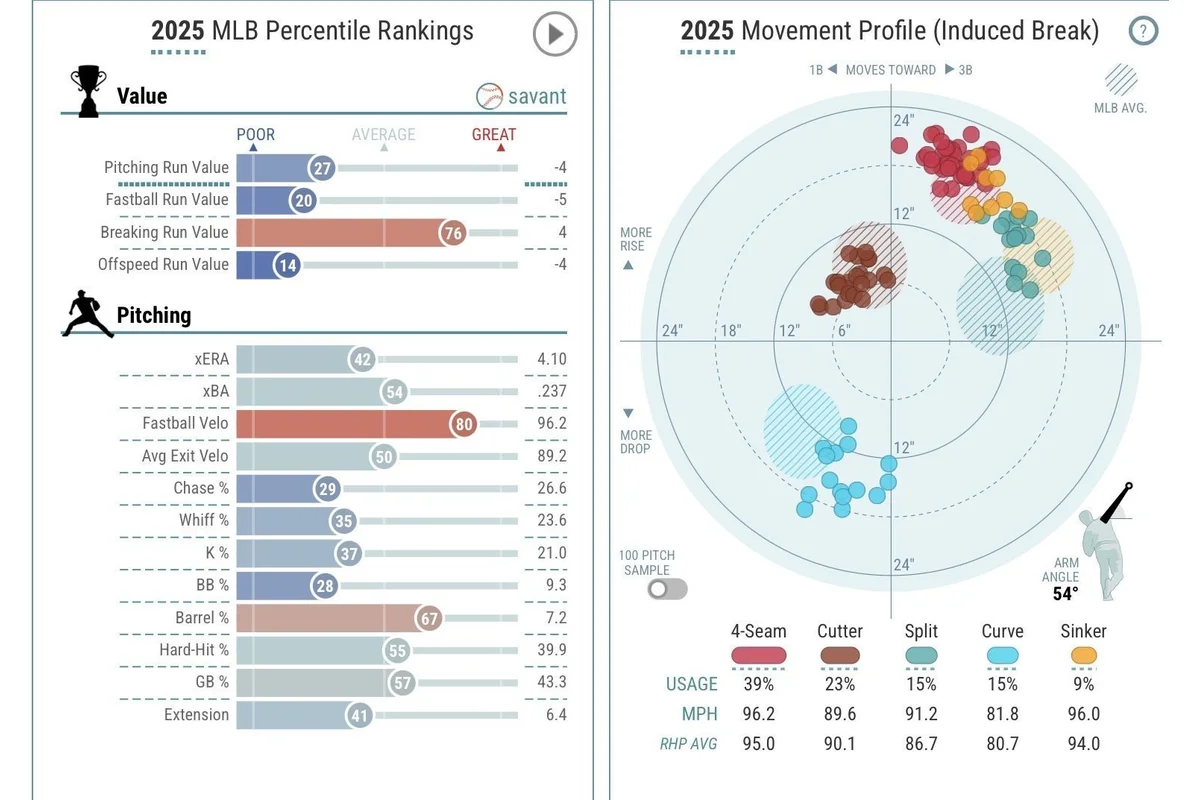
Statistically, Bradley’s four-seam fastball features a mid-90s velocity, occasionally touching near 100 mph, coupled with 18.5 inches of induced vertical break (IVB) and 6.2 inches of horizontal break. The sinker variant shares similar speed but offers 15.4 inches of vertical break and 10.5 inches of arm-side run. The four-seamer’s above-average vertical break should make it effective in the upper strike zone by creating a ‘rising’ illusion to deceive hitters.
However, paradoxically, Bradley’s fastball is his least effective pitch. Over nearly 3,000 fastballs thrown in 385⅓ major league innings, it has produced an .896 OPS against, ranking 371st out of 419 qualified pitchers since his 2023 debut, despite its frequent use. The sinker’s sample size is smaller but indicates somewhat better results with a .756 OPS across 192 pitches.
The rest of Bradley’s pitch portfolio, by contrast, performs significantly better. His cutter has yielded a .711 OPS over nearly 1,500 pitches, placing it solidly among effective pitches considering volume and OPS rankings. His splitter boasts a .597 OPS, while the curveball stands out as his most dominant offering with a remarkable .454 OPS, featuring exceptional vertical drop and velocity around 82 mph. This curve’s 55.8 inches of vertical break (with gravity) surpasses the league average by about four inches, making it one of baseball’s best.
Adjusting Bradley’s pitch mix, especially increasing curveball usage and possibly the cutter, could enhance his effectiveness. His cutter, though slower and less dynamic in movement, still outperforms his fastball in generating weak contact, suggesting it could serve as a more reliable option even at increased volume.
Projection of Bradley’s Role with the Twins in 2026
Bradley retains sufficient quality in his pitches to fulfill a starting pitcher role at the major league level. His cutter, splitter, and curveball have all been consistently at or above league-average effectiveness throughout his brief big-league tenure. A tactical shift toward relying less on four-seam fastballs and emphasizing more curveballs and cutters when facing right-handed hitters could address his difficulty against same-handed batters, where he has struggled with a .754 OPS and lower K-BB%, anomalies considering left-handers generally perform worse against righty starters.
Despite the potential, Bradley’s track record is a mixed one. His early promise as a high-strikeout starter has diminished, with strikeout rates falling from 28% in his rookie year to 21% in 2025, while his walk rates have risen to a concerning 9.3%. These trends depict a pitcher who needs to improve his ability to generate swings and misses and limit free passes to sustain a role as a starter.
It is possible that 2026 represents a critical juncture in Bradley’s career; unless he refines his command and pitch sequencing, his future as a traditional starter may be limited. The Twins and Bradley face a pivotal season that could determine whether he can fulfill the potential that made him a sought-after prospect or if alternative roles might better suit his skill set.
