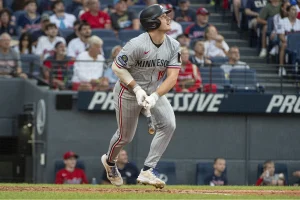
Minnesota Twins Overview
The Minnesota Twins are a professional baseball team based in Minneapolis, Minnesota. They compete in Major League Baseball as a member of the American League Central Division and play their home games at Target Field. The franchise has won three World Series titles, in 1924, 1987, and 1991, and has captured six American League pennants and thirteen division championships. The team’s official colors are red, navy blue, and white, and their mascot is T.C. Bear. The Pohlad family has owned the franchise since 1984, with Joe Pohlad serving as chairman.
The Twins are identified with the Twin Cities of Minneapolis and Saint Paul, and the team name reflects that regional connection. Their retired numbers include 3, 6, 7, 10, 14, 28, 29, 34, 36, 42, and a “W” honoring the Washington era. Dave St. Peter serves as president, Jeremy Zoll serves as general manager, and Derek Shelton is the current manager. The franchise traces its origins to 1894 and has been part of the American League since 1901.
Founding and Organizational Origins
The franchise was founded in Kansas City in 1894 as the minor league Kansas City Blues. In 1901, the club moved to Washington, D.C., to become one of the eight original teams of the American League. The team was first known as the Washington Senators from 1901 to 1904, then the Washington Nationals from 1905 to 1955, before returning to the Senators name from 1956 to 1960. Clark Griffith joined the team in 1912 and became its owner in 1920. Griffith family ownership lasted until 1984, when Carl Pohlad purchased the club and committed to keeping it in Minnesota.
During its Washington years, the franchise built its early identity around stars such as Walter Johnson, Bucky Harris, Goose Goslin, Sam Rice, Heinie Manush, and Joe Cronin. The team’s struggles during the 1950s, including long stretches near the bottom of the standings, became the inspiration for the musical and film “Damn Yankees.” After Clark Griffith’s death in 1955, his nephew Calvin Griffith led the organization and eventually negotiated a relocation to the Minneapolis–Saint Paul area.
Growth Into Major League Baseball Competition
The relocation to Minnesota was finalized in 1960, and the renamed Minnesota Twins began play in 1961 at Metropolitan Stadium in Bloomington. The team was named to honor the Twin Cities, and the original “TC” insignia was placed on the caps to represent both Minneapolis and Saint Paul. The early Minnesota roster carried over stars from Washington, including Harmon Killebrew and Bob Allison, and quickly added homegrown talents such as Tony Oliva and Zoilo Versalles.
By 1965, the Twins reached the World Series behind Mudcat Grant’s pitching, Versalles’s American League Most Valuable Player season, and Oliva’s batting title. Following that pennant, the team endured an eight-year stretch near the .500 mark before reasserting itself in the American League West during the late 1980s. The move to the Hubert H. Humphrey Metrodome in 1982, the sale to Carl Pohlad in 1984, and the arrival of stars such as Kirby Puckett, Kent Hrbek, and Frank Viola transformed the franchise into a perennial contender.
Minnesota Twins Competitive Journey
The Minnesota Twins have traced a long arc through Major League Baseball, from their origins in Washington to three World Series championships, multiple pennants, and a sustained presence in the postseason during the 2000s and 2010s. The franchise’s competitive journey has included championship highs, rebuilding periods, and renewed divisional success across multiple eras.
Early Seasons and Development (1961–1981)
The Twins opened at Metropolitan Stadium in 1961 and quickly developed a strong core that produced the 1965 American League pennant. Stars such as Rod Carew, Jim Kaat, and Jim Perry anchored the team during the late 1960s and 1970s. Carew won seven American League batting titles, including four in a row from 1972 to 1975, and captured the 1977 Most Valuable Player Award. The 1969 and 1970 teams won the American League West Division Championship but were swept by the Baltimore Orioles in the American League Championship Series.
After the 1970 season, the Twins entered a long stretch of middling results as free agency and financial pressures cost the team stars such as Carew, Lyman Bostock, and Larry Hisle. The franchise’s attendance dipped, and the club entered the 1980s in transition. Killebrew departed after the 1974 season, and the team’s identity began shifting toward a younger generation of players who would soon lead the franchise back to prominence.
Breakthrough in the American League (1982–1991)
The 1982 move to the Hubert H. Humphrey Metrodome ushered in a new era. After a difficult start that year, the Twins built toward contention behind young players such as Kent Hrbek, Gary Gaetti, and Kirby Puckett. In 1984, Carl Pohlad purchased the team from the Griffith family. The Twins captured the 1987 World Series under Tom Kelly, defeating the St. Louis Cardinals. Frank Viola earned the 1988 American League Cy Young Award, and the 1988 Twins became the first American League team to draw more than three million fans.
The 1991 World Series against the Atlanta Braves is widely regarded as one of the greatest in baseball history. Four games were won in the final at-bat, and three went into extra innings. Jack Morris pitched ten shutout innings in Game 7 before Gene Larkin delivered the walk-off single that secured the championship. Kirby Puckett’s extraordinary performance in Game 6, capped by his eleventh-inning home run, remains one of the iconic moments in Major League Baseball history.
Modern Program and Current Direction (1994–Present)
Following the 1994 realignment, the Twins moved to the American League Central Division and dominated the new division during the 2000s, capturing titles in 2002, 2003, 2004, 2006, 2009, and 2010. Joe Mauer won three American League batting titles and the 2009 Most Valuable Player Award, while Justin Morneau captured the 2006 Most Valuable Player Award and Johan Santana won two Cy Young Awards. The team moved into Target Field in 2010, ending its years in the Metrodome and securing a long-term commitment to Minnesota.
After a downturn that included 103 losses in 2016, the Twins rebounded to claim the 2017 American League Wild Card and ended the longest postseason losing streak in North American sports history with their 2023 playoff series win. In 2019, the team set a Major League record with 307 home runs and earned the “Bomba Squad” nickname. The Pohlad family announced in 2025 that it would retain majority control of the franchise while bringing in limited partnership groups to strengthen the organization’s financial base.
Philosophy and Competitive Strengths
The Twins are known for an organizational emphasis on player development, fundamentals, and a balanced approach to offense and pitching. Recent playoff success has been driven by dominant starting pitching, while the 2019 squad demonstrated overwhelming power. The franchise has historically placed value on clubhouse chemistry and continuity, which helped define its championship teams in 1987 and 1991.
Key Milestones and Major Moments
Major milestones include the 1924 World Series title as the Washington Senators, the 1965 American League pennant, the 1987 and 1991 World Series championships, the 1990 game in which the Twins turned two triple plays, the 2019 Major League record for home runs, and the 2023 win that ended an eighteen-game postseason losing streak. The franchise also marked the retirement of Joe Mauer in 2018 after a fifteen-year career spent entirely with the Twins.
Minnesota Twins Achievements and Results
The Minnesota Twins have built a verified record of success that includes three World Series championships, six American League pennants, and thirteen division titles. Their achievements span the Washington era, the early Minnesota years, the late-1980s dynasty, and the sustained competitiveness of the 2000s and 2010s.
American League Achievements
The franchise has won six American League pennants, beginning with the 1924 championship won as the Washington Senators. The Senators repeated as league champions in 1925 and again in 1933, but lost the World Series in both of those subsequent appearances. In Minnesota, the Twins won the 1965 pennant behind Versalles’s Most Valuable Player season before falling to the Los Angeles Dodgers in seven games. The Twins returned to the World Series in 1987 and 1991, winning both championships.
Conference Achievements
Six American League pennants reflect the franchise’s overall conference-level success, with championships in 1924, 1925, 1933, 1965, 1987, and 1991. The 1925 and 1933 pennants both ended in World Series defeats, while the 1965 pennant produced a seven-game loss to Los Angeles. The franchise’s conference championship pedigree has been a defining feature of its identity across eras.
Divisional Achievements
The Twins have won thirteen division championships, including four American League West titles in 1969, 1970, 1987, and 1991, and nine American League Central titles in 2002, 2003, 2004, 2006, 2009, 2010, 2019, 2020, and 2023. The team also earned an American League Wild Card berth in 2017. The Central Division titles in the 2000s established the Twins as the defining team of their division during that era.
Series Achievements
The Twins’ World Series titles in 1924, 1987, and 1991 are the cornerstone achievements of the franchise. The 1987 and 1991 championships were both won under manager Tom Kelly and featured memorable performances from stars such as Kirby Puckett, Kent Hrbek, Jack Morris, and Frank Viola. The 1991 championship in particular is remembered as one of the most dramatic Fall Classics ever played.