
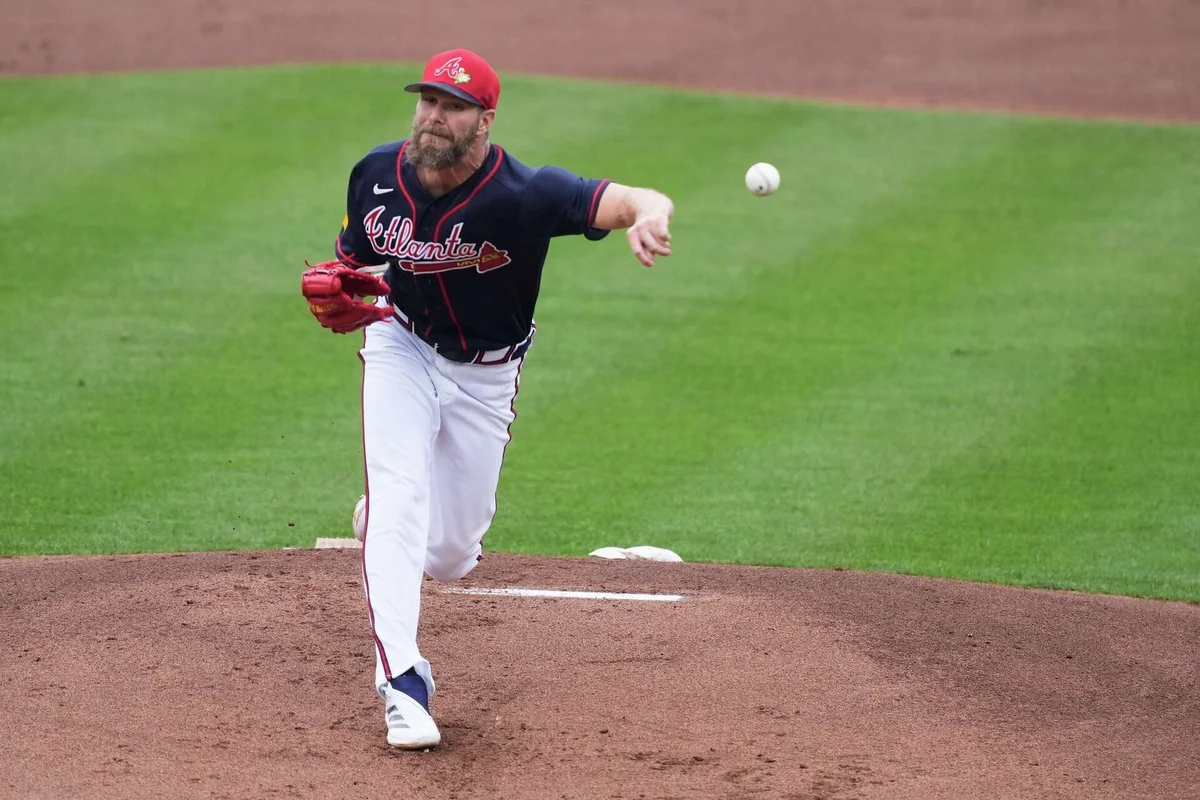
The Atlanta Braves have agreed to a one-year contract extension with their ace left-hander, Chris Sale, for the 2027 season, valued at $27 million. The deal, announced Tuesday, also includes a $30 million club option for 2028. Sale is currently owed $18 million for 2026, the final year of the extension he signed earlier this year. This agreement comes amid concerns over the Braves’ starting pitching depth and payroll management. Sale’s ongoing role is pivotal as Atlanta faces challenges with injured pitchers and roster planning.
Sale expressed surprise at how quickly the deal was completed, stating,
“We just kind of looked at each other like, ‘Are we serious?’”
and added,
“And I called (my agent) and was like ‘Hey, call (POBO Alex Anthopoulos), figure something out.’ You know, we made our pitch, they made their pitch, and we just kind of met in the middle. I feel like this was done in like a week.”
?Chris Sale, Pitcher
Sale’s revival and recent performance with the Braves
Now 36, Chris Sale is entering his third season with Atlanta following a trade from the Boston Red Sox that has clearly favored the Braves. Last year, Sale secured the 2024 National League Cy Young Award after pitching 125⅔ innings with a 2.58 ERA and striking out 165 batters, despite recovering from a rib cage fracture. His 3.9 WAR ranking him 20th among all pitchers underscores his elite impact despite his relatively low innings pitched, which ranked 100th.
The timing of Sale’s extension is critical given Atlanta’s current pitching challenges. Two promising arms, Spencer Schwellenbach and Hurston Waldrep, recently underwent elbow surgeries to remove loose bodies, sidelining them for months, with Schwellenbach already on the 60-day injured list and Waldrep expected to follow. This leaves the Braves’ rotation reliant on Sale alongside Bryce Elder, Grant Holmes, Reynaldo López, and Spencer Strider as the projected starters for Opening Day.
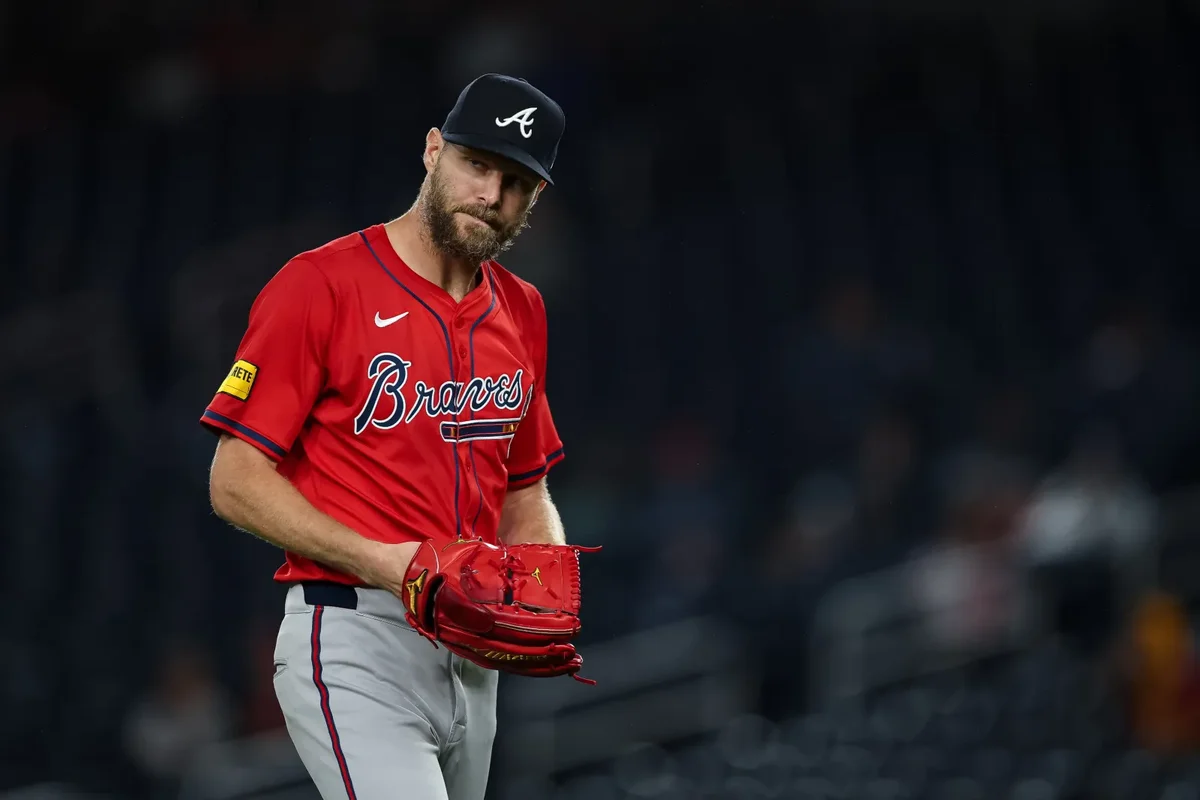
However, there is risk involved. López is returning from shoulder surgery, Holmes is recovering from a partially torn UCL, and Strider struggled with injuries and inconsistency last season. The combination of upside and uncertainty creates a delicate balance for the Braves’ pitching staff in 2027.
Challenges and options in strengthening the pitching staff
As spring training progresses, the Braves face limited options to bolster their rotation. Trade activity for starting pitchers is typically scarce in this period, and Atlanta’s payroll constraints may prevent them from signing available free agents such as Lucas Giolito or Zack Littell. Instead, the team plans to rely on Carlos Carrasco and Martín Pérez for depth, maintaining as much stability as possible behind their core starters.
Sale’s journey back to elite form
Chris Sale’s career experienced significant setbacks with injuries, including Tommy John surgery and shoulder issues, which restricted him to only 56 starts and 298⅓ innings between 2020 and 2023 with the Red Sox, posting a 4.16 ERA during that time. Many had doubted whether Sale could return to his prior ace status. Boston even covered $17 million of the $27.5 million owed to him to facilitate the trade to Atlanta.
Sale’s rejuvenation with the Braves is largely attributed to regained health. Aside from the rib cage injury, his arm has been in excellent condition, with his pitching velocity actually increasing in his mid-thirties—a rare feat among veteran pitchers. The Braves have also encouraged Sale to increase reliance on his signature slider, which he has thrown over 43% of the time in the last two years compared to 36% previously. This blend of improved velocity and pitch selection has been central to his career revival.
Sale emphasized his satisfaction with his current team environment, saying,
“These guys obviously gave me a shot and kind of picked me up from off the ground after I exited 2023 limping into the offseason. Everyone’s been great to me here, and I have really enjoyed being here.”
?Chris Sale, Pitcher
Evaluating Sale’s Hall of Fame prospects
While Chris Sale may not reach traditional Hall of Fame pitching milestones such as 300 wins, evolving standards for elite pitchers provide a promising outlook. For context, Félix Hernández retired with 169 wins, a 3.42 ERA, and 2,524 strikeouts and has gained increasing support on the Baseball Writers’ Association of America Hall of Fame ballot, rising from 20.6% to 46.1% in his first two years of eligibility.
Sale’s career totals going into 2026 stand at 145 wins, a 3.01 ERA, and 2,579 strikeouts, placing him tenth all-time among left-handed pitchers in strikeouts, including Hall of Famers like Randy Johnson, Steve Carlton, and Tom Glavine. He also ranks favorably alongside notable contemporaries such as Max Scherzer and living lefties with potential Hall of Fame candidacy.
Notably, Sale’s 30.7% strikeout rate—the highest in baseball history for pitchers with at least 2,000 innings—demonstrates exceptional dominance, outperforming even Max Scherzer. He maintains a career batting average against of .218, tied for eighth best all-time, indicating his effectiveness on a per-inning basis.
Sale’s continued health will be the determining factor in his ascent on strikeout leaderboards, potentially entering the 3,000-strikeout club by the end of 2027 and elevating his Hall of Fame profile considerably in an era where strikeouts carry significant weight in ballot decisions.
Implications of Sale’s extension on Braves payroll
Several of Atlanta’s key players have recently reached new contract stages, where salaries reflect their growing value. Stars like Ronald Acuña Jr. will earn $17 million in 2026, Spencer Strider pulls in $20 million this season, and Matt Olson and Austin Riley are set to make $22 million each. The team’s formerly inexpensive core players have become more costly, but still offer value relative to the free-agent market.
Despite Sale’s substantial contract, the Braves maintain reasonable payroll flexibility. According to Cot’s Baseball Contracts, Atlanta’s projected payrolls are as follows:
2023: $201.5M (cash), $248.8M (commitments)
2024: $234.0M (cash), $276.1M (commitments)
2025: $220.3M (cash), $234.8M (commitments)
2026 (projected): $262.0M (cash), $259.5M (commitments)
2027 (projected): $199.3M (cash), $187.5M (commitments)
The 2026 payroll sits just below the $264 million threshold that triggers MLB’s second Competitive Balance Tax penalty, which may explain Atlanta’s hesitancy to pursue premium free agents Griffin Giolito or Zack Littell, given their cost. The team expects to clear salary by losing Ha-Seong Kim, Raisel Iglesias, Aaron Bummer, and Joe Jiménez after the 2026 season, with Iglesias’ replacement Robert Suarez already on the roster.
Looking ahead to 2027, the Braves’ actual cash payroll is expected to drop significantly, by more than $60 million compared to 2026 projections. This forecast includes club options for Acuña and Ozzie Albies but excludes arbitration raises, which are expected to be minimal due to injury concerns for key pitchers like Schwellenbach.
While uncertainties such as a potential MLB lockout could reshape spending rules—including the possible introduction of a salary cap or harsher tax penalties—the Braves appear positioned to maintain financial flexibility. This gives them capacity to manage their roster needs efficiently, particularly after committing to Sale’s $27 million extension.
Ultimately, Sale’s extension solidifies the Braves’ commitment to sustaining a competitive rotation despite injury risks and opens avenues for strategic roster moves. How the club uses this payroll space in the coming offseason will be critical to their success as they balance a talented but fragile pitching staff.
Chris Sale on his contract extension pic.twitter.com/eIFhe37anP
— Chad Bishop (@MrChadBishop) February 24, 2026
