
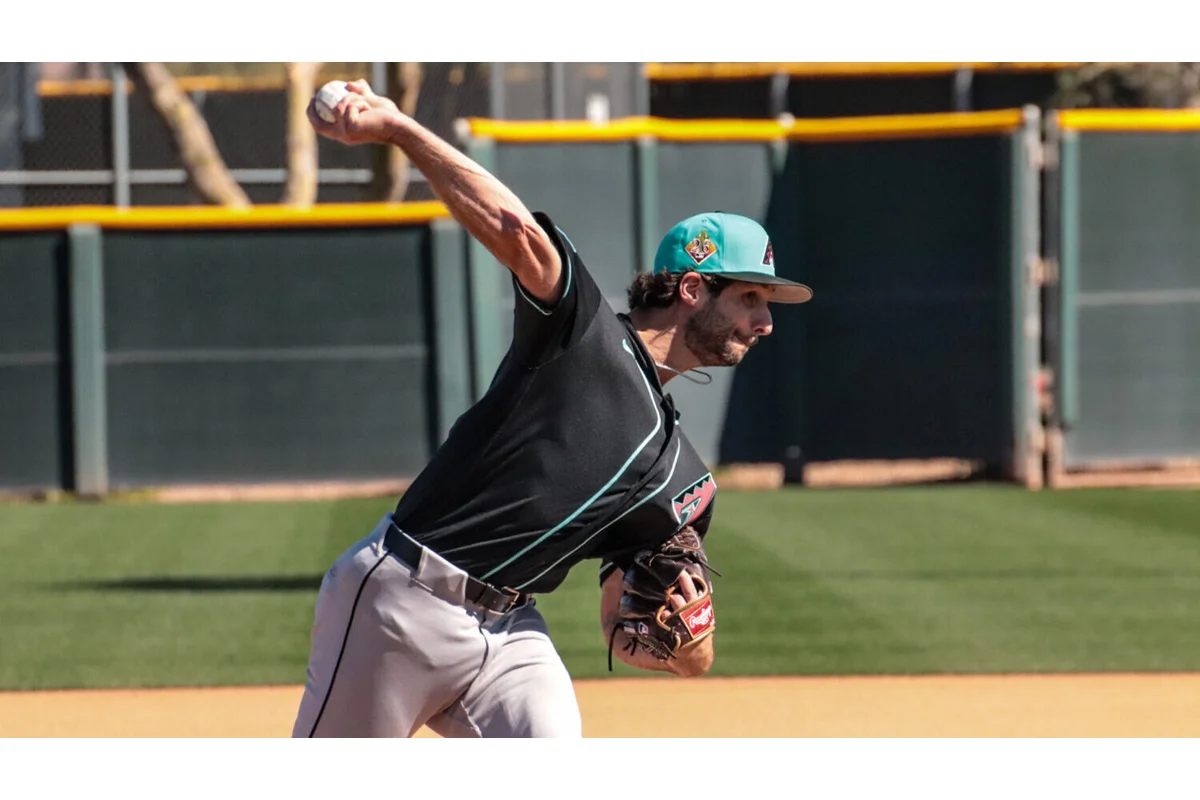
The Colorado Rockies acquired Jake McCarthy in a trade following a disappointing season, fueling skepticism about his ability to regain his earlier potential. Despite the franchise’s recent efforts to improve under Paul DePodesta, doubts remain whether McCarthy can bounce back from his downturn and provide meaningful offensive value. The primary focus lies on adjusting Jake McCarthy’s hitting approach to restore his productivity and fit Colorado’s lineup needs.
Analyzing McCarthy’s Past Success and Recent Decline
McCarthy had promising seasons in 2022 and 2024, hitting at batting averages of .283 and .285 respectively, and compiling respectable wRC+ marks of 116 and 110. His overall contributions resulted in 2.2 and 3.0 WAR during those years. His performance was heavily supported by an above-average BABIP, attributing to his status as a left-handed groundball hitter with elite speed on the bases. However, in 2025, that BABIP plummeted to .233 over 222 plate appearances, placing him near the bottom of qualified hitters league-wide. The significant decline was partially due to bad luck but also reflected underlying issues in his approach, as evidenced by his underperformance relative to expected batting average (xBA) and expected weighted on-base average (xwOBA).
What Went Wrong for McCarthy in 2025?
McCarthy’s struggles extended beyond misfortune on batted balls. His plate discipline suffered: he chased more pitches outside the strike zone, made less contact on pitches inside it, and swung harder, all while reducing walks and increasing strikeouts. Additionally, he shifted toward producing more groundballs and fewer line drives, which limited his offensive impact. His attempt to adopt a power-focused swing, despite a history of limited home run output, culminated in poorer results. In 2025, McCarthy doubled his barrel rate and achieved an exit velocity surpassing 110 mph for the first time but failed to translate that into consistent offensive damage.
Contrasting McCarthy’s Profile With Successful Contact Hitters
Although McCarthy is a physically solid athlete at 6-foot-1 and 215 pounds, power hitting has never been his strength, as shown by an isolated power (ISO) of just .115 in his more productive 2024 season. Instead, his best asset has been making frequent contact on pitches in the strike zone. In 2024, McCarthy achieved a 94.0% Z-Contact% rate, ranking among the top 10 hitters in baseball while remaining in the bottom five percent for HardHit%, a profile shared by players like Steven Kwan, Ernie Clement, and Sal Frelick. However, McCarthy has struggled with the quality and location of his contact, often pulling weak groundballs into defensive shifts, which hindered his offensive value.
Adjusting Swing Mechanics to Maximize Contact and Speed
In 2025, the ratio of McCarthy’s pull-side groundballs to opposite-field hits worsened to more than five-to-one, exacerbating his offensive difficulties. Yet, he also increased weak contact and reduced air balls to the pull side, contradicting his efforts to hit harder. The logical adjustment for 2026 is clear: McCarthy needs to abandon his pursuit of power hitting and concentrate on putting the ball in play with precision, leveraging his speed to create offensive opportunities.
The Offensive Environment at Coors Field and Its Implications
Playing in Coors Field, the most hitter-friendly stadium in Major League Baseball, McCarthy could thrive with an approach centered around contact hitting. Coors Field ranks first in singles and second in doubles and triples but only sixth in home runs, which supports a style emphasizing ground and line drives combined with aggressive base running. Historically, the Rockies have excelled with speedy center fielders who provide value through contact and baserunning rather than power, as evidenced by players like Ellis Burks, Larry Walker, and Juan Pierre during various eras.
Lessons From the Rockies’ Past Center Fielders
Past center fielders with exceptional speed and limited power—Tom Goodwin, Juan Pierre, Willy Taveras, and Dexter Fowler—offer a frame of reference for McCarthy’s potential role. Although not all were elite hitters, their speed and contact ability contributed to the Rockies’ offensive production. McCarthy’s athletic profile and baserunning acumen suggest he could similarly fulfill this archetype, especially if he improves his plate discipline and contact placement.
Defensive Alignment and Projected Role for 2026
With Brenton Doyle projected to hold down center field, McCarthy could shift to a corner outfield spot, where his defensive skills should shine. A return to a contact-oriented approach complemented by roughly thirty stolen bases would make McCarthy a valuable contributor and potentially an All-Star candidate on the current roster. This adjusted approach would better align with his strengths and take advantage of the Rockies’ offensive environment.
“In 2024, McCarthy posted a 94.0% Z-Contact%, which was among the 10 best in baseball. His HardHit% was in the bottom five percent of the league. Other guys who were in the bottom 10% for HardHit% but the top 10% for Z-Contact% that year: Steven Kwan, Ernie Clement, and Sal Frelick.” ?Analyst, Baseball Writer
“McCarthy, whom you’d usually expect to be a high-BABIP guy for the reasons I mentioned, posted just a .233 BABIP in 222 plate appearances last year. Out of 348 hitters with 200 or more plate appearances, he was 333rd.” ?Analyst, Baseball Writer
“Maybe that approach is the most effective way for a generic major league hitter to go about his business. You don’t even have to leave the 2025 Diamondbacks clubhouse to find a guy who turned into a superstar by doing what McCarthy tried to do. But it doesn’t suit McCarthy.” ?Analyst, Baseball Writer
