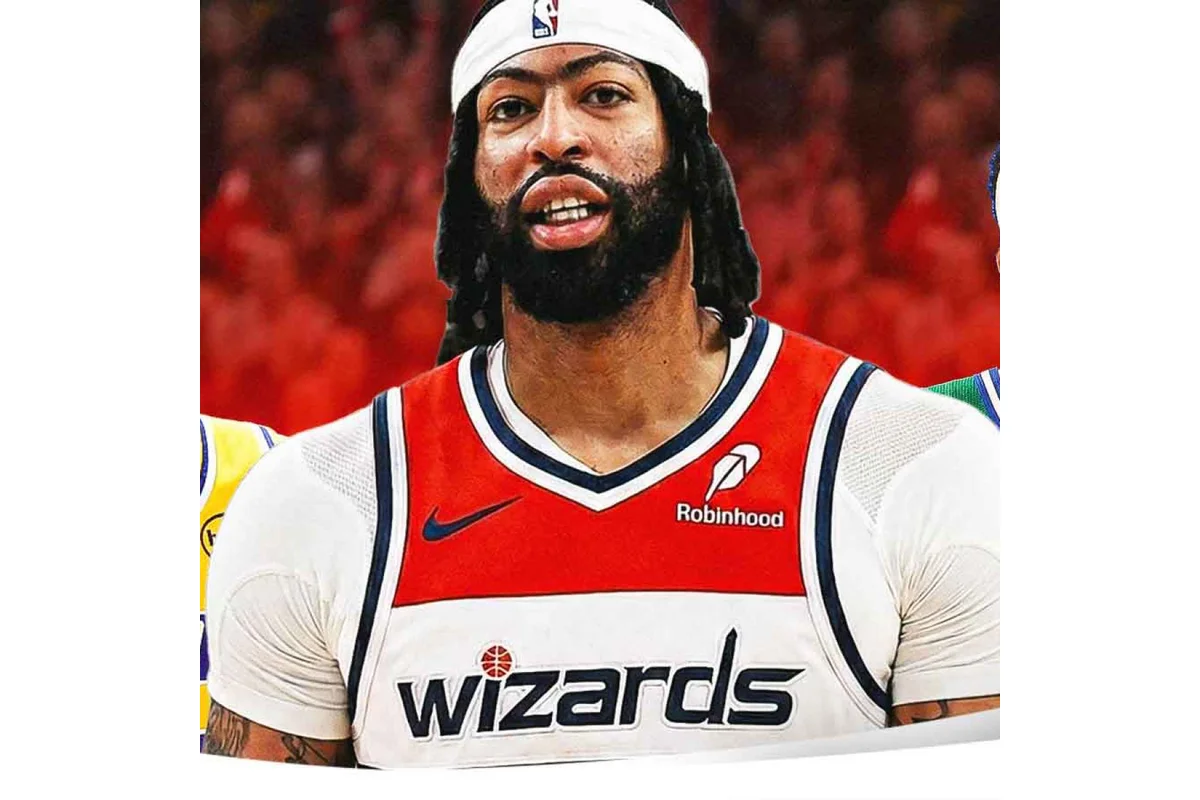
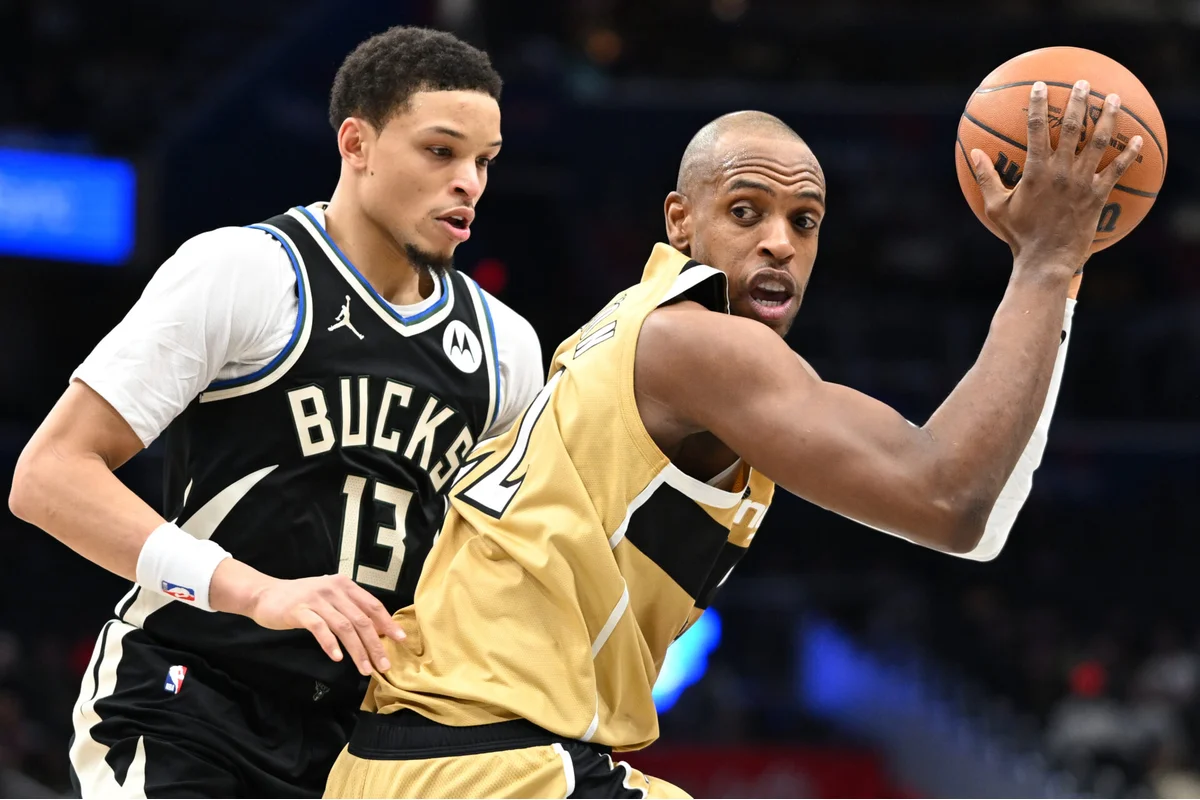
Anthony Davis joins Wizards in stunning eight-player blockbuster trade. [Image Source: CLUTCHPOINTS]
The Washington Wizards dramatically altered their roster by securing 10-time NBA All-Star Anthony Davis from the Dallas Mavericks in a significant eight-player trade. The deal, finalized in 2026, also includes the Wizards receiving Jaden Hardy, D’Angelo Russell, and Dante Exum, while Dallas obtains Khris Middleton, AJ Johnson, Malaki Branham, Marvin Bagley III, two first-round draft picks, and three second-round selections. This move immediately put the Wizards at the center of NBA trade discussions, marking a clear bid to accelerate their competitiveness.
Unexpected Moves Stir Reactions Across NBA Circles
The trade took many NBA experts and fans by surprise due to its unanticipated nature and the Wizards’ aggressive approach. Ricky O’Donnell from SB Nation remarked,
“No one anticipated the Washington Wizards would be a suitor for his services… The Mavs and Wizards are each picking a lane with this deal. It’s probably the most surprising trade of the deadline so far, partly because it didn’t leak at all.”
O’Donnell graded Washington’s move with a B, while rating Dallas with a B+.
Dan Favale of Bleacher Report highlighted the unexpected boldness of the Wizards, noting that Washington’s front-office had already shaken things up earlier by acquiring Trae Young in the same season. Favale assigned the Mavericks a D- and awarded the Wizards a B+, underlining how rare it is to see the Wizards make such a franchise-altering trade.
Wizards’ Strategy Centers on Immediate Competitiveness
Washington’s decision to pursue Davis aligns with a clear shift in direction toward contending sooner rather than later. Luke Adams from Hoops Rumors observed,
Image of: Anthony Davis
“While Washington is an unlikely landing spot for a veteran star like Davis, the 13-36 Wizards are clearly pivoting toward being competitive next season… As they did with Young, the Wizards are buying low on Davis amid an injury-plagued season in which he has dealt with several separate health issues and has been limited to 20 appearances.”
Tim MacMahon of ESPN shared insights into the Wizards’ motivations:
“Wizards’ thought process on AD trade: With intent to be competitive next season, Washington added a 10-time All-Star big to pair with Trae Young without giving up homegrown young talent or premium picks.”
Further elaborating on the frontcourt strategy, Jake Fischer of The Stein Line noted the team’s belief in Alex Sarr as a highly versatile power forward. According to Fischer, Washington explored alternatives involving Domantas Sabonis and Walker Kessler before ultimately deciding on Davis. This frontcourt pairing is a crucial component of their plans moving forward.
O’Donnell also pointed out the relative value of the draft picks given up in the trade, stating,
“It’s a really bold play for the Wizards, but the picks they gave up aren’t that valuable.”
He added,
“With the East wide open, the Wizards can legitimately go from worst to a contender if everything falls into place. The biggest piece of the puzzle will be Washington’s 2026 lottery pick. If the Wizards can land either Cameron Boozer or Darryn Peterson, suddenly this thing can go to the moon.”
Questions Loom Over Anthony Davis’ Health and Durability
Despite the excitement surrounding the trade, major concerns remain about Davis’ fitness and injury history. Liam Griffin of The Washington Times highlighted that the 32-year-old has recently been out with a hand injury and is expected to miss at least another three weeks before further assessment. Griffin also pointed out,
“A five-time All-Defense selection, Davis played just nine games for Dallas last season after a shocking midseason trade sent him from the Los Angeles Lakers in exchange for superstar Luka Doncic.”
Griffin further documented Davis’ difficulty maintaining consecutive games, noting he never played more than five games in a row during his time with Dallas. ESPN analyst Kevin Pelton expressed skepticism about Davis’ current impact calling him
“an unreliable contributor with one of the NBA’s seven largest salaries.”
Pelton wrote,
“Instead of viewing him as the two-way force he was at best, teams surely now see Davis as an unreliable contributor with one of the NBA’s seven largest salaries.”
He added,
“It’s unlikely any team would have valued Davis as much as Dallas evidently did a year ago, and the series of injuries he’s dealt with since — including a hand sprain that has sidelined him for the last month — has only decreased his appeal.”
ESPN’s Bobby Marks provided financial context regarding Davis’ contract, noting that the player is eligible for a four-year, $275 million extension starting August 6, with the final year paying $76.1 million when Davis will be 37. Marks stressed that this level of commitment is significant for a player who,
“for the fifth time in six seasons, is projected to play fewer than 60 games.”
Criticism and Doubts About the Trade’s Long-Term Impact
Several analysts voiced unease about Washington’s gamble on an aging star with a persistent injury history. Sam Quinn of CBS Sports gave Washington a D+ rating, suggesting that while the Trae Young–Anthony Davis duo has potential, the team’s health risks and roster readiness raise doubts about sustained contention. Quinn described the Mavericks’ return as
“about as fake as any ever traded for a player as notable as Davis,”
labeling Dallas’ move as
“a cap dump dressed up as a blockbuster.”
Sam Allred of Soaring Down South questioned the wisdom of the Wizards’ move, writing:
“Washington… what were you thinking?”
He further described the team as
“ostensibly all-in on their star core of Young, Davis, and Alex Sarr. … What frankly, most NBA fans know is that this experiment is doomed to fail. Or, at least be limited to mediocre results.”
Allred acknowledged the talent pairing by stating it
“would be a dream core… if it were 2020.”
Stephen Noh from The Sporting News provided a contrasting view, arguing the Wizards missed a chance to build through the draft and called the Davis acquisition a misstep. He assigned Washington a C- grade and remarked,
“They could have spent their cap space more wisely, continuing to accrue draft picks for bad contracts until they find a superstar worth building around.”
Noh gave Dallas a C+, citing the trade as a necessary financial reset.
Eric Smithling of Yardbarker expressed skepticism regarding the Wizards’ path to growth, stating,
“Adding Davis is unlikely to elevate Washington to much more than a fringe playoff team, making this a curious move for a team in a position to organically grow around a young core.”
He warned that if the Wizards believe this trade moves them closer to relevancy despite Davis’ injury history, they risk significant disappointment.
Reflections on the Mavericks’ Decline Since Luka-AD Trade
The trade also signals a full rebuild for the Dallas Mavericks, whose initial acquisition of Davis in exchange for Luka Doncic failed to deliver expected success. Jeremy Brener of SI.com commented,
“The Dallas Mavericks are officially waving the white flag after trading Anthony Davis to the Washington Wizards in an eight-player deal just over a year after acquiring him in exchange for Luka Doncic. … The Mavericks have floundered since the trade, missing the playoffs in 2025 and struggling to get back there in 2026. Trading Davis is a sign that the team is officially in a rebuild.”
Brener concluded by noting the importance of rookie Cooper Flagg as the team’s hopeful franchise cornerstone.
Svyatoslav Rovenchuk from Lakeshow Life described Davis’ current status as a sharp fall from grace:
“It feels surreal just how far the former Lakers star has fallen, in terms of basketball situation, in such a short time. Davis is still in search of the light at the end of the tunnel following the seismic Luka Doncic trade.”
Dallas Gains Financial Flexibility with Payroll Reduction
This trade eases the Mavericks’ salary cap burden substantially. Tim McMahon of ESPN, drawing on Bobby Marks’ analysis, stated that the Mavericks dropped below the luxury tax threshold, cutting guaranteed payroll to roughly $150 million for the next season. In a post on X, McMahon added that Dallas sheds approximately $70 million in salary, representing a massive financial reset.
Luke Adams of Hoops Rumors highlighted the short-term savings from the trade, noting Washington’s capacity to absorb Davis’ salary given their tax room. Salary cap expert Yossi Gozlan commented on X that Dallas was operating close to the “second tax apron” but will now move entirely out of tax territory, saving around $57 million.
Trade’s Role in Broader Franchise Visions and Future Prospects
Liam Griffin of The Washington Times underscored that the Wizards maintained control over their most valuable draft picks in the deal, consistent with general manager Will Dawkins’ patient plan. Dawkins has emphasized the necessity of dismantling a previously underperforming roster before building toward a contender.
Schuyler Dixon of The Associated Press highlighted Dallas’ focus on Cooper Flagg as the franchise’s future following the deal. Dixon noted the rookie’s outstanding recent performances, including an NBA scoring record for a teenager and consecutive 30-point games, underpinning the Mavericks’ rebuild efforts.
Ricky O’Donnell of SB Nation summarized the Wizards’ transformation:
“The Wizards have been tanking by design since trading Bradley Beal in the summer of 2023. Washington has collected some nice young players in Alex Sarr, Tre Johnson, Kyshawn George, and Bilal Coulibaly, but they didn’t have a star to stir the drink. Now Washington has two potential veteran stars in Trae Young and Anthony Davis who complement each other well on both ends of the floor.”
Wizards’ thought process on AD trade: With intent to be competitive next season, Washington added a 10-time All-Star big to pair with Trae Young without giving up homegrown young talent or premium picks. https://t.co/3nRVpwpBd7