
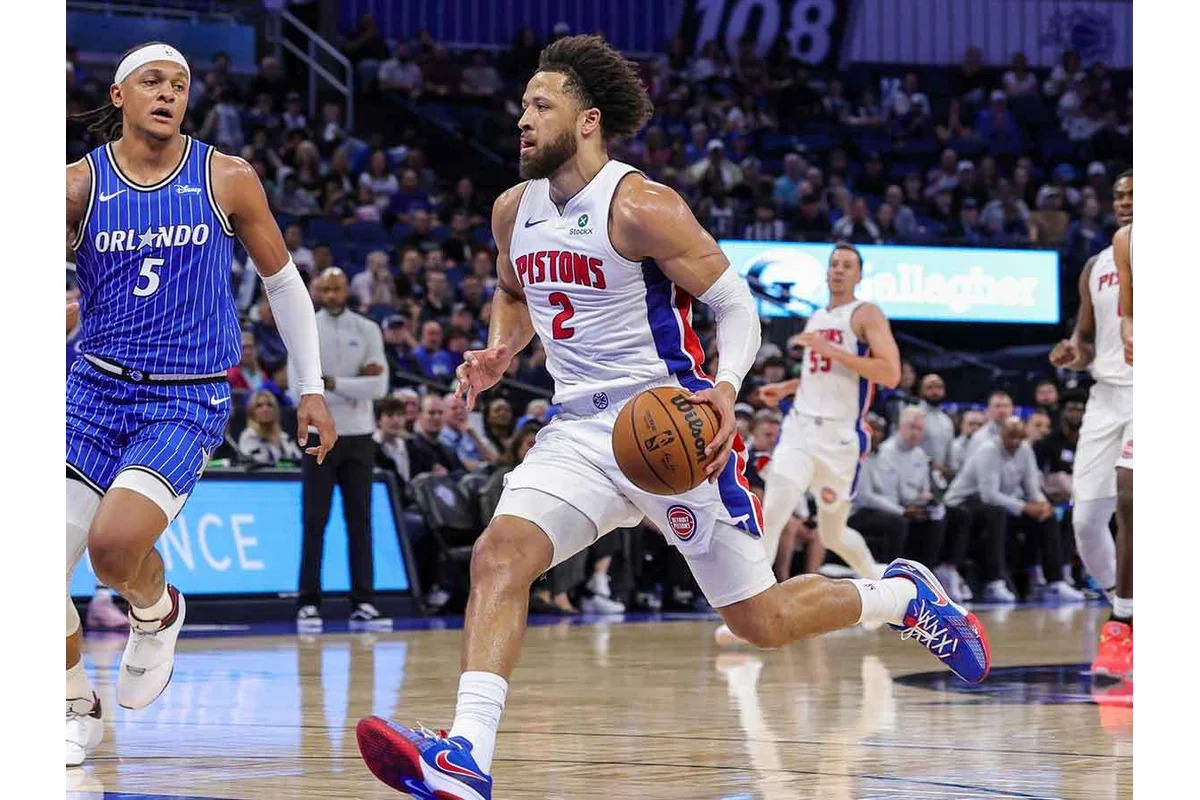
In the battle for the title of the league’s top lead guard, Cade Cunningham’s playmaking impact is being compared intensely with Shai Gilgeous-Alexander’s elite scoring. Both stars are powering their teams at the peak of the season, excelling in different ways: Shai dominates with smooth, high-volume scoring, while Cunningham excels as an on-ball facilitator who drives offense through smart decision-making. This dynamic duo leads the NBA standings as the Detroit Pistons and Oklahoma City Thunder hold prominent positions in their conferences.
Comparing Scoring Efficiency and Volume
Shai Gilgeous-Alexander averages an impressive 31.8 points per game, earning 2 points in the scoring category by virtue of both volume and precision. His shooting splits—55.1% from the field, 38.1% from beyond the arc, and 89.2% from the free-throw line—are exceptional for a guard shouldering such responsibility. He consistently finds high-percentage shots near the rim and nail area, combining speed of play with decisive finishes, even when fouled.
On the other hand, Cade Cunningham scores 25.5 points per game, slightly lower but still significant, earning 1 point in the scoring metric. His field goal percentage settles at 46.0%, with a three-point success rate of 33.2%. Cunningham often takes tough, late-clock shots when offensive sets stall, highlighting his role in clutch moments. While his scoring is not as clean or efficient as Gilgeous-Alexander’s, it is impactful within a more complex offensive context.

Rebounding: Physical Presence on the Court
Cunningham holds the rebounding advantage with 5.8 boards per game, garnering 2 points in this category. His size and forward-like contributions shine as he secures critical rebounds in traffic, helping the Pistons maintain possession and transition swiftly into offense. His ability to snag loose balls on both ends reinforces Detroit’s rebounding identity and extends possessions for his team.
Meanwhile, Gilgeous-Alexander records 4.4 rebounds per game, receiving 1 point here. His role in Oklahoma City’s lineup reduces the number of contested rebounding chances, focusing more on initiating offense after defensive stops. His rebounding, while solid for a guard, is less central to the Thunder’s game strategy compared to Cunningham’s.
Assists: Commanding the Offense
The assist category marks Cunningham’s strongest suit, with nearly 10 assists per game, earning him 2 points. This highlights his exceptional ability to direct teammates and create scoring opportunities consistently. His keen court vision enables him to manipulate defensive help, find open players for layups, dunks, or three-pointers, and manage possession tempo. Detroit’s offense revolves around Cunningham’s capacity to read defenses and control the floor with pace and precision.
Gilgeous-Alexander, although a capable passer, averages 6.4 assists per contest, earning 1 point. The Thunder employ a more balanced offensive system where Gilgeous-Alexander’s scoring gravity forces defenders to collapse, leading to quick passes rather than extended reads. His passing is efficient, but less focused on orchestrating entire possessions compared to Cunningham.
Defensive Contributions: Steals and Blocks
In defensive stats, Cunningham slightly leads with 1.5 steals and 0.9 blocks per game, earning 2 points in both areas. His defensive instincts, length, and timing disrupt passing lanes and challenge shots effectively. Often, his steals initiate fast breaks since he usually handles the ball himself, turning defensive stops directly into scoring opportunities for the Pistons.
Gilgeous-Alexander closely follows with 1.4 steals and 0.8 blocks per game, garnering 1 point in each category. His defense remains impactful, highlighted by performances such as a recent game with four steals while maintaining a heavy scoring load. Although the gap is narrow, Cunningham’s slightly higher numbers reflect his defensive influence within Detroit’s aggressive style.
Ball Control and Turnovers
Turnover management is crucial in gauging a guard’s effectiveness, especially at elite levels. Gilgeous-Alexander excels here with only 2.1 turnovers per game, scoring 2 points. His ability to maintain high-usage scoring and solid playmaking without frequently surrendering possessions adds stability to the Thunder’s offense.
Cunningham turns the ball over 3.8 times per game, resulting in 1 point. This reflects the risks intrinsic to his heavy on-ball playmaking role. Although not alarming given his usage, the higher turnover count is a notable drawback when considering playoff consistency. Minimizing turnovers becomes critical in extended postseason runs, where wasted possessions carry greater consequences.
Overall Efficiency Indicators
Shai Gilgeous-Alexander’s effective field goal percentage stands at 59.4%, granting him 2 points in efficiency. This figure underlines his talent for converting high-value shots, particularly near the rim, and maintaining elite shooting percentages uncommon for lead guards. His scoring stability is evident in these numbers, emphasizing a balanced offensive game that avoids high-risk attempts.
Cunningham’s effective field goal percentage is 51.1%, worth 1 point. This aligns with his role as a tougher shot creator, frequently taking midrange jumpers and late-clock shots under pressure. While his efficiency is lower than Shai’s, it still marks star-level production amid challenging circumstances and defensive attention.
Player Efficiency Rating and Win Shares
In Player Efficiency Rating (PER), Gilgeous-Alexander achieves a remarkable 31.5, generating 2 points and signaling dominant overall production. This metric accounts for scoring, efficiency, defensive impact, and turnover management, matching observations of his game control without resorting to erratic play.
Cunningham posts a 22.2 PER, earning 1 point. While still impressive, the number reflects his high usage, diverse responsibilities, and turnovers. PER notably favors players with efficient shot selection and lower turnover rates, areas where Cunningham has a relative disadvantage compared to Gilgeous-Alexander.
When measuring contributions to team success through Win Shares (WS), Gilgeous-Alexander leads with 11.8 points, receiving 2 points due to his efficient scoring and two-way impact. His high volume of quality possessions correlates strongly with the Thunder’s positive outcomes.
Cunningham follows with 9.8 Win Shares, earning 1 point. This shows his integral role in the Pistons’ top seeding in the Eastern Conference and reflects his substantial playmaking and defensive value. The gap is meaningful but not decisive, illustrating Cunningham’s influence in Detroit’s winning culture.
Team Success and Its Context
Looking at team records, the Pistons hold a slight advantage at 45-14, awarding Cunningham 2 points, while the Thunder sit at 47-15, giving Gilgeous-Alexander 1 point. The Pistons’ marginally better win percentage underscores how faithfully Cunningham anchors their success as the core facilitator. The Thunder’s greater total wins highlight their status as the best team in the Western Conference, with Gilgeous-Alexander driving much of their high-level performance.
This category rewards Cunningham due to his pivotal role as an offense orchestrator and the offense’s dependence on his decisions rather than just scoring volume.
Final Assessment: A Tight Battle for the Top Guard
Both players amassed 15 points each over the nine comparison categories within the Fadeaway scoring model, emphasizing how closely matched they are despite differing styles. Gilgeous-Alexander claimed scoring volume, turnovers, shooting efficiency, PER, and Win Shares, while Cunningham secured advantages in rebounding, assists, steals, blocks, and team record.
Cunningham’s profile represents a sophisticated, reliable offensive engine with strong defensive traits: averaging 25.5 points and 9.8 assists across 53 games, along with 1.5 steals and 0.9 blocks. His ability to control possessions and influence all facets of the game, coupled with his size and passing, form the backbone of the Pistons’ system.
However, when selecting the best guard in the league today, the edge still belongs to reigning MVP Shai Gilgeous-Alexander. His scoring dominance at 31.8 points per game, combined with elite shooting splits and exceptional ball security, demarcate him as an unstoppable offensive force. His efficiency and low turnover rate underline a rare balance of usage and precision, marking him as a dependable and game-controlling superstar.
This dead heat underscores the nature of the ongoing debate: Cunningham’s value manifests in orchestration and possession management, while Gilgeous-Alexander’s impact lies in relentless, efficient scoring. Ultimately, the guard who can carry a team through diverse opponent strategies and playoff defenses with consistent execution is currently Gilgeous-Alexander, making him the preferred choice for the best guard on the planet at this stage.
