
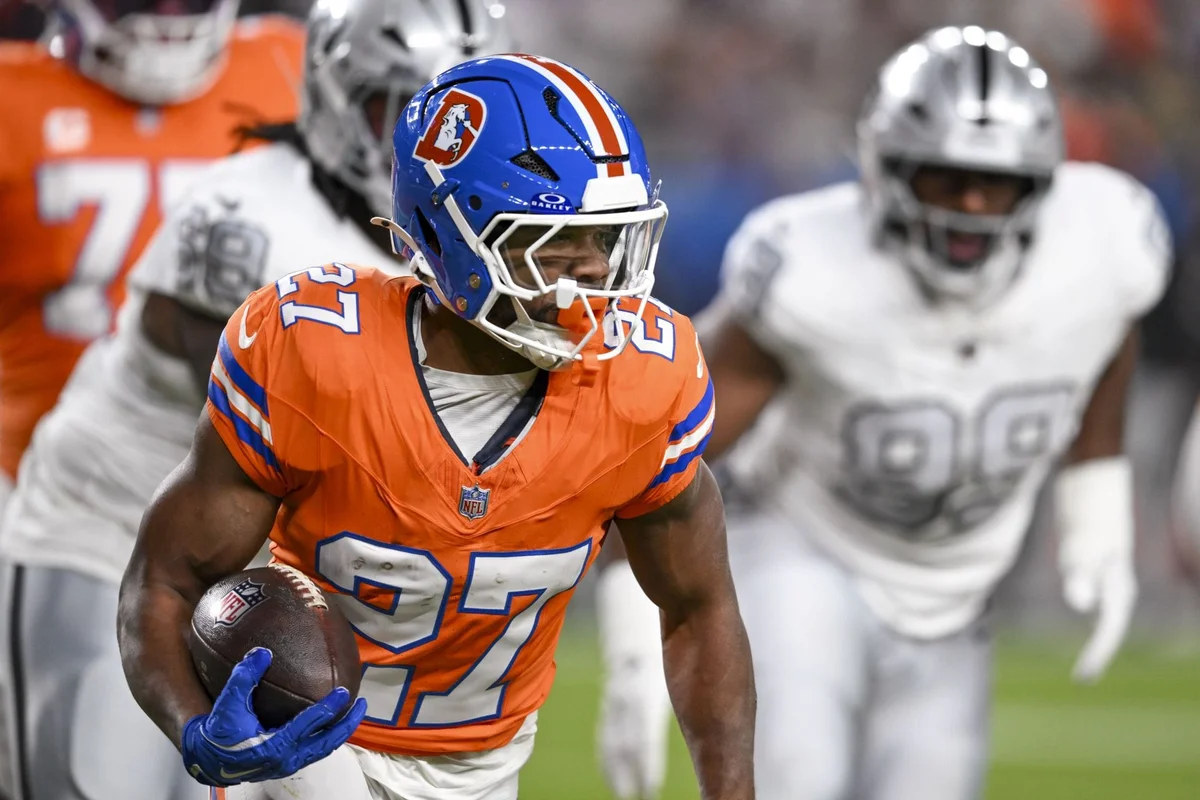
The Denver Broncos face a critical need at running back heading into the upcoming offseason, as sustaining offensive success largely depends on maintaining a reliable rushing attack. Last season, the Broncos signed running back J.K. Dobbins, who showed promising potential by pacing for over 1,300 rushing yards across 10 games. The team’s ground game was notably efficient during the time he was active, reinforcing why the Broncos must prioritize his return when managing their roster. Incorporating J.K. Dobbins Broncos running back into Denver’s plans offers both production and continuity for the offense moving forward.
Evaluating the Running Back Position Depth and Injury Risks
Despite Dobbins’s impact, the Broncos still face uncertainty at the running back position due to his injury history. Throughout his NFL career, he has struggled to stay on the field consistently, never completing a full 17-game season and peaking at 15 games during his rookie year. Denver knew this risk when they acquired him in June and took steps to mitigate it by drafting RJ Harvey in the second round of the 2025 NFL Draft.
However, when Dobbins was sidelined, Harvey took over as the primary ball carrier but did not manage to sustain an efficient running game. Harvey’s strengths lie more in change-of-pace roles and receiving out of the backfield rather than as a reliable every-down back. This limitation by no means diminishes his value but underscores why the Broncos cannot rely solely on him going forward.
Potential Strategies for Strengthening the Backfield Beyond Re-Signing Dobbins
Re-signing Dobbins, therefore, must be paired with a strategy to strengthen the running back room, recognizing that his injury risk could resurface. Denver may need to bring in additional talent through the 2026 NFL Draft, where a strong class of running backs awaits selection. Prospects such as Emmett Johnson, Seth McGowan, Jonah Coleman, Jadarian Price, Nicholas Singleton, and Kaytron Allen all have the potential to make immediate NFL impacts as rookies. Adding a promising rookie alongside Dobbins and Harvey would offer balance to the running back room, providing immediate production while fostering long-term stability.
The Alternative of Signing a Different Lead Running Back
Another possibility for the Broncos is to move away from re-signing Dobbins and pursue top free agent running backs like Breece Hall, who is considered the best available on the market and projected to command a substantial contract. Should Denver sign Hall, he could assume the role of the lead back, reducing immediate pressure to find additional running back talent early in the draft. Hall’s ability to be an every-down back would give the Broncos stability at the position without urgent depth concerns.
Coaching Philosophy and the Ideal Running Back Lineup
Head coach Sean Payton favors incorporating multiple running backs into his offensive schemes, which supports the idea of maintaining a diverse and dynamic backfield. In an optimal scenario, Denver could field a running back core consisting of Dobbins, Harvey, and a rookie draft pick in 2026. This combination would not only enable productivity this season but would also help ensure the team’s running back unit remains competitive and adaptable in the future.
