
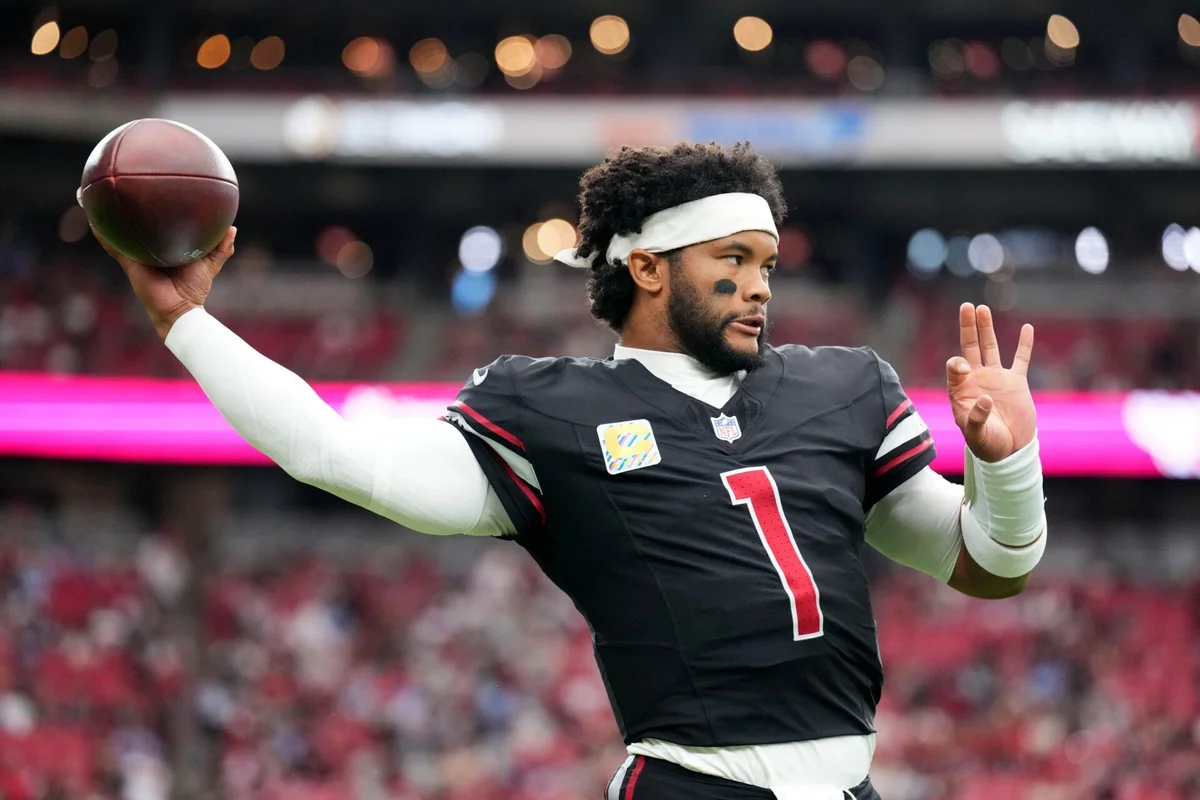
The New York Jets are reportedly considering a bold quarterback acquisition this offseason, with Kyler Murray, the two-time Pro Bowl quarterback and former first overall pick, emerging as a prominent trade candidate. Murray’s status with the Arizona Cardinals has become uncertain, especially with a new coaching staff arriving and critical contract deadlines approaching in mid-March 2026, making a trade potentially imminent.
Given the Jets’ desperate need to secure a reliable starting quarterback, the Kyler Murray Jets trade has sparked intense debate among analysts and fans alike, weighing the potential rewards against significant risks involved in such a move.
Analyzing Murray’s Contract Complexity and Cap Implications
One of the key considerations for any team eyeing Kyler Murray is the detailed structure of his current contract. Entering the third year of a five-year extension signed in 2022, the contract technically extends through 2027, with the final year being a team option. However, no guarantees exist beyond 2026, which increases his trade eligibility for both the Arizona Cardinals and potential acquiring teams.
The Cardinals stand to free up $35.3 million in cap space by trading Murray before March 15, 2026, while absorbing $17.9 million in dead money largely tied to prorated bonuses. This arrangement makes the trade financially sensible from Arizona’s perspective. For a acquiring team, the costs are significant: Murray’s base salary of $22.8 million in 2026 (already guaranteed as of early 2025) plus $19.5 million in 2027 (guaranteed in March 2026), accompanied by a $17 million roster bonus in 2026, create a $39.8 million cap hit for that year alone.

This sizeable single-season cap commitment raises concerns for the Jets, who already face heavy dead money charges of approximately $57 million from quarterbacks Aaron Rodgers and Justin Fields. Even if Fields is released with a post-June 1 designation to reduce immediate financial burden, the Jets’ cap sheet could carry nearly $88 million committed to three quarterbacks in 2026, with continued heavy charges projected through 2027.
It remains likely that any trade negotiation would involve attempts by prospective teams, including New York, to convince Arizona to retain part of Murray’s 2026 salary, which might increase the trade compensation required. While Murray’s contract limits long-term cap exposure beyond 2026, the immediate financial strain and resource allocation challenges present a difficult puzzle for the Jets front office, especially when other roster needs demand attention.
Assessing On-Field Performance: A Reliable Baseline for the Jets
The Jets’ recent history with quarterbacks has been marred by inconsistency and underperformance, with franchise legends like Joe Willie Namath long gone and only rare flashes of league-average play since. From 1976 to the present, New York has managed league-average or better quarterback play in only 13 seasons, with just four such seasons after 2000. Notably, Chad Pennington accounted for three of those years, while Josh McCown was the last Jets QB to post such numbers in 2017.
Against this backdrop, Kyler Murray’s career baseline appears attractive. Despite criticisms tied to high draft expectations and injuries, Murray has proven to be a durable NFL starter with career statistics that would surpass typical Jets recent production. His 67.1% completion rate, 121 touchdown passes to 60 interceptions, and an average of 7.0 yards per pass attempt culminate in a 92.2 passer rating—slightly above the 2025 league average.
His rushing ability offers an additional dimension, averaging nearly 37 yards per game on the ground and scoring 32 rushing touchdowns. Murray also demonstrates sound decision-making relative to mobile quarterbacks, maintaining a low sack rate and a reasonable turnover ratio. If he replicates his career performance in 2026, he would instantly become the Jets’ best quarterback since Pennington, presenting a meaningful upgrade over recent options.
Still, the question remains whether the Jets should be content aiming for average quarterback play given their franchise history. Yet in today’s NFL, where megastar QBs are not the sole path to championships, having a capable and dynamic quarterback like Murray may align well with the Jets’ goals.
Potential for Peak Performance: Could Murray Still Reach Elite Heights?
Murray’s NFL journey has been characterized by peaks and valleys, with tantalizing glimpses of elite-level play interspersed with injury setbacks and inconsistency. Entering his eighth NFL season, the same as Sam Darnold’s breakthrough year leading to a Super Bowl victory, Murray’s potential ceiling remains a topic of interest.
He showed MVP-caliber form midway through the 2021 season with the Cardinals undefeated at 7-0 and averaging over 32 points per game before injuries curtailed his momentum. Though his prime has been interrupted by physical setbacks, including a torn ACL in 2022 and other injuries, he demonstrated a promising rebound in 2024, posting a top-10 quarterback rating in the league that season.
Murray’s ability to reach elite performance levels, even if for limited stretches, suggests the possibility that he could experience a late-career resurgence similar to Darnold’s. The Jets acquiring Murray would mean securing a quarterback with a reliable floor and flashes of substantial upside, which could energize an otherwise unsettled offense.
Compatibility with Jets’ Offensive Scheme and Frank Reich’s System
From an offensive strategy standpoint, Murray appears well-suited to the Jets’ system under coordinator Frank Reich. Analysis of Murray’s 2024 season reveals a preference for short and intermediate routes, prioritizing quick outs, corners, and hitch routes—patterns closely aligned with Reich’s offensive philosophy, which minimizes vertical passing and deep shots.
Both Reich’s recent teams and Murray’s cardinals’ offense have shown similarly low frequencies of deep go and post routes, favoring ball control and timing-based throws over risky downfield attempts. Such alignment could ease Murray’s transition to New York and maximize his strengths.
This compatibility with Reich’s route concepts and play-calling style increases the appeal of trading for Murray, suggesting a smoother integration than other potential quarterback options, such as Malik Willis, who might not fit the scheme as seamlessly.
Concerns Regarding Injury History and Durability
One of the most significant red flags surrounding Kyler Murray is his chronic injury record. Over his seven-year career, he has started only 87 out of 117 possible games, missing more than a quarter of available games. His health issues have repeatedly impacted both his playing time and performance level.
The 2021 ankle injury was a pivotal moment, effectively halting his MVP-caliber campaign and leading to diminished production in the following games. Subsequent wrist and hamstring problems, coupled with the devastating ACL tear in late 2022, have further limited his availability and raised questions about his long-term durability.
Though he completed a full season in 2024, Murray’s 2025 campaign ended prematurely due to a foot injury, amid speculations of possible benching tied to declining performance. Given his 5’10”, 205-pound frame and highly mobile playstyle, staying healthy remains a significant challenge.
For a team like the Jets, investing heavily in a player with notable durability risks compounds uncertainties surrounding performance consistency and season-to-season availability.
Evaluating Murray’s Leadership Qualities and Fit in New York’s Intense Media Market
Leadership concerns have dogged Murray since joining the NFL. Reports of a prior independent study clause in his contract and critiques from former teammates contribute to questions around his ability to serve as a team leader.
Patrick Peterson, a former Cardinals teammate, openly criticized Murray’s leadership and energy in October 2025:
“To me, it starts with body language. As a quarterback, a lot of guys on the team look to see how you carry yourself,” said Peterson.
“If he’s continuing to not have good energy and (not) cheering his teammates up, the team is going to continue to look the way that it’s looking. I’m sorry to say that. I know fans hate to hear me talk about Kyler Murray, but these are the things we need to see to see the team turn around, and it starts with him.” ?Patrick Peterson, Former Cardinals Cornerback
Murray’s entire career has been rooted in the relatively sheltered Phoenix market. Transitioning to New York means entering a media environment with relentless scrutiny and heightened pressure, especially considering the Jets’ 15-year playoff drought. Whether Murray can shoulder these expectations and elevate his leadership under such circumstances remains uncertain.
Scenarios for Murray’s Impact on the Jets and the Franchise’s Future
Considering all factors, Kyler Murray represents both a promising opportunity and a complicated gamble for the Jets. On the positive side, he offers a higher baseline and ceiling than many other potential starters available through the draft or veteran free agency. His ability to produce reliable starts and flashes of spectacular play present tangible benefits for a franchise desperate for stability at quarterback.
His fit within Frank Reich’s system and the finite long-term financial risk due to contract structure further enhance his appeal.
Conversely, significant challenges persist in the form of cap space constraints already stretched by the presence of Aaron Rodgers and Justin Fields dead money, the large cap hit Murray would bring, and the risk of adding a third costly quarterback to the financial ledger. Additionally, his injury history and questionable leadership raise doubts about consistency and cultural harmony.
Jets head coach Aaron Glenn, currently under scrutiny and working for job security, faces immediate pressure to improve results. His recent staff selections reflect cautious moves on offense, but the decision whether to pursue a high-risk, high-reward player like Murray or settle for safer, less ambitious options will reveal much about the franchise’s direction heading into the 2026 season.
Ultimately, how the Jets approach the veteran quarterback market will be a crucial indicator of their broader strategy and appetite for volatility as they prepare to break their long-standing playoff drought.
