
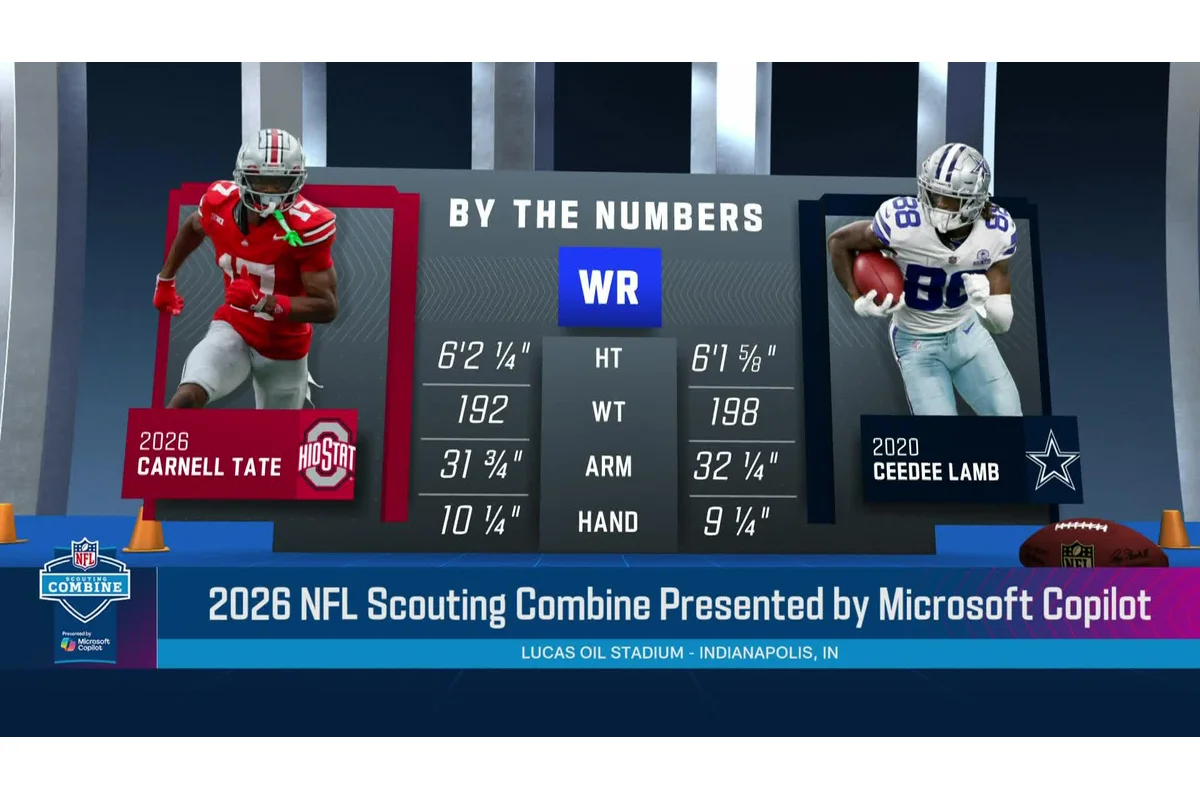
On February 28, 2026, during the NFL Combine at Indianapolis, Buffalo Bills General Manager Brandon Beane openly criticized wide receiver Carnell Tate’s 40-yard dash time, casting doubt on the player’s speed as the NFL Draft approaches. Tate, the standout receiver from Ohio State, clocked in at 4.53 seconds, a performance that Beane described as “pretty slow” while broadcasting live from the booth. This comment has sparked debate in football circles about the significance of combine measurements versus on-field production.
Beane’s remarks came during Tate’s 40-yard dash when the GM remarked,
“I probably wouldn’t take him early. … Did you see how slow he was out of the gate? The corner’s gonna lock him down.”
Despite the harsh critique, Beane maintained a smile during his comments, leaving observers to wonder if his skepticism was genuine or a bit of playful banter. Nonetheless, his statement highlights a potential concern over Tate’s speed impacting his draft value.
The Impact of Combine Results on Tate’s Draft Outlook
The Bills hold the 26th selection in the 2026 NFL Draft, positioning them to benefit if Tate’s stock declines due to his combine times. Beane’s public doubts may be a tactical attempt to encourage teams picking earlier to pass on Tate, allowing Buffalo to acquire a highly productive receiver later than initially expected. Known for his explosive starts rather than pure top-end speed, Tate’s 1.61-second 10-yard split at the combine underscores his ability to accelerate quickly, a trait many scouts value more than his overall 40-yard dash time.
Tate’s collegiate achievements firmly support his first-round potential. During his tenure at Ohio State, he caught 51 passes for 875 yards and nine touchdowns despite playing behind the team’s WR1. Notably, Tate led the nation with six touchdown receptions covering 30 or more yards. Analysts compare him to elite receivers such as CeeDee Lamb, citing his smooth route running and exceptional body control when contesting catches. These skills underline his value beyond raw speed metrics.
Contextualizing Tate’s Speed: The Wider Debate on Combine Times
Although a 4.53-second 40-yard dash is not blazing fast compared to other receivers, it is far from slow when viewed in historical and positional context. Legends like Jerry Rice reportedly ran times ranging from 4.59 to 4.71 seconds, while Hall of Famers such as Cris Carter (4.63), Larry Fitzgerald (4.63), and Anquan Boldin (4.71) all posted slower times than Tate. Many of these players forged Hall of Fame careers despite lacking elite track speed.
Among the 2026 draft class, Tate’s time is also competitive. Wide receivers such as Vinny Anthony (4.54), Caullin Lacy (4.55), and Malachi Fields (4.61) recorded similar or slower times at the combine. The NFL landscape is filled with examples of productive receivers who have succeeded without blazing speed; some even struggle at the highest level despite possessing quicker sprint times. Current star Justin Jefferson faced speed-related skepticism before becoming one of the league’s top wideouts, illustrating how combine performances do not always predict professional success.
Balancing Speed Concerns with On-Field Talent
While some players with sub-4.5 times, like Tyquan Thornton’s 4.28, can struggle to contribute consistently, those in the 4.5-to-4.6 range often enjoy productive NFL careers. Beane’s doubt about Tate may rightly reflect a cautious approach, yet the Bills likely recognize the receiver’s polished route running and playmaking abilities, qualities that could compensate for any perceived lack of speed.
Should Tate fall to the Bills at No. 26, it would fill a crucial need for Josh Allen’s offense, which has been seeking a dynamic, reliable receiving option since Stefon Diggs’ departure. Moreover, any improvement over players like Keon Coleman would be welcomed by Buffalo fans hopeful to strengthen the receiving corps.
The Strong Argument Against Overemphasizing Combine Speed
Football insiders and analysts frequently remind teams to consider “game speed” over pure sprint times. Tate’s quick burst off the line and ability to make contested catches are more relevant to actual NFL performance than how fast he runs in a straight line. The NFL Combine often functions as a psychological game, with front offices sometimes amplifying weaknesses or dissecting numbers to influence perceptions and draft positioning.
Brandon Beane’s comments, while appearing critical, may thus reflect the complex negotiations and mind games involved as teams prepare for the draft. His smiling demeanor during the remarks fuels speculation that his skepticism might be strategic rather than purely evaluative.
Pre-Draft Drama and What It Means for Carnell Tate’s Future
This exchange between Beane and commentators typifies the tension-filled atmosphere ahead of the NFL Draft, where speculation about player traits can dominate discussions. While Tate’s 40-yard dash timing generated headlines, it is unlikely to drastically damage his draft prospects given his documented productivity and skill set. Whether he goes in the top five or slips to later rounds, the consensus remains that Carnell Tate will be an impactful NFL receiver from day one.
For Buffalo, Tate represents a potential answer to the team’s long-standing need for a dependable, high-caliber target for Josh Allen. Despite the public questioning from their general manager, the Bills could still view Tate as a prime candidate to elevate their offensive game.
Examining the “Slow Wideouts” Narrative in Light of Beane’s Comments
The notion of a “slow wide receiver” being unable to succeed in the NFL has been challenged repeatedly, especially when evaluating players through a historical lens. Advanced route running, football intelligence, and catch radius often outweigh raw speed. Tate’s example confirms this trend, as his impressive college production and explosiveness fall outside conventional 40-yard dash measures.
Furthermore, many NFL stars have enjoyed long, illustrious careers with similar speed metrics. This challenges the simplistic idea that a receiver’s 40-time alone predicts career outcomes. Beane’s public dismissal of Tate’s speed fits into a broader discussion about how NFL franchises interpret combine data and its limitations.
Potential Outcomes for Tate in the 2026 NFL Draft
While Brandon Beane openly questioned Tate’s speed on February 28, this does not definitively rule out the possibility of the Bills selecting him should he be available late in the first round. Given Buffalo’s need for a reliable receiver, they might seize the opportunity if Tate slides down the board due to his combine performance. This strategy reflects the complex calculus teams perform to maximize value while addressing roster needs.
Ultimately, Carnell Tate’s draft destination remains uncertain, but the consensus is that his on-field talent will ensure he enjoys a successful NFL career. Buffalo’s skepticism over his speed adds an extra layer of intrigue as the league’s decision-makers weigh measurable metrics against proven football ability in the lead-up to the draft.
“He’s pretty slow I probably wouldn’t take him early”
Bills GM Brandon Beane during Ohio State WR Carnell Tate’s 40-yard dash pic.twitter.com/T0FHxUqFWr
— Underdog (@Underdog) March 1, 2026
