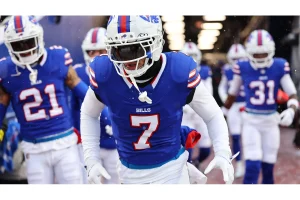
Buffalo Bills Overview
The Buffalo Bills are a professional American football team based in the Buffalo–Niagara Falls metropolitan area of New York. They compete in the National Football League as a member of the American Football Conference East division and play their home games at Highmark Stadium in Orchard Park, New York. The franchise is owned by Terry Pegula, along with Arctos Partners LP, the Estate of Kim Pegula, and a coalition of investors including former Toronto athletes Vince Carter, Tracy McGrady, and Jozy Altidore. The Bills are led by head coach Sean McDermott and general manager Brandon Beane, and their team colors are royal blue, crimson red, white, and navy blue. Their official mascot is Billy Buffalo, an eight-foot-tall anthropomorphic blue American bison.
Founded in 1959 as a charter member of the American Football League, the Bills joined the NFL in 1970 as part of the AFL–NFL merger. The team is named after an earlier All-America Football Conference franchise from Buffalo, which in turn took its name from western frontiersman Buffalo Bill. Across more than six decades, the Bills have built a reputation for loyal fan support, four consecutive Super Bowl appearances in the early 1990s, and a sustained return to postseason contention in the 2020s.
Founding and Organizational Origins
The Buffalo Bills were founded on October 28, 1959, by Ralph Wilson, a Detroit Lions minority owner who saw an opportunity to bring professional football to upstate New York. The franchise was created as one of the eight charter members of the American Football League, a rival league designed to challenge the established National Football League. Wilson partnered with a group of local investors and chose Orchard Park, just south of Buffalo, as the team’s home base. The team took the name Bills in tribute to an earlier Buffalo pro football franchise that had competed in the All-America Football Conference in the late 1940s.
From the start, the organization built its identity around the city of Buffalo and the broader western New York region. Buster Ramsey was hired as the team’s first head coach, and the front office assembled a roster through the AFL’s territorial draft. The Bills’ original uniforms were modeled on those of the Detroit Lions, reflecting Wilson’s previous ties to that franchise, with Honolulu blue, silver, and white as the team’s first colors. The team’s original logo was a standing red bison, introduced in 1962, and by 1965 the franchise had added red and blue center stripes to its helmets. These early choices set the foundation for a visual identity that would evolve across decades.
War Memorial Stadium in Buffalo served as the team’s first home, and the Bills played there from 1960 through 1972. The franchise established itself as a regional institution quickly, drawing fans from across western New York and southern Ontario. By the middle of the decade, the Bills were winning American Football League championships and becoming a central part of life in the Buffalo–Niagara Falls area.
Growth Into National Football League Competition
The Bills stepped into NFL competition in 1970 as part of the AFL–NFL merger, joining the American Football Conference East division. The transition brought new rivals, including the Baltimore Colts, Miami Dolphins, and New England Patriots, and required the franchise to adjust to a larger league with deeper talent pools. The team moved to a new home, Rich Stadium, in 1973, marking the start of a long run in Orchard Park. The stadium’s name later became Ralph Wilson Stadium, honoring the team’s founder.
Throughout the 1970s, the Bills featured All-Pro running back O. J. Simpson, who became the first player in NFL history to rush for more than 2,000 yards in a single season in 1973. Despite Simpson’s individual brilliance, the team posted generally mediocre results. A period of struggle in the mid-1980s pushed the organization to the brink of failure before the collapse of the rival United States Football League and a series of high draft picks allowed the franchise to rebuild. Quarterback Jim Kelly, running back Thurman Thomas, defensive end Bruce Smith, and linebacker Darryl Talley formed the core of a team that returned to playoff contention in the late 1980s under head coach Marv Levy. The hiring of Levy and the development of a strong front office set the stage for one of the most successful periods in franchise history.
Buffalo Bills Competitive Journey
The Bills’ competitive journey stretches from their earliest AFL seasons through four consecutive Super Bowl appearances, a long playoff drought, and a modern resurgence built around quarterback Josh Allen. After early AFL championships in 1964 and 1965, the team endured decades of mixed results before becoming perennial postseason contenders in the late 1980s and early 1990s. A 17-year playoff drought followed, ending in 2017, and the franchise has since returned to consistent AFC East contention.
Early Seasons and Development (1960–1987)
The Bills began competitive play in 1960 under head coach Buster Ramsey, posting records of 5–8–1 and 6–8 in their first two seasons. Quarterback Jack Kemp and head coach Lou Saban led the team to American Football League championships in 1964 and 1965, the only major professional sports championships ever won by a franchise representing Buffalo. The Bills reached the AFL Championship Game again in 1966 but lost to the Kansas City Chiefs, and Saban left the team shortly afterward. From the late 1960s through 1987, the franchise tallied only five winning seasons and three postseason appearances, including playoff berths in 1974, 1980, and 1981.
Despite the uneven results, the team continued to develop a strong regional identity. The 1973 introduction of blue pants paired with white jerseys and the 1974 unveiling of a redesigned charging bison logo by aerospace designer Stevens Wright helped refine the team’s visual brand. Rich Stadium opened in 1973 and quickly became one of the loudest venues in professional football. By the end of the 1980s, a series of high draft picks, including Jim Kelly, who joined the team after his United States Football League career ended, gave the Bills the talent needed to return to championship contention.
Breakthrough in the National Football League (1988–1999)
The Bills’ breakthrough came in the late 1980s under head coach Marv Levy, with the team reaching the playoffs in 1988 and 1989. In 1990, the Bills won the AFC Championship and advanced to Super Bowl XXV, beginning a record run of four consecutive Super Bowl appearances. Buffalo returned to the big game after the 1991, 1992, and 1993 seasons, but lost each time, including a 20–19 defeat to the New York Giants in Super Bowl XXV decided by Scott Norwood’s wide-right field goal attempt. The four consecutive Super Bowl losses remain an NFL record shared with the Minnesota Vikings.
The team also captured AFC East titles in 1988, 1989, 1990, 1991, 1993, and 1995, building one of the most successful stretches of any franchise in the conference. Quarterback Jim Kelly, running back Thurman Thomas, wide receiver Andre Reed, and defensive end Bruce Smith formed the offensive and defensive core, while special teams players such as Steve Tasker helped set league records. The Bills also produced one of the most memorable comebacks in NFL history in the 1992 playoffs, when Frank Reich replaced an injured Jim Kelly and led Buffalo from a 35–3 deficit to a 41–38 overtime victory over the Houston Oilers. Despite the on-field success, the team’s inability to win a Super Bowl defined the era.
By the late 1990s, the core of the 1990s rosters had aged or moved on, and the Bills’ playoff appearances became less frequent. Buffalo reached the postseason in 1995, 1996, 1998, and 1999, but lost in the wild card round each time. The 1999 season ended with the Music City Miracle, a controversial kickoff return that eliminated the Bills in the wild card round and began the longest active playoff drought in major North American professional sports.
Modern Program and Current Direction (2000–Present)
The Bills endured a 17-year playoff drought from 2000 to 2016, the longest in the four major North American professional sports at the time. Head coaches Mike Mularkey, Dick Jauron, Chan Gailey, Doug Marrone, and Rex Ryan each attempted to rebuild the team without success. In 2014, following the death of original owner Ralph Wilson, Terry and Kim Pegula received unanimous NFL approval to purchase the franchise, becoming only the second ownership group in team history. The Pegulas invested heavily in the team’s facilities and brought in general manager Brandon Beane and head coach Sean McDermott in 2017.
The selection of quarterback Josh Allen with the seventh overall pick of the 2018 NFL draft marked the start of a new era. In 2020, the Bills won the AFC East for the first time since 1995 and advanced to the AFC Championship Game for the first time since 1993, ending with a 38–24 loss to the Kansas City Chiefs. Buffalo then won the AFC East for five consecutive seasons from 2020 through 2024, reaching the AFC Championship Game twice more and losing each time to Kansas City. In 2024, the Bills became one of the first NFL teams to sell a minority ownership stake to outside private equity investors, with 20.6 percent of the franchise sold at a $5.6 billion valuation, including a 10 percent stake to Arctos Partners LP.
The organization has continued to invest in infrastructure, announcing plans to build a new stadium in Orchard Park to replace Highmark Stadium, with completion scheduled for 2026. Training and front office operations are based at the ADPRO Sports Training Center in Orchard Park. The Bills retain the services of head coach Sean McDermott and general manager Brandon Beane, with a roster built around Josh Allen, Stefon Diggs, Matt Milano, and Tre’Davious White. The team has retired three jersey numbers, No. 12 for Jim Kelly, No. 34 for Thurman Thomas, and No. 78 for Bruce Smith, in honor of the players who defined its greatest eras.
Philosophy and Competitive Strengths
The Bills’ modern identity centers on a strong defense, a versatile dual-threat quarterback, and a deep supporting cast built through the draft. Under Sean McDermott, the team has emphasized discipline, situational football, and aggressive play in the secondary. Josh Allen’s ability to extend plays with his legs and throw accurately downfield has made the offense one of the most dynamic in the league, and the team’s investment in offensive line play and skill positions has produced consistently high-scoring performances.
Key Milestones and Major Moments
Among the Bills’ most important milestones are their 1964 and 1965 AFL championships, the run of four consecutive Super Bowl appearances from 1990 to 1993, and the 2017 Wild Card win over the Jacksonville Jaguars that ended a 17-year playoff drought. The 1992 comeback win over the Houston Oilers and the 2020 return to the AFC Championship Game stand as defining moments, while the 2021 playoff victory over the New England Patriots, the only perfect offensive game in NFL history, remains a recent highlight.
Buffalo Bills Achievements and Results
The Bills have won 15 division championships, four conference championships, and zero Super Bowls. Their four Super Bowl appearances are the most of any NFL franchise that has yet to win the Super Bowl, a record they share with the Minnesota Vikings. The franchise has made 25 total postseason appearances across the AFL and NFL.
League Achievements
The Bills have yet to win a Super Bowl or NFL championship. Their closest attempts came in four straight Super Bowl losses from 1990 through 1993, including narrow defeats to the New York Giants, Washington Redskins, and Dallas Cowboys. The 1991 season ended with a 37–24 loss to the Giants, the 1992 season with a 52–17 defeat at the hands of the Cowboys, and the 1993 season with a 30–13 loss to the Cowboys again. The franchise’s only major professional championships remain the 1964 and 1965 AFL titles.
Conference Achievements
The Bills have won four AFC Championships, in 1990, 1991, 1992, and 1993, each earned under head coach Marv Levy. They have also reached the AFC Championship Game in 2020, 2021, and 2024, losing each time to the Kansas City Chiefs. The four consecutive AFC titles of the early 1990s remain a league record, and the Bills’ three additional appearances in the conference championship during the 2020s underline their sustained return to elite competition.
Divisional Achievements
The Bills have won 12 AFC East division titles, capturing the crown in 1980, 1988, 1989, 1990, 1991, 1993, 1995, 2020, 2021, 2022, 2023, and 2024. The five consecutive AFC East titles from 2020 through 2024 marked the longest divisional winning streak in franchise history and represented the most dominant stretch for the team since the early 1990s. The Bills also won three AFL Eastern division titles in 1964, 1965, and 1966.
Series Achievements
The Bills have reached the playoffs 25 times in franchise history, including three AFL postseason berths in 1963, 1964, 1965, and 1966, and 22 NFL postseason appearances beginning in 1974. The 2017 Wild Card win over Jacksonville ended the longest active playoff drought in major North American professional sports. Buffalo has won multiple playoff games in each of the past five postseasons, including victories over Indianapolis, New England, Pittsburgh, Denver, Baltimore, and Jacksonville.