
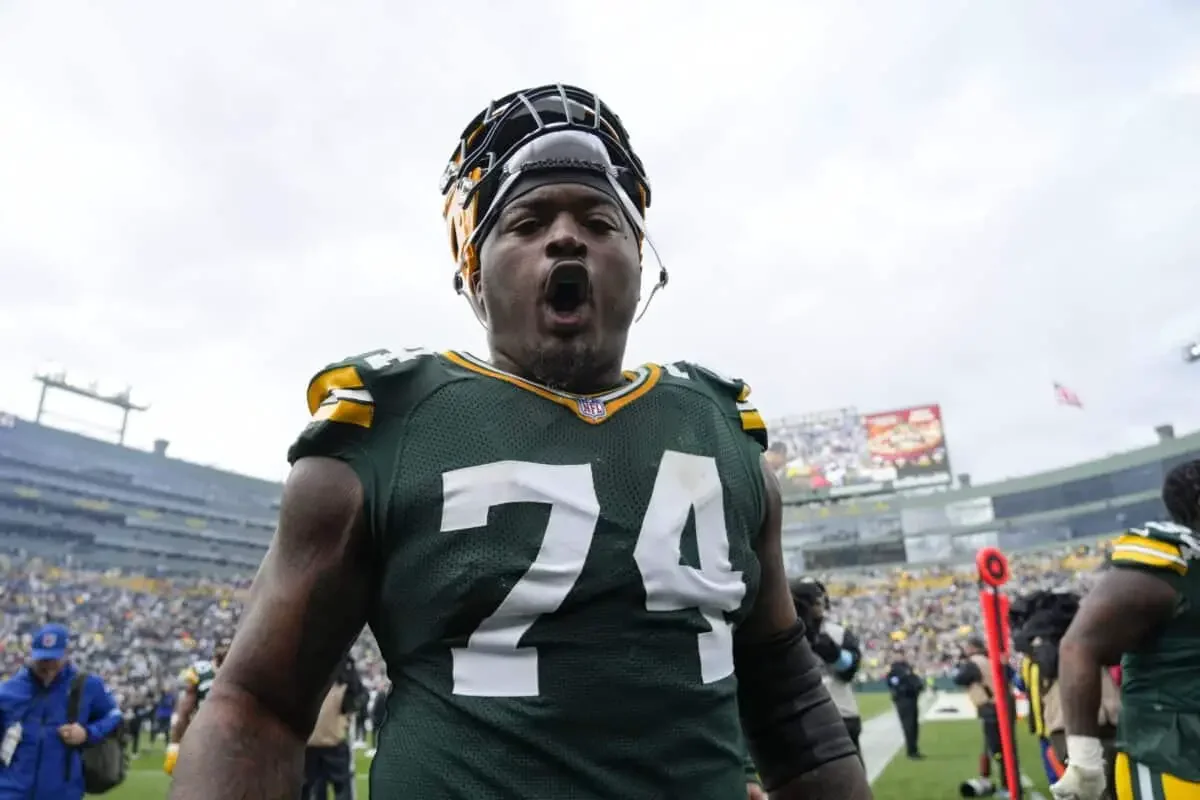
The future of Elgton Jenkins with the Green Bay Packers appears uncertain as his combination of declining performance, a season-ending injury, and a large salary cap charge poses challenges. Although many anticipated the team would release the two-time Pro Bowl offensive lineman to alleviate cap strain, recent updates suggest the Packers might find a surprising trade partner for Jenkins. This development emerged following discussions at the NFL Scouting Combine, as reported by ESPN’s Jeremy Fowler.
Salary Cap Implications and Trade Challenges
Releasing or trading Jenkins would free up $19.53 million in salary cap space for the Packers, making it the most significant cap-saving maneuver available. Despite this, a trade seemed unlikely for several reasons. This situation parallels the Packers’ experience with Jaire Alexander last year. Teams hesitated to trade for Alexander because they anticipated that Green Bay would release him anyway, thus discouraging other franchises from surrendering assets. The same logic initially applied to Jenkins, suggesting a trade might not materialize.
Any team that acquires Jenkins would assume the burden of his $19.53 million cap hit, though this would last only one season before Jenkins becomes a free agent. It is possible a team with sufficient cap flexibility might consider this move if it means securing Jenkins’ talents for the upcoming season.
Potential Trade Value and On-Field Performance
The Packers are unlikely to receive significant draft compensation in return, with projections pointing to a late Day 3 pick or a conditional selection. Still, obtaining any draft capital is advantageous, especially given that Green Bay currently lacks a first-round draft pick. Even a modest draft asset would help replenish the team’s limited draft resources.
Jenkins, who earned two Pro Bowl selections primarily as a left guard, was shifted to center by the Packers in 2025, a change that did not yield positive results. While Jenkins maintained adequate pass protection, he struggled with consistency, especially in run blocking. Pro Football Focus assigned him a 62.0 overall grade at center, ranking him 25th out of 40 centers, and his 60.6 run-blocking grade placed him at 30th. The Packers likely hoped this position shift would extend his effectiveness, but Jenkins was unable to replicate his prior success.
What a Trade Could Mean for Jenkins and the Packers
There remains a possibility that another team could envision Jenkins returning to his original left guard role and regaining his previous high level of play. While this is uncertain, such a scenario might make Jenkins appealing to organizations seeking to strengthen their interior offensive line. Despite this, a release still appears to be the most probable outcome for the Packers.
Jeremy Fowler’s report from the NFL Scouting Combine highlights a noteworthy development. Securing any form of draft compensation for Jenkins would represent an unexpected victory for Green Bay, considering the circumstances. Even a late-round pick could provide important draft capital for the team’s rebuilding efforts.
