

As the 2026 Olympic break begins, the Winnipeg Jets stand at a vital juncture in their NHL season, balancing patience and hesitation. Their campaign after 56 games has displayed strong goaltending and a dependable core guided by an organization focused on stability rather than radical change, but with the playoff race tightening, their margin for error has nearly vanished. The pressing question ahead is no longer about maintaining competitiveness, but about the willingness to evolve their approach moving forward.
How the Current Roster Shapes Winnipeg’s Season
The Jets’ roster comprises a combination of long-term core players and seasoned veterans added for depth, many drafted or acquired through trades. After more than halfway through the season, they’ve needed to redefine their identity and reset expectations, a theme reflected by assistant coach Scott Arniel, who described the post-Olympic return as akin to a “mini training camp.” The team leans heavily on its veteran leadership, aiming for immediate success, yet has never fully committed to a wholehearted push, even when conditions appeared favorable.
Offensively, Winnipeg’s top line centered around Kyle Connor and Mark Scheifele dominates, but secondary scoring remains a major weakness, with supporting wingers providing limited offensive impact. Defensively, the Jets exhibit solidity; emerging players like Logan Stanley and Elias Salomonsson have taken on pivotal roles, while veterans Josh Morrissey and Dylan Samberg continue as steady contributors. Despite defensiveness strength, the season ongoing is often viewed as an anomaly rather than a trend.
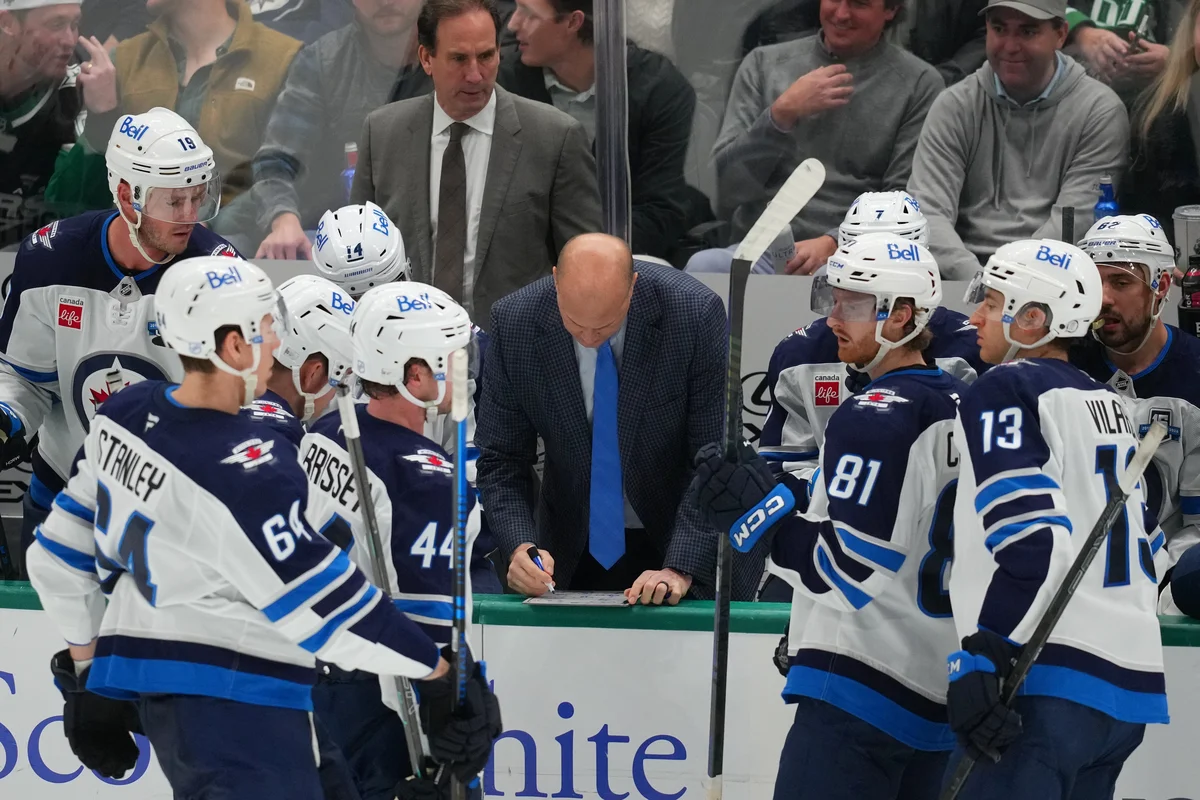
In goal, one of the league’s elite netminders, Connor Hellebuyck, has masked underlying issues, especially with the backup situation complicated after Hellebuyck’s mid-season surgery. Eric Comrie has been serviceable but may be nearing the end of his tenure as backup, as prospects Thomas Milic and Domenic DiVincentiis have excelled in the AHL, potentially ready for NHL opportunities.
Heading into the final 26 games, expectations for the Jets should be adjusted. While the first three forward lines have potential on paper, production has primarily come only from the top unit. The regular-season finish will be a sprint lasting roughly 50 days, demanding both endurance and a solution to the long-standing problem of secondary scoring.
The Jets’ current lineup includes: Kyle Connor, Mark Scheifele, Alex Iafallo; Cole Perfetti, Adam Lowry, Gabriel Vilardi; Nino Niederreiter, Jonathan Toews, Vladislav Namestnikov; Cole Koepke, Morgan Barron, Gustav Nyquist; Tanner Pearson. The defense features Josh Morrissey with Dylan DeMelo, Dylan Samberg paired with Elias Salomonsson, Logan Stanley with Luke Schenn, and Isaak Phillips. Goaltenders are Connor Hellebuyck and Eric Comrie, with Neal Pionk, Haydn Fleury, and Colin Miller sidelined on injured reserve.
Evaluating Team Identity and Adjustments Since Season Start
A key concern this season has been the coaching staff’s trust hierarchy, especially regarding lineup stability versus changes during games. Defense stands as Winnipeg’s strongest position, yet the Jets frequently revert to familiar line combinations even when trailing, indicating a preference for stability over tactical in-game experimentation. This pattern has persisted for years; for example, last season the Jets resisted moving Kyle Connor off the top line despite alternate combinations showing promise, and have similarly persisted with predictable player placements like Patrik Laine on the second line and Blake Wheeler on the first.
During their February 4th game against Montreal, the Jets mainly made minor swaps, such as exchanging Jonathan Toews and Adam Lowry, or Alex Iafallo and Gustav Nyquist, reinforcing this tendency toward measured and cautious change. Early season optimism quickly faded as an 11-game losing streak went unaddressed with no immediate roster or lineup modifications. Rather than building momentum following wins, Winnipeg’s approach has focused on damage control.
They followed the losing streak with a four-game winning streak but have since alternated between wins and losses, which reflects coaching staff’s reliance on consistency and stable lines. Puck possession stats reinforce this: at five-on-five, Winnipeg holds a below-average possession rate of 48.21% Corsi For over 56 games, contrasting sharply with a dominant 88.44% rate on the power play. Peak possession occurred just before Christmas, but has yet to regain that level since.
Mid-November roster moves activating Cole Koepke and Morgan Barron from injured reserve helped improve puck control from about 42% to 50% Corsi between games 10 and 22, yet winning was limited. The 11-game losing run is notable for how many one-goal losses it included—nine within that span and 19 for the season overall—underscoring a crucial vulnerability. Winning even half of those close games would likely place the Jets in contention for a wildcard spot, but currently, they sit 11 points away from that threshold, seventh in the Central Division.
Scoring efficiency also reveals challenges. Winnipeg converts high-danger scoring chances slightly above league average but depends heavily on a handful of players. Only Mark Scheifele and Kyle Connor have reached the 60-point plateau, with Gabriel Vilardi and Josh Morrissey as the only others surpassing 40 points. Eleven more players range between 10 and 20 points, emphasizing a lack of balanced offensive contribution. Scheifele and Connor have been on the ice for roughly 60% of the Jets’ 159 goals, while Vilardi and Morrissey’s presence accounts for a significant portion of scoring opportunities, restricting chances for the wider roster and impeding overall offensive depth.
This concentration limits lineup flexibility and explains why opposing teams, such as the Canadiens, can neutralize the Jets’ top units by pressing them more aggressively, knowing fewer scoring threats lie beyond. As the Olympic break approaches, questions loom about whether the Jets will attempt to deepen scoring via trade deadline moves or promote youth from their AHL affiliate to boost offense.
Approaching the Trade Deadline: To Supplement or Protect?
The Jets face a complex decision ahead of the NHL trade deadline: whether to pursue additional talent or protect their current core despite the increasing pressure to advance in the standings. Although Winnipeg isn’t viewed as a top NHL destination, the team possesses enough skill to be competitive, and the fan base has shown committed support. Organizational tendencies, however, lean toward cautious midseason changes, exemplified by the failure to shake up the lineup during the prolonged losing streak, perhaps missing an opportunity to regain momentum.
After a short winning streak late in the losing run, the Jets largely preserved their existing lines, sparking discussion on whether they are protecting core players or avoiding the risk involved in disruptive roster moves. The front office’s restraint contrasts sharply with other NHL teams that actively make moves to improve during the season.
Assistant coach Scott Arniel acknowledged the urgency after a 5-1 loss to Detroit, stating that the Jets are “fighting for its life.” Despite this, calls-ups from the Moose have been limited and controlled rather than broadly utilized, reflecting a conservative strategic approach.
Winnipeg’s hesitation to engage fully in rebuilding or augmenting their roster has been evident for years. The 2024-25 season represented a prime opportunity to go all-in, with a strong veteran core, an MVP-level season from Hellebuyck, and acquisitions like Brandon Tanev and Luke Schenn supporting a Presidents’ Trophy campaign. Though those additions were valuable, the absence of more transformative trades raises questions about the organization’s direction.
Currently, the Jets seem caught at a crossroads: whether to continue emphasizing complementary depth players or seek a headline-making acquisition to energize the team down the stretch. While the trade deadline will likely affirm the organization’s commitment level, dramatic change remains unlikely. Still, some infusion of new talent, from within or outside the organization, is necessary to support the core and enhance the team’s competitive prospects long term.
Insights from the Manitoba Moose Development System
The Manitoba Moose, Winnipeg’s AHL affiliate, are enjoying a competitive season that reflects a well-rounded roster balanced with veteran depth. Their approach employs a four-line rotation, promoting consistent play rather than relying on star performers. The Moose tend to excel when scoring first and leading into the third period but struggle with come-from-behind situations, revealing a predictable pattern in results.
Players on the Moose have demonstrated growth and readiness, with several prospects earning NHL looks. Conversations within the press box highlight the Moose’s depth and utility players as valuable assets, offering reliable contributions rather than flashiness. This steady development environment has benefited from blending emerging stars with experienced veterans, a model tied closely to Winnipeg’s organizational philosophy.
Notable players like Nikita Chibrikov, Brad Lambert, and Parker Ford began the season with the Jets but have since returned to Manitoba, while younger prospects such as Samuel Fagemo, Walker Deuhr, Mason Shaw, David Gustafsson, and Phillip Di Giuseppe anchor the Moose’s top-six scorers and could be candidates for NHL call-ups if situations demand. The Moose’s improved fortunes this year contrast sharply with their struggles last season and underscore the importance of leadership and chemistry in prospect development.
Goaltending has been another strength for Manitoba, with Thomas Milic and Domenic DiVincentiis reliably guarding the crease and helping win crucial games. The team plays with an aggressive offensive style, excelling when controlling the puck but relying heavily on strong netminding when under pressure.
With promising junior graduates like Kieron Walton and Kevin He joining next season, the Moose will add firepower. The question remains whether the Jets will better integrate their AHL prospects into the NHL roster without stalling development, an urgent consideration given the lack of free-agent attraction historically for Winnipeg.
Resetting During the Olympic Break to Prepare for the Final Push
The three-week Olympic pause offers both physical rest for non-participating players and a mental breather before the NHL’s demanding schedule resumes. However, it functions more as a reflective mirror than a reset button, allowing the Jets to assess their position after 56 games.
With five games scheduled before the trade deadline immediately post-Olympics, how the Jets approach this stretch will be influenced by their performance thus far. It is crucial for the organization to identify which players represent the foundation for the future and which may need to be moved on. The break also provides an unpressured opportunity to reconsider player roles and usage, enabling coaches to evaluate potential adjustments before the intense run to the season’s end.
Changes made during this period should not radically alter the team’s identity but reinforce it. Scott Arniel’s description of the post-Olympics practice period as a “mini training camp” symbolizes this mindset and offers a platform for reenergizing the roster. The grueling schedule ahead will test depth players, making the decisions around whom to retain after the trade deadline especially significant.
An infusion of talent from the Manitoba Moose could help, but the Moose must continue performing well for such call-ups to be beneficial. Ultimately, the Jets’ response to this break and the resulting trade deadline moves will shape whether this season becomes an aberration or a turning point where the team recommits to balanced scoring, deeper roster support, and sustained competitiveness.
