
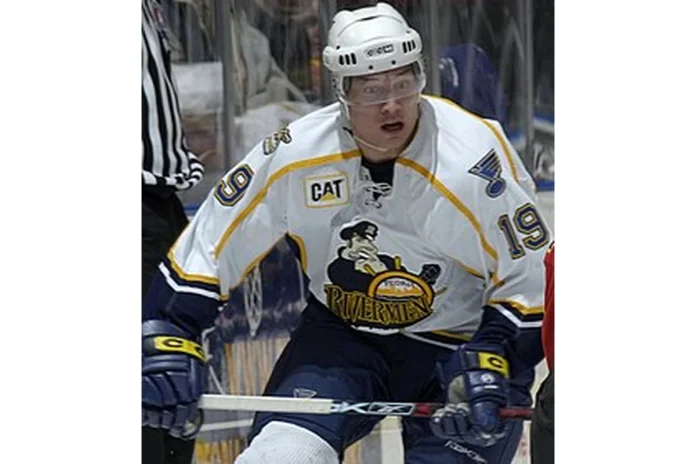
D.J. King Bio
Dwayne King Jr., known professionally as D.J. King, is a Canadian former professional ice hockey left winger who played in the National Hockey League (NHL) with the St. Louis Blues and the Washington Capitals. Recognized throughout his career as an enforcer, King began his professional career in 2004 and was drafted in the sixth round of the 2002 NHL Entry Draft, 190th overall, by the St. Louis Blues. Over the course of his playing days he was widely respected for his willingness to defend teammates and engage opposing tough guys.
Standing 6 ft 3 in tall and listed at 230 lb during his NHL tenure, King used his size and physicality to carve out a role as a fourth-line energy forward. He retired from professional hockey in 2013 and has since moved into business ownership and chuckwagon racing, a transition that reflects the same competitive spirit that defined his time on the ice.
Early Life and Background
Dwayne King Jr. was born on June 27, 1984, in Meadow Lake, Saskatchewan, Canada. He grew up in a Canadian Prairie community with deep roots in winter sports, and from a young age he gravitated toward hockey, the region’s dominant pastime. His upbringing in Meadow Lake helped shape the work ethic and toughness that later became trademarks of his professional career.
King is of Métis heritage, a background that connects him to a long tradition of Indigenous athletes in Canadian hockey. His younger brother, Dwight King, also pursued professional hockey, eventually playing in the National Hockey League and later competing in the Kontinental Hockey League with Avtomobilist Yekaterinburg. The family’s connection to the sport gave D.J. an early training partner and a familiar example of the path he hoped to follow.
As a teenager, King developed his game in the Western Hockey League, skating for both the Lethbridge Hurricanes and the Kelowna Rockets. It was during these junior years that his physical, confrontational style first drew league-wide attention, and it was here that he began to build the reputation as a fighter that would follow him to the professional ranks.
Path to Professional Hockey
King’s rise through junior hockey convinced scouts that he had the tools to compete at the next level. His combination of size, skating ability, and willingness to drop the gloves made him an attractive late-round pick for organizations looking to add toughness to their prospect pool. The St. Louis Blues selected him 190th overall in the 2002 NHL Entry Draft.
Following his draft year, King continued to refine his game with the Lethbridge Hurricanes and the Kelowna Rockets, where he took on a featured role as one of the Western Hockey League’s most recognizable enforcers. His junior résumé included a memorable bout against Dion Phaneuf, a fight that helped cement his reputation as a player opponents had to account for whenever he was on the ice.
After concluding his junior career, King signed his first professional contract and was assigned to Blues affiliates in the American Hockey League and the ECHL. He spent his first two professional seasons adjusting to the pace and physical demands of pro hockey, preparing for the opportunity he would receive to make his NHL debut in the fall of 2006.
D.J. King Career
Early Career (2004–2006)
From 2004 through 2006, King developed his professional game within the St. Louis Blues organization, skating for minor-league affiliates including the Peoria Rivermen of the American Hockey League. The time in the minors allowed him to sharpen his defensive responsibilities and adjust to the faster, more structured style of professional hockey.
During these development seasons, King continued to build his identity as a fighter, taking on opponents willing to engage him at both the AHL and ECHL levels. His steady progress through the system positioned him for a call-up to the NHL roster in the fall of 2006.
NHL Debut with the St. Louis Blues (2006–2007)
King made his NHL debut on October 5, 2006, against the San Jose Sharks, stepping onto the ice for the first time as a member of the St. Louis Blues. After that initial appearance, he was reassigned to the Peoria Rivermen, where he spent the bulk of the season while adjusting between levels.
Recalled by the Blues later in the year, King went without a point in his first 24 NHL games before breaking through with his first career goal. He scored against goaltender Curtis Joseph in a 5–2 victory over the Phoenix Coyotes on April 4, 2007, a milestone moment that validated years of work in the minors.
He finished his rookie NHL season appearing in 27 games for the Blues, registering two points consisting of one goal and one assist, along with 52 penalty minutes. Those numbers reflected his role as an energy forward whose value came as much from physical play as from offense.
Setbacks and Trade to the Washington Capitals (2007–2010)
King’s 2008–09 season was cut short by a shoulder injury that limited him to a single game with the Blues, a frustrating setback after the promise of his debut year. He returned for the 2009–10 season and immediately made his presence felt, defeating Krys Barch in a fight during his first game back. The victory was short-lived, however, as King broke an already-damaged finger in the bout, sidelining him for several months.
Throughout this period, King frequently moved between the American Hockey League and the NHL, never quite establishing himself as an everyday big-league player. On July 28, 2010, the Blues re-signed him to a two-year contract extension in order to facilitate a trade that sent him to the Washington Capitals in exchange for Stefan Della Rovere, giving him a fresh start with a new organization.
Washington Capitals and Final Seasons (2010–2013)
With the Washington Capitals, King continued to serve as a depth forward and enforcer, embracing the same role he had filled in St. Louis. He skated in games for the Capitals during the 2010–11 and 2011–12 seasons, providing physicality and energy while competing for limited minutes on a deep roster.
By the 2012–13 season, King was a free agent, and on February 20, 2013, he signed a contract with the Ontario Reign of the ECHL. He finished his playing career at the minor-league level, formally retiring from professional hockey in 2013 after a career that spanned nearly a decade.
Driving Style and Strengths
King’s on-ice identity revolved around physicality, fighting, and energy-line minutes rather than offensive production. He was particularly effective as a deterrent, using his 6 ft 3 in frame and willingness to engage to protect skilled teammates and shift momentum. His limited but well-timed scoring contributions, including his first NHL goal against the Phoenix Coyotes, showed that he could contribute in other ways when called upon.
Notable Events and Milestones
Among the signature moments of King’s career were his 2002 NHL Draft selection by the St. Louis Blues, his NHL debut against the San Jose Sharks in October 2006, and his first NHL goal against Curtis Joseph in April 2007. His high-profile bouts with fighters such as Colton Orr and Derek Boogaard, along with his Western Hockey League fight against Dion Phaneuf, remain the moments most associated with his reputation as one of the league’s notable enforcers of his era.
D.J. King Career Wins
D.J. King’s career was defined less by goal totals and more by fight victories and the intangible contributions an enforcer brings to a winning locker room. Across his time in the Western Hockey League, the American Hockey League, the ECHL, and the NHL, he established himself as a dependable physical presence willing to answer the bell against any opponent.
NHL Highlights
In the NHL, King’s most memorable individual highlights included his debut on October 5, 2006, and his first career goal against Curtis Joseph on April 4, 2007. He finished his time with the St. Louis Blues having appeared in dozens of games over multiple seasons before being traded to the Washington Capitals in July 2010.
Other Wins and Performances
Beyond the NHL, King posted a strong junior résumé with the Lethbridge Hurricanes and the Kelowna Rockets in the Western Hockey League, where his heavyweight bouts, including a fight with Dion Phaneuf, helped define his early reputation. He also contributed in the American Hockey League with the Peoria Rivermen and in the ECHL with the Ontario Reign, the team where he closed out his playing days.
D.J. King Family
Family Background and Racing Lineage
King is of Métis heritage, part of a proud tradition of Indigenous athletes in Canadian sport. His younger brother, Dwight King, pursued his own NHL career and later played for Avtomobilist Yekaterinburg of the Kontinental Hockey League, making the King brothers one of the more notable sibling pairs in recent hockey history.
Personal Life
King and his longtime partner Chantal Babin have two sons together. In 2015, he partnered with James Norman and Jeremy Norman to become an owner of Tawaw Cabins, a resort located in Waterhen Lake, Saskatchewan. The venture reflects King’s continued ties to his home province and his interest in building a life beyond the rink.
2025 Season Performance
In 2025, King stepped into a new competitive arena when he debuted at the Rangeland Derby at the Calgary Stampede as a chuckwagon driver. The appearance marked a public transition from his years as a professional hockey enforcer to a new chapter in western sport and entertainment.
His participation in chuckwagon racing drew attention because of his athletic background and his Saskatchewan roots, both of which made the move a natural fit for his public profile. King has continued to be involved with Tawaw Cabins and other ventures, balancing business ownership with his emerging role in the chuckwagon circuit.
While he is no longer active in professional hockey, King’s 2025 activities suggest a continued appetite for competition and a desire to remain connected to sport in a different form. Whether behind the reins of a chuckwagon or through his resort business, he remains a recognizable figure from his NHL days who has successfully reinvented himself after retirement.