New York Red Bulls Overview
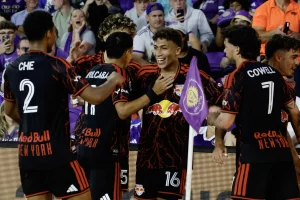
Red Bull New York, widely known as the New York Red Bulls, is a professional soccer club competing in Major League Soccer as a member of the Eastern Conference. Founded in 1994, the club began play in MLS’s inaugural 1996 season as the New York/New Jersey MetroStars before being purchased by Red Bull GmbH in 2006 and rebranded. The team is owned by Red Bull GmbH, plays its home matches at Sports Illustrated Stadium in Harrison, New Jersey, and is led by head coach Michael Bradley and general manager Marc de Grandpré. Known by nicknames including the Red Bulls and Metro, the club’s team colors are white, red, navy blue, and yellow, and its supporters affectionately call Sports Illustrated Stadium “The Fortress” because of the team’s dominant home record.
New York Red Bulls Competitive Journey
Across nearly three decades, the New York Red Bulls have evolved from a struggling inaugural side into one of MLS’s most consistent playoff participants. The club’s competitive journey includes two MLS Cup final appearances, three Supporters’ Shield titles, two U.S. Open Cup final appearances, and a deep run in the CONCACAF Champions League. Along the way, the team has cycled through more than a dozen head coaches, multiple sporting directors, and a global network of player development, all while maintaining a reputation for high-pressing, energetic soccer.
Founding and Organizational Origins
The franchise was established in 1994 under the working name Empire Soccer Club, a name that later inspired the Empire Supporters Club. Original owners John Kluge and Stuart Subotnick selected the MetroStars name in reference to Kluge’s media company Metromedia, after Nike’s original suggestion of MetroFlash was rejected. The owners also explored acquiring the rights to the Cosmos name but decided against it. Tab Ramos, the first player signed in MLS history, became the first MetroStars player, joined by 1994 FIFA World Cup teammate Tony Meola and AC Milan midfielder Roberto Donadoni. Peter Vermes was named the team’s first captain, and Eddie Firmani, a former New York Cosmos star, was hired as the first head coach.
From the outset, the MetroStars were expected to dominate MLS, but the team never quite clicked. In the first home match, an own goal by Nicola Caricola handed the New England Revolution a 1–0 win in front of 46,000 fans, an incident later dubbed the “Curse of Caricola” by frustrated supporters. Firmani departed after only eight games, and the team cycled through coaches and players, hitting a low point in 1999 with a 7–25 record under Bora Milutinović, the worst in MLS history. Despite that collapse, the club captured the Eastern Conference title in 2000 after acquiring German icon Lothar Matthäus and watching Clint Mathis set an MLS record with five goals in a single game against the Dallas Burn.
Growth Into MLS Competition
The MetroStars’ path into the upper tier of American soccer featured a mix of European signings and homegrown talent. Manager Bob Bradley, a New Jersey native, arrived in 2003 and immediately led the team to the U.S. Open Cup final and a playoff berth. Under Bradley, the MetroStars became the first MLS team to win a trophy on foreign soil by capturing the 2004 La Manga Cup in Spain, defeating Dynamo Kyiv and Viking FK. Following Bradley’s midseason dismissal in 2005, Austrian energy drink conglomerate Red Bull GmbH purchased the franchise on March 9, 2006, and immediately began a sweeping rebrand that changed the name, colors, and crest.
Red Bull had originally explored creating an MLS expansion club in New York City proper, but the cost of buying out the MetroStars’ territorial rights and the difficulty of finding a stadium site led the company to acquire the existing franchise instead. The territorial rights to a second New York area club eventually returned to MLS and were later used for the launch of New York City FC. In the years that followed, the Red Bulls invested heavily in star players, including Thierry Henry, Rafael Márquez, and Tim Cahill, while building one of the most sophisticated player development pipelines in North America.
Early Seasons and Development (1994–2005)
The MetroStars’ first decade in MLS was defined by inconsistency and unmet expectations. The team reached the playoffs in 1996, 1997, 1998, 2000, 2003, 2004, and 2005, but rarely advanced deep into the postseason. The arrival of Bob Bradley in 2003 brought the club its first taste of trophy contention, including the 2003 U.S. Open Cup final and the 2004 La Manga Cup. Early sponsors and investors helped the team build a foundation, but on-field results lagged behind the star power of players like Roberto Donadoni, Tab Ramos, Giovanni Savarese, and Lothar Matthäus. By the time Red Bull took over in 2006, the MetroStars had been to one conference final and had not won a major domestic trophy.
Despite the frustrations of the early years, the MetroStars developed a passionate fan base that organized into supporters groups, including the Empire Supporters Club, which was founded in 1995 before the team had even played a game. These groups laid the groundwork for the vibrant matchday culture that continues to define the franchise today. The club’s inability to deliver a championship, combined with a string of coaching changes, set the stage for the sweeping transformation that came with Red Bull’s purchase of the team.
Breakthrough in MLS (2006–2014)
Under Red Bull’s ownership, the club began a rapid climb up the MLS ladder. The 2008 season ended with a run to the MLS Cup final against the Columbus Crew, a 3–1 loss that gave the Red Bulls their first appearance in the league’s championship game. Two years later, the opening of Red Bull Arena in 2010 ushered in a new era, with the team clinching first place in the Eastern Conference for the first time since 2000 and setting an MLS record for best single-season improvement. The signings of Thierry Henry, Rafael Márquez, and Tim Cahill turned the Red Bulls into a regular playoff side, though a series of postseason disappointments kept the trophy cabinet empty.
The breakthrough finally arrived in 2013, when first-year head coach Mike Petke, a former MetroStars and Red Bulls player, led the team to the Supporters’ Shield with the best regular-season record in MLS. The 2014 season brought another deep playoff run, with the Red Bulls advancing to the Eastern Conference final before falling to the New England Revolution. By the end of 2014, the club had established a new identity built on a strong defense, an emerging academy, and a long streak of consecutive playoff appearances.
Modern Program and Current Direction (2015–Present)
The hire of Jesse Marsch in 2015 ushered in the era of “Energy Drink Soccer,” a high-pressing style modeled on the global Red Bull network. Marsch won two more Supporters’ Shields in 2015 and 2018, and his teams consistently set the pace in the Eastern Conference. The 2016 season produced a 7–0 win over New York City FC, the largest margin of victory in Hudson River Derby history. The Red Bulls also broke through in continental play during this period, qualifying for the 2018 CONCACAF Champions League semifinals after becoming the first MLS club to win by multiple goals on Mexican soil.
After Marsch’s departure in 2018, the club cycled through Chris Armas, Gerhard Struber, Troy Lesesne, and Sandro Schwarz, while continuing to invest in young players and the global Red Bull pipeline. The Schwarz era peaked with a 2024 run to the MLS Cup final against the LA Galaxy, a 2–1 loss that gave the Red Bulls their second appearance in the league’s championship game. Following the 2025 season, the club named former MetroStar and United States captain Michael Bradley as its new head coach. Under Bradley, the Red Bulls are refocusing on a long-term succession plan built around the academy, a brand-new $100 million performance center, and the playing style that has defined the franchise for the last decade.
Philosophy and Competitive Strengths
The Red Bulls’ identity is built on high-pressing, athletic, and direct soccer that emphasizes winning the ball back quickly and launching fast attacks. The team’s signature strength has long been its home form at Sports Illustrated Stadium, where the famous “Fortress” mentality has produced the most home wins in MLS history. Combined with one of the strongest academy systems in North America, the Red Bulls have built a roster that mixes young, high-energy talent with experienced veterans from the global Red Bull network.
Key Milestones and Major Moments
Notable milestones include the 2008 MLS Cup final appearance, the 2010 opening of Red Bull Arena, three Supporters’ Shield titles in 2013, 2015, and 2018, two U.S. Open Cup final appearances in 2003 and 2017, the 2018 CONCACAF Champions League semifinal run, and the 2024 MLS Cup final appearance. Off the field, the franchise has continued to expand its infrastructure with the launch of New York Red Bulls II in 2015, the opening of the $6 million training facility in Hanover in 2013, and the construction of the 80-acre RWJBarnabas Health Red Bulls Performance Center.
New York Red Bulls Achievements and Results
The New York Red Bulls have built a competitive resume that includes three Supporters’ Shield titles, two MLS Cup final appearances, two U.S. Open Cup final appearances, and a deep run to the CONCACAF Champions League semifinals. While the club has yet to lift the MLS Cup, its consistent regular-season success and its record-setting run of 15 consecutive playoff appearances have cemented its place among the league’s most competitive franchises.
MLS Achievements
The Red Bulls have won three Supporters’ Shield titles, awarded to the team with the best regular-season record, in 2013, 2015, and 2018. The club reached the MLS Cup final in 2008, falling 3–1 to the Columbus Crew, and again in 2024, losing 2–1 to the LA Galaxy. The franchise has also qualified for the MLS Cup Playoffs in 15 consecutive seasons, a North American sports record, with the streak ending in 2025.
Conference Achievements
The Red Bulls have won the Eastern Conference regular-season title in 2000 and 2010, and they have advanced to the Eastern Conference final on multiple occasions, including 2014, 2015, and 2024. The team has also been a fixture in the Eastern Conference playoff race, finishing in the top six of the conference 12 times in the 15-year run that ended in 2025.
Divisional Achievements
Within the Eastern Conference’s divisional structure, the Red Bulls have consistently ranked among the top teams in the Atlantic Division and later the Eastern Conference as a whole. The club has won the Eastern Conference regular-season title in 2000 and 2010, and has produced division-level finishes that have helped it earn home-field advantage in the MLS Cup Playoffs on several occasions.
Series Achievements
The Red Bulls have participated in three major U.S. Soccer series competitions, including the MLS Cup Playoffs, the U.S. Open Cup, and the CONCACAF Champions League. The franchise reached the U.S. Open Cup final in 2003 and 2017, and advanced to the CONCACAF Champions League semifinals in 2018, becoming the first MLS club to win by multiple goals on Mexican soil during that campaign.