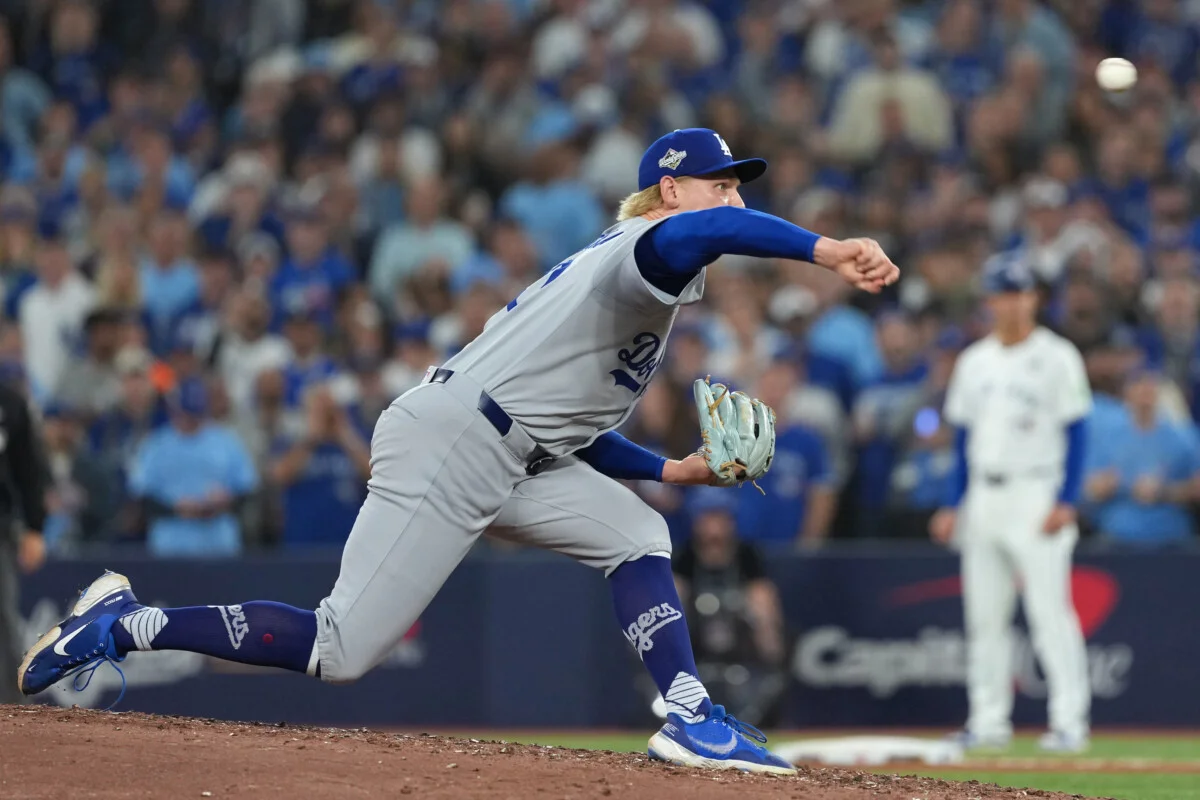
Emmet Sheehan aims to secure Dodgers rotation spot in 2026. [Image Source: DODGERSNATION]
The Los Angeles Dodgers face a pivotal offseason as they work to finalize their pitching rotation for the upcoming season, with Emmet Sheehan emerging as a key contender for a starting role. While the Dodgers boast an elite frontline including Shohei Ohtani, Yoshinobu Yamamoto, Tyler Glasnow, and Blake Snell, concerns over Snell’s offseason shoulder soreness and the team’s innings management strategy have elevated the importance of depth at the back end of the rotation. With two rotation spots open, Sheehan, alongside Roki Sasaki and River Ryan, aims to overcome past injuries and compete for these crucial roles.
Snell’s uncertain start to the year has intensified the competition behind the Dodgers’ stars. Sasaki, the notable off-season free agent acquisition, has battled shoulder impingement issues and carries previous Tommy John surgery concerns. Both Sheehan and Ryan have recovered from Tommy John surgery, with Sheehan missing all of 2024 and Ryan sitting out the previous season after his UCL injury. All three pitchers entered spring training healthy and are determined to prove their readiness to contribute to the Dodgers’ rotation.
Sheehan’s Journey Through Recovery and Spring Preparation
Emmet Sheehan has focused on sustaining his health and improving his conditioning, aiming to make an impact as a starter throughout the season. Before a recent spring training game, he emphasized his approach:
Image of: Emmet Sheehan
“I’m just trying to set myself up as best as possible to be healthy at the end of the year and contribute at the end of this year,”
he shared.
“Whether that’s getting stronger, moving a little bit better, understanding my throw a little bit better.”
Sheehan’s 2025 campaign marked a significant milestone in his comeback. After gradually returning to form with 17.2 innings at Triple-A, he dominated 73.1 innings with the Dodgers, posting an impressive 2.82 ERA, a 0.97 WHIP, and a strikeout rate of 30.6%. However, his transition to the bullpen during the playoffs proved more challenging, as he posted an 8.59 ERA in his relief appearances. Despite this setback, Sheehan described the postseason experience as invaluable for his growth:
“I think just being able to contribute and help in the playoffs was a really great feeling,”
Sheehan said.
“I struggled early in the playoffs a lot, so to be able to turn that around towards the end was a great feeling.”
Refining Skills: How Bullpen Experience Informs Sheehan’s Starting Role
Sheehan believes that his time in the bullpen strengthened his mental approach to pitching. The need to be fully prepared from the first pitch in relief has shaped his mindset as a starter. He explained,
“Coming out of the bullpen, just being ready from pitch one is an advantage as a pitcher. Hitters only get three or four at-bats a game, so they’re gonna be ready for every pitch. If you’re not completely locked in when you get out there, you’re at a disadvantage. I think it’s good to have a mix of both because, starting, you have to figure out how to navigate a lineup maybe three times, where you shouldn’t show all your cards early, and then maybe save them for later. But as a bullpen guy, you’re only facing five or six hitters at the most, and you can show all your cards whenever you want. But I think it’s a good mix.”
In 2025, Sheehan adjusted his pitching strategy by increasing his reliance on his slider, throwing it about 30% of the time overall and nearly 41% against right-handed hitters. This was a noticeable jump from 2023, when he threw his slider 20% of the time overall and 34% against righties. The slider proved effective with a 24.4% swinging strike rate, and it became a potent two-strike pitch for left-handed batters, boasting a 32.4% PutAway Rate. However, lefties managed to hit his slider hard, prompting Sheehan to leverage his changeup more to get ahead in counts. The changeup demonstrated solid control with few hard contacts allowed, even though its swinging strike percentage lagged behind the slider.
Another notable mechanical change in 2025 was an increase in Sheehan’s arm angle from roughly 30 degrees in 2023 to 35 degrees, which influenced both pitch movement and effectiveness. Reflecting on this adjustment, Sheehan said,
“When my delivery was right, before I got called up in 2023 in Double-A, I was throwing harder, I was feeling better, my arm slot was a little bit higher,”
he said.
“When I got up to the big leagues, for whatever reason that year, [my arm slot] just dropped naturally. Getting back to the way the throw was before, and the way it was supposed to be, was big.”
This change in arm slot reduced horizontal movement on his four-seam fastball and increased vertical rise, leading Sheehan to throw the pitch higher in the strike zone 73% of the time in 2025—a 10% increase. This higher fastball location played a key role in generating strikes and a notable swinging strike rate on the pitch despite its flatter trajectory.
Rotation Contenders Beyond Sheehan: Sasaki and Ryan’s Competition
While Sheehan looks poised to secure one of the rotation spots, the other positions remain fiercely contested. Roki Sasaki is a high-profile candidate working on incorporating a third pitch this offseason, but his four-seam fastball’s efficiency (a 5.5% swinging strike rate ranking in the bottom 4% of the league last year) suggests he may need further refinement in the minors before solidifying a rotation role. This uncertainty could open the door for River Ryan, whose skillset and physical conditioning have drawn growing attention.
River Ryan’s Rehabilitation and Readiness After Tommy John Surgery
Ryan, a 27-year-old 11th-round draftee from UNC Pembroke in 2021, quickly ascended through the Dodgers’ system—from primarily an infielder to a respected pitching prospect ranked 5th within the organization before his 2024 injury. In limited minor league innings in 2024, Ryan dazzled with a 1.33 ERA, 1.18 WHIP, and a strong strikeout-to-walk ratio, but a UCL tear in August against the Pirates sidelined him for the entire 2025 campaign.
Absent a traditional minor league rehab timeline due to the shortened season, Ryan paused his recovery late last year after completing live bullpen outings. He described this phase:
“Last year, I had a normal rehab process here in Arizona. I did my live outings, and, unfortunately, when I was done with my lives out here, there wasn’t anywhere to go do rehab outings,”
he explained.
“All the minor league seasons were over, so it was either jump straight from throwing in the backfield to pitching in the postseason, which I was prepared to do, but we all had a talk, and came to the consensus of just having a normal off-season. So I shut it down for a little bit at the end of the year, and then rebuilt my arm throughout the off-season, and had a normal throwing progression. It’s led me to have a normal offseason, normal spring training, and be ready for opening day.”
Sharpening Pitching Arsenal and Conditioning
Ryan has concentrated on honing his pitch selection, particularly focusing on his “out” pitches to efficiently reach two-strike counts. He explained,
“Just really fine-tuning my arsenal,”
adding,
“Learning what pitches are my out pitches. What pitches can I go to to get to two strikes as fast as I possibly can? Then anything goes from there.”
His primary “out” pitch is a slider he threw to righties nearly 40% of the time in 2024, which, while not overpowering in strikeouts during that small sample, showed promise with a close to 30% PutAway Rate. He also commands a two-plane curveball effective against left-handed hitters and an upper-90s fastball with “ride.” Complementing these are a sinker and cutter designed to keep hitters off balance by preventing them from sitting on his four-seam fastball.
Ryan’s comprehensive pitch mix combined with his physical development places him among baseball’s top prospects, currently ranked 55th according to Keith Law. His arsenal remains largely consistent entering 2026, but the mental and tactical improvements developed during rehab—especially accelerating the path to two strikes—are expected to elevate his game. He reflected on this mental growth:
“It was just diving into the cerebral side of how to get guys out and how to get them out fast, and how to collect punchouts when I can… It was just watching a lot of video of myself, especially early on, from where I started to where I am now. Noticing the changes and what works and building a routine based on what has worked for me.”
Building Strength to Sustain Performance Over a Full MLB Season
To complement his pitch refinement, Ryan prioritized improving his body’s durability to meet MLB demands. He focused on gaining weight and muscle mass, moving from about 190-195 pounds at the time of his UCL injury to roughly 231 pounds after offseason training. He described how this transformation affected his endurance and velocity:
“It was really just trying to put on weight when I was down and to be as healthy as I can coming into the year and manage a workload that I’m prepared to manage,”
Ryan said.
“When I tore my UCL in 2024, I was 190-195 pounds, and I was like, ‘Dude, I really need to make a change.’ I just really got into the weight room and worked my butt off in there. I ate as much as I could, and I got to like 231 [pounds], and I noticed that my body was able to take the high intensity and high velocity throws for a lot longer. I was able to maintain a lot of stamina instead of having to work so hard.”
This added strength may serve to lessen stress on Ryan’s arm, as stronger legs aid in driving pitches, reducing arm compensation during fatigue and possibly increasing longevity. Similar physical development contributed to Carlos Rodon’s career breakthrough after addressing his injury struggles with enhanced lower-body strength.
Ryan’s Priority: Staying Healthy and Flexible Role Acceptance
Despite possessing potential for a breakout, Ryan’s foremost goal is to complete a healthy season, regardless of role. He stated plainly,
“My main goal is to have a healthy season,”
continuing,
I think it would build a lot of assurance and confidence in the things that I’ve been through to know that my body can handle it.”
Ryan remains open to contributing either as a starter or out of the bullpen, signaling his team-first approach and adaptability.
“I’m just doing everything I can to prepare myself for any role and any situation. Obviously, I want to be in the starting rotation, and I think I have a lot to offer, but I also know that we have a ton of guys, and the main goal is to be healthy and pitch in the big leagues. Whether that’s in the starting rotation or coming out of the bullpen, I’m prepared for both.”
If Ryan secures a rotation spot, his upside could make him a difference-maker for both Dodgers fans and fantasy managers. Combined with Sheehan’s trajectory and Sasaki’s development curve, the Dodgers’ back-end rotation competition will be an important storyline as they aim to defend their World Series championship.