
Denny Hamlin has raised concerns about the upcoming Darlington race, predicting that NASCAR’s 2026 aerodynamic and horsepower package will lead to unusually erratic car behavior. Speaking at Phoenix Raceway, Hamlin highlighted how the new setup, which modifies underbody aerodynamics and increases engine power, will present fresh challenges at several tracks, including Darlington.
Overview of NASCAR’s New Aerodynamic and Power Package
NASCAR has rolled out a revised short-track and road-course aerodynamic package featuring 750 horsepower, designed to be used at select events starting this season and continuing into 2026. This package reduces the influence of underbody aerodynamics through a simplified diffuser and lowered spoiler height while boosting engine horsepower beyond the current intermediate-track specifications.
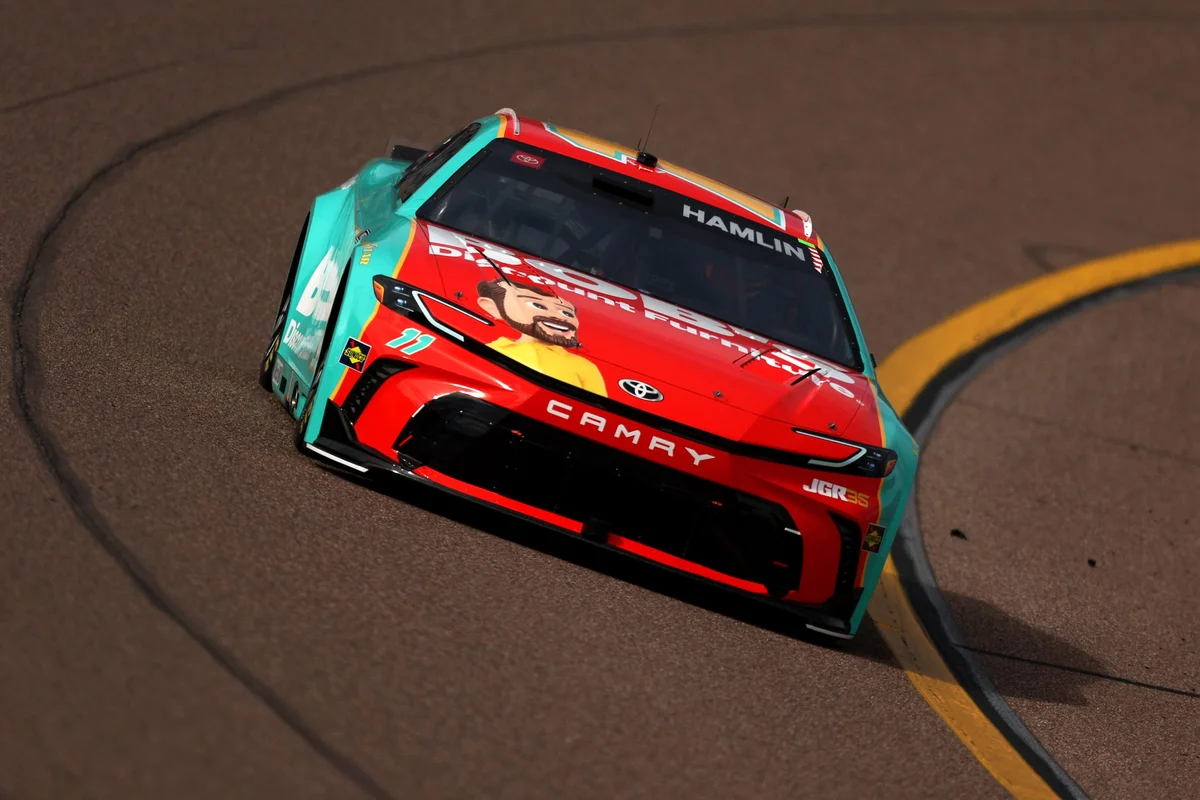
Phoenix Raceway served as the first oval track to implement this setup with the current generation car. Following Phoenix, the same mechanical and aerodynamic characteristics will be applied at venues like Darlington, Bristol, Dover, Nashville Superspeedway, and World Wide Technology Raceway. The newly introduced combination immediately affected driver and team strategies, especially regarding tire management and vehicle control.
Changes Observed at Phoenix and Expectations for Darlington
The increase in horsepower paired with reduced aero grip at Phoenix resulted in elevated tire degradation, compelling drivers to adopt careful throttle and steering inputs over long green-flag runs. Hamlin acknowledged that the overall racing quality improved modestly but expected a more pronounced reaction at Darlington due to the upcoming short-track aerodynamic package.
“It’s going to be a small incremental change,” Hamlin said on Actions Detrimental (40:02 onwards). “What was the racing truly better this time around? Was it 10%, maybe fifteen. But it’s something. I think you’ll see the same change at other racetracks.”
Despite the incremental improvements seen so far, Hamlin issued a strong warning about the unique challenges the Darlington race will present.
“One thing I will tell you is heads up on Darlington,” he added (40:22 onwards). “You want to see some cars out of control here in a few weeks. These cars with essentially little to no underbody, because we’re going to the short track aerodynamic package for Darlington, these cars are out of control.”
Hamlin clarified that the reduction in underbody aero grip means drivers will have to depend more on mechanical grip and carefully manage tires, leading to a likely sharp decline in tire performance during sustained green-flag periods.
“I’m predicting four seconds of falloff,” Hamlin continued. “It might be more. With that underbody gone and the simple diffuser, even on new tires, the cars are just absolutely out of control. So it’s going to be a wild-card race.”
This prediction refers to tire falloff, where lap times decrease as tires degrade. A drop of about four seconds per lap may force teams to rethink their race strategies significantly.
Hamlin’s Strong Run at Phoenix Amid Tire Concerns
Hamlin’s insights on the 2026 package come after a solid fifth-place finish at Phoenix Raceway, where he earned 15 stage points—third best for the event—and boosted his championship standing from 23rd to 12th. His steady performance underscored his adaptability to the new setup amid rising tire wear challenges.
At Phoenix, NASCAR used a Goodyear tire compound engineered for increased durability and compatibility with multiple racing lines. However, as the race progressed, tire degradation became evident, forcing drivers to adjust driving techniques to avoid loss of grip. Tire-related incidents affected competitors including Kyle Busch and Shane van Gisbergen, underlining the package’s impact on race dynamics.
Despite these difficulties, many drivers viewed the changes positively, appreciating the combination of higher horsepower and greater tire wear as a way to promote more overtaking and strategy variations. For Hamlin and his Joe Gibbs Racing team, the Phoenix race highlighted the direction NASCAR is heading and bolstered his confidence heading into the rest of the Cup Series events.
Looking Ahead to Las Vegas and the 2026 Season
Before the Darlington race, Denny Hamlin and other Cup Series drivers will contest the Pennzoil 400 at Las Vegas Motor Speedway on March 15. This intermediate track event will offer another testing ground for understanding how the 2026 aerodynamic and power changes continue to affect racing performance and tire management.
The upcoming Darlington race promises to be a significant test for drivers, with Hamlin’s warnings indicating potentially unpredictable and thrilling racing as teams adapt to cars with reduced underbody downforce and increased horsepower. The evolution of this package across multiple racetracks will likely redefine strategies and vehicle setup approaches throughout the season, as drivers seek to master the delicate balance between speed and control.

