
Donovan Clingan has shown impressive growth in his second season with the Portland Trail Blazers, establishing himself as a key part of the team’s future. His biggest contributions have come on defense, where his presence offers Portland a reliable anchor inside the paint. At 7-foot-2 and 280 pounds, Clingan’s rare combination of size and strength makes him a top-tier rebounder and rim protector, a skill set he demonstrated at UConn and has successfully brought to the NBA.
Despite these strengths, Clingan’s performance reveals a troubling weakness—his struggles on the perimeter. While dominant inside, he frequently becomes vulnerable when forced to guard opponents away from the basket, a concern that poses risks for Portland moving forward.
Perimeter Exposures Highlighted Against Key Opponents
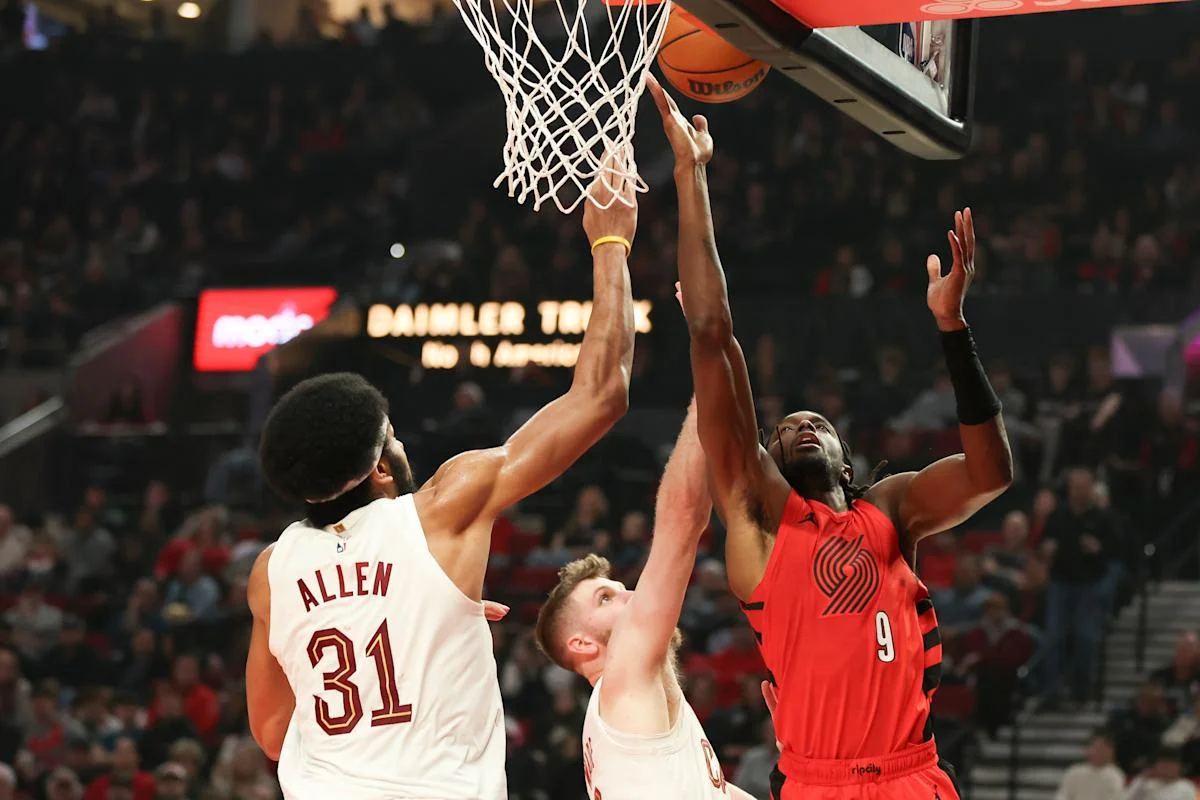
Clingan’s defensive limitations became apparent during Portland’s 130-111 loss to the Cleveland Cavaliers, where he had difficulty containing the quicker Jarrett Allen, who racked up 40 points and 17 rebounds. This issue reappeared in a closely contested 130-125 defeat to the Phoenix Suns. Although Clingan started strong by making three early three-point shots, Phoenix exploited mismatches on the perimeter, targeting Clingan’s defensive weaknesses.
The Suns shot an efficient 49 percent from beyond the arc, with many attempts falling against Clingan, who was often switched onto smaller, faster guards. On multiple occasions, Clingan failed to effectively navigate screens, giving shooters like Collin Gillespie and Grayson Allen too much freedom to score. These moments underscore the challenge Portland faces in trusting Clingan against perimeter-oriented offenses.
Coaching Strategy Versus Player Limitations
Some of Clingan’s limited perimeter engagement is intentional, as head coach Tiago Splitter prefers to have him focus on protecting the paint. However, this approach also reveals a gap in Clingan’s defensive skill set that cannot be ignored. Frequently caught hesitating or out of position, Clingan finds himself in “no man’s land,” struggling to close out shooters in a timely fashion. This hesitation leaves the Blazers vulnerable, and in today’s NBA, where many teams emphasize long-range shooting, it restricts Clingan’s effectiveness on the court.
As a result, Clingan currently offers tangible value only in selective matchups. Facing teams like the Suns or quick big men such as Jarrett Allen limits his impact and creates scenarios where his presence is a disadvantage. Since numerous NBA teams feature perimeter threats or agile centers, this weakness complicates Portland’s roster decisions and game strategies.
Necessity for Offensive Development and Adaptation
Given his perimeter difficulties, Clingan must also improve offensively to remain a consistent threat. Expanding his skills to punish smaller, faster defenders would provide Portland with more offensive balance and reduce the tradeoff currently facing the team. Without this adjustment, Clingan risks being sidelined during critical stretches against versatile lineups, which could delay Portland’s plans surrounding one of their foundational players.
Future Implications for Portland Trail Blazers
Donovan Clingan’s defensive prowess inside remains a cornerstone for the Trail Blazers’ future, but his clear vulnerabilities beyond the paint present urgent challenges. Addressing his perimeter defense—or compensating with offensive growth—will be essential for him to maintain his role as a key contributor. Portland’s success hinges on how effectively Clingan adapts to the evolving demands of the NBA, where versatility and defense away from the rim have become increasingly important.
