
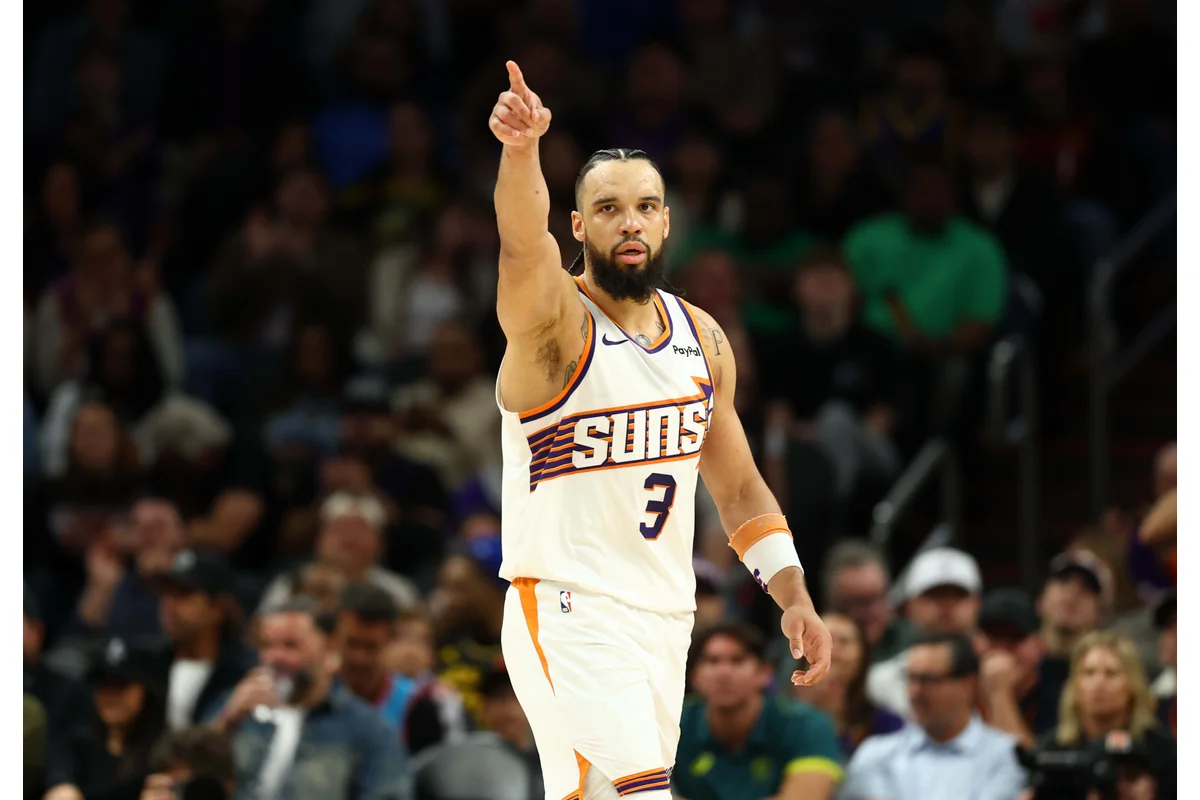
Dillon Brooks is experiencing a dramatic shift in his NBA career during the 2023-24 season with the Phoenix Suns, transforming from primarily a defensive specialist to a prolific scorer. Since arriving in Phoenix via the Kevin Durant trade last offseason, Brooks has seen his scoring surge to a career-high 21.2 points per game, propelling the Suns to a strong 32-23 record as the league approaches the All-Star break. This breakout season has allowed Brooks to showcase a side of his game that was previously limited.
Brooks reflected,
“exactly the way I wanted it.”
While his defensive tenacity remains intact, it is his offensive evolution—taking more post-up shots, attacking the midrange, and scoring efficiently—that stands out. His emergence has injected a critical scoring dimension into a Suns roster adjusting to the loss of stars like Kevin Durant and Bradley Beal.
Preparing for Phoenix: Confidence Built Over Summer Workouts
As teammate Ryan Dunn noted,
“no one really knew what he could do”
offensively before this season began. However, Brooks saw his offensive breakout coming long before his first Suns game. Spending much of last summer training intensely in his hometown of Mississauga, Ontario, including facilities like Father Henry Carr and Humber Lakeshore, he focused relentlessly on enhancing his scoring skills.
Brooks said,
“getting my post-up touches, getting to the midrange, just scoring efficiently out there.”
He embraced the trade and the opportunity it presented to redefine his role, explaining,
“That’s why I wasn’t mad about the trade.”
Unlike a crowded offense in Houston, Phoenix offered him the chance to become a primary scoring threat.
In his Suns debut in October, despite an off night from three-point range, Brooks scored 22 points and asserted his confidence boldly. After sinking a clutch isolation jumper, he declared to DeMar DeRozan,
“I worked on my shit, too.”
That moment signaled the new direction for Brooks, setting the tone for his season.
Consistent Scoring and Increased Offensive Responsibility
Brooks’ confidence has translated into remarkable consistency. He has posted 25 or more points in 16 games, including a 40-point outburst against the Detroit Pistons recently. Reflecting on his scoring patterns, he said,
“I had years where I would do it some and then it would slowly fall off. But now, I’m motivated to do it every single night. I’m like a fiend for that feeling every single night.”
This consistency differentiates his current season from previous ones. Though he averaged 18.4 points with Memphis in 2021-22, his efficiency was lower. Now, his offensive production is more reliable and impactful, contributing to the Suns ranking 11th in net rating with an offense rated better than last season and above league average.
Brooks expressed the determination driving him:
“I just wanted to prove critics wrong,”
referencing skepticism around both his and the Suns’ potential. His growing impact has not gone unnoticed, with Charles Barkley publicly advocating for Brooks to secure an All-Star Game selection, a milestone Brooks narrowly missed.
“I feel like I always had it, I just needed to work on it,”
Brooks said.
“I just needed the motivation to get to that point. It took me three years.”
A Difficult Ending in Memphis Fuels New Motivation
The struggles Brooks experienced in Memphis serve as a powerful motivator for his improvement. He has deliberately distanced himself from the painful memories of the 2023 playoff series against the Lakers, which saw his shooting slump and public confrontations.
Reflecting on that series, Brooks said,
“I put those to rest because it wasn’t a picture of myself.”
The series was difficult: Brooks shot just 31.2% from the field and 23.8% from three-point range, experienced a flagrant foul ejection, and faced criticism for his conduct postgame. Memphis’ General Manager Zach Kleiman had instructed him to limit his shots, and the team did not re-sign him, making Brooks feel scapegoated.
David Tyndale, Brooks’ skills trainer, described this period as “embarrassment.” He said,
“Feeling like you can’t affect the game in a certain way, shooting the ball bad, the crowd’s saying this and that about you. On top of that, people start creating narratives and talking mad shit, like, ‘Oh, he’s going to play in China,’ all type of shit. That was just a tough time, dark time. He never really shows it — he’s a big, bad guy — but I know deep down that really hurt him.”
Since that painful chapter, Brooks has been resolute about reshaping his career.
“I don’t give any team or coach or GM an excuse to treat you like that,”
he said. The summer after his Memphis departure, Brooks and Tyndale rebuilt his shooting mechanics from the ground up, addressing long-standing technical issues including shot release speed, knee bend, and follow-through.
Dedicated Training and Technical Refinement
Tyndale recalled the painstaking work on Brooks’ mechanics:
“He was big on his knees going in a lot on his shot. It was a bad, bad habit. I felt like he wasn’t using his glutes and wasn’t using his hips.”
They worked on keeping the ball higher at the catch and speeding up Brooks’ release. Tyndale often joked,
“Every time he shot a shit shot, I would tell him, ‘Shit hands,’”
though Brooks did not always appreciate the critique.
Brooks committed to intense training, frequently returning for additional shooting sessions that sometimes involved making 500 three-pointers. This effort quickly bore fruit: with the Canadian national team at the FIBA World Cup, he shot 59.4% from the field and 58.8% from three-point range across eight games, highlighted by a 39-point performance against Team USA in the bronze medal game.
His three-point accuracy also improved significantly from his time with Houston, climbing from 35.9% to 39.7% in his second season. Once confident with his shooting, Brooks and Tyndale shifted focus towards increasing scoring output through post-up moves. Brooks explained,
“Post up. I worked on my post-up for two years and now it’s efficient enough where I can just be so confident to break off a play with 20 seconds left and post up a guy that I feel like I have a matchup on and be able to score every single time.”
Enhanced Scoring Techniques Boost Offensive Versatility
This season, Brooks is scoring out of post-ups at double the rate he had in his 345 games with Memphis, demonstrating his more precise and surgical scoring approach. Tyndale noted,
“In his Grizzlies days, Brooks couldn’t tell me what footwork he preferred going into a catch-and-shoot 3. Last summer, we broke down one move and worked on it over and over for a week.”
Brooks studied the midrange techniques of NBA greats such as Kawhi Leonard, Carmelo Anthony, Paul Pierce, and Kobe Bryant to improve his ability to create space and attack at different angles. Tyndale commented,
“What we focused on was his attack angles, his bumps, being able to be physical and bump people.”
This physicality complements Brooks’ defensive reputation, adding a new dimension to his game.
Motivation remains high, as Tyndale urged him to “chase 30,” a reference to a $30 million annual contract in Brooks’ contract year. Despite that, Brooks’ motivation is internal—he still often returned to work on shooting even when advised to rest. Tyndale said, “He could not help himself.”
Impressing Teammates and Coaches With Offensive Growth
Brooks’ development quickly captured the attention of his teammates. Suns guard Collin Gillespie said,
“I thought he was a 3-and-D guy,”
but witnessed Brooks’ advanced array of moves in pick-up games during training camp.
“The handle, the moves in the mid-post, getting to his spots, creating his own shot, I saw all that in the summertime and I was like, ‘Whoa, I didn’t know he had all this.’”
Devin Booker praised Brooks’ imaginative approach, saying,
“Exactly how he trains in the practice gym is how it turns out in the real game,”
calling Brooks’ scoring emergence “a relief for everybody.” Gillespie added,
“I didn’t know how efficient it would be, like throughout the whole year, but he’s been unbelievable for us. And we’ve needed all of it.”
Brooks’ Importance on a Roster Facing Injuries
Brooks has proven more essential to Phoenix’s offense than anticipated, especially since teammates who could share offensive burdens have missed significant time. Jalen Green, also acquired in the Durant trade, has been sidelined for most of the season. Booker, Phoenix’s franchise player, has missed 12 games, and Grayson Allen has been out for 20 games while taking on a larger offensive role.
Notably, only 44% of Brooks’ made baskets have been assisted this season, down from 70% last year, highlighting his ability to create his own shots. His midrange shooting accuracy has reached a career-high 47%, despite an increase in shot volume, according to Cleaning The Glass.
Allen, who played alongside Brooks in Memphis, emphasized his value:
“The ability to get off a good look for himself in these one-on-one situations, it adds a lot to our offense. When we get stalled up, we can go to a guy like that who can just create his own look and it be a good shot. So it’s really helpful. And for a guy who has played off-ball most of his career, it’s a really big thing to have.”
Continuous Learning and relentless work ethic define Brooks’ evolution
Suns coach Jordan Ott acknowledged Brooks is still refining his skills. Highlighting a 4-for-16 shooting night where the Detroit Pistons aggressively defended Brooks, Ott said,
“That’s what’s cool about all this.”
After reviewing the game tape, Brooks demonstrated his ability to bounce back with a 40-point game in a rematch against Detroit.
Brooks’ commitment to improvement is evident in his routine. The night after the Detroit loss, Ott encountered Brooks en route to the NBPA facility in Manhattan for extra training. On off-days between games, Brooks engages in rigorous drills encompassing ball-handling, form shooting, and quick-release jump shots under tight time constraints, sometimes training for an hour to an hour and a half even on “lighter days.”
Postgame, Brooks’ trainer Tyndale meticulously analyzes his minutes and possessions, providing detailed feedback on aggression and effort. Organized film breakdowns routinely arrive within 12 hours. Tyndale called this “a beautiful thing to see,” comparing it to prior years when Brooks lacked these habits. Preparing in Atlanta as Brooks arrived off the team plane, Tyndale planned to spend the upcoming month closely training his client.
Brooks Sets High Standards for Himself and Team
Now nine years into his career, Brooks is more invested than ever in maximizing his potential. He aims to be a leader and example within the Suns organization by maintaining high standards. “I keep everything fine-tuned,” Brooks said. In Phoenix, he has become both a culture-setter and a reliable scorer alongside his established status as a lockdown defender.
Brooks expressed his enduring mindset:
“No matter what age I’m at, no matter what circumstance I’m in, I can always get better.”
His trajectory highlights the impact of relentless self-improvement, overcoming past frustration and criticism to emerge as an indispensable player on a rising Suns team.
.@KellanOlson: You remember the last time you weren't confident on the basketball court?
Suns forward Dillon Brooks: "I would say probably the series against the Lakers (with Grizzlies in 2023). I couldn't shoot the ball. The GM (Zach Kleiman) is telling me to only shoot 6… pic.twitter.com/Pv7YGbU6Ip
— Duane Rankin (@DuaneRankin) November 14, 2025
