
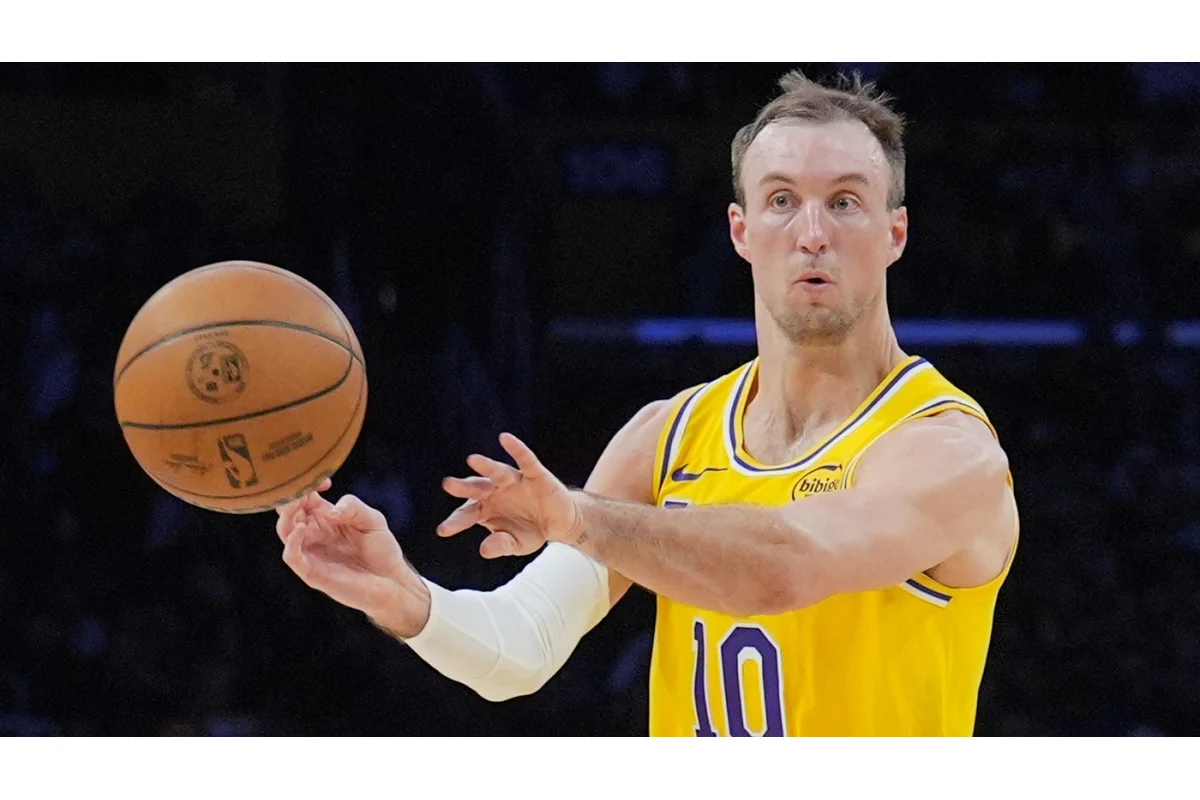
When the Los Angeles Lakers acquired Luke Kennard, many believed his renowned three-point shooting would bolster the team’s perimeter offense. Kennard, recognized for his ability to deliver consistent shots beyond the arc, has instead reduced his reliance on three-point attempts since joining the Lakers. This surprising change raises questions about how his role and approach have evolved in Los Angeles.
Before arriving in Los Angeles, Kennard averaged 3.2 three-point attempts per game and 5.7 attempts per 36 minutes. However, over seven games with the Lakers, those numbers have dipped to 2.3 attempts per game and 3.8 per 36 minutes. Despite this decline, Kennard remains the NBA leader in three-point field goal percentage, shooting an outstanding 49.1 percent, making his reduced volume puzzling for a Lakers team struggling with perimeter shooting.
Alterations in Kennard’s Playing Style Since Joining the Lakers
Kennard’s role shift is evident in his decreased number of wide-open three-point opportunities, which have dropped from 42.5 percent with his former team to 26.5 percent with the Lakers. Instead of focusing on catch-and-shoot threes, Kennard has taken on more ball-handling duties, holding the ball longer during possessions compared to his time with Atlanta.
In Atlanta, only 2.1 percent of Kennard’s touches lasted over six seconds, but in Los Angeles, that figure has risen to 8.8 percent. This longer engagement with the ball reflects increased playmaking responsibilities but has coincided with a sharp decline in catch-and-shoot three-point accuracy, dropping from 51.2 percent in Atlanta to 27.3 percent in Los Angeles.
Balancing Efficiency and New Offensive Responsibilities
While Kennard’s catch-and-shoot three-point effectiveness has suffered, he has compensated by driving more to the basket, taking 12 shots in the restricted area over seven Lakers games, compared to 36 attempts in 53 games with the Hawks. Additionally, he has found success with midrange jumpers and floaters, showcasing versatility beyond his three-point shooting.
However, these adjustments come with trade-offs. In one game against the Orlando Magic, Kennard did not attempt a single three-pointer, signaling a concerning drop in the three-point threat he once provided. For a Lakers team that ranks in the lower half of the NBA in three-point field goal percentage, reviving Kennard’s sharpshooting is critical.
Implications for the Lakers’ Offensive Strategy Going Forward
The Lakers must address why their top three-point shooter is attempting fewer shots from beyond the arc despite his elite efficiency. Ensuring that Kennard’s three-point shooting remains a central element of their offense could improve spacing and scoring balance. How the coaching staff integrates his skills with the team’s broader strategy will be crucial in revitalizing their perimeter game as the season progresses.
