

Dyson Daniels has encountered significant difficulties with his long-range shooting throughout the current NBA season. His ongoing struggles from three-point range have steadily eroded his confidence, making it harder for him to regain his form. This issue has become even more pronounced as opposing teams have recognized and exploited this weakness in their defensive strategies.
Coaches around the league have adapted by leaving Daniels open far more often than usual, despite his previous career average of approximately 35% from three-point range. A new metric tracked by NBA.com, known as “gravity,” highlights how often a player attracts defensive attention, and Daniels’ numbers reveal a troubling trend.
Understanding the Role of ‘Gravity’ in Player Defense
Gravity measures how much defensive pressure a player draws based on their offensive threat. At one extreme are players like Luka Doncic, Kawhi Leonard, Anthony Edwards, James Harden, and Kevin Durant, who are so effective scorers that defenders rarely leave them open. In stark contrast, Daniels ranks near the bottom among guards playing at least 20 minutes per game, positioned just above Isaiah Collier and the Thompson twins.
This low rating indicates that opponents increasingly feel comfortable leaving Daniels wide open, an unusual situation for a player who last season demonstrated a reliable jumper. This defensive approach has contributed to his ongoing scoring difficulties and is a sign of the league adjusting to exploit his current struggles.
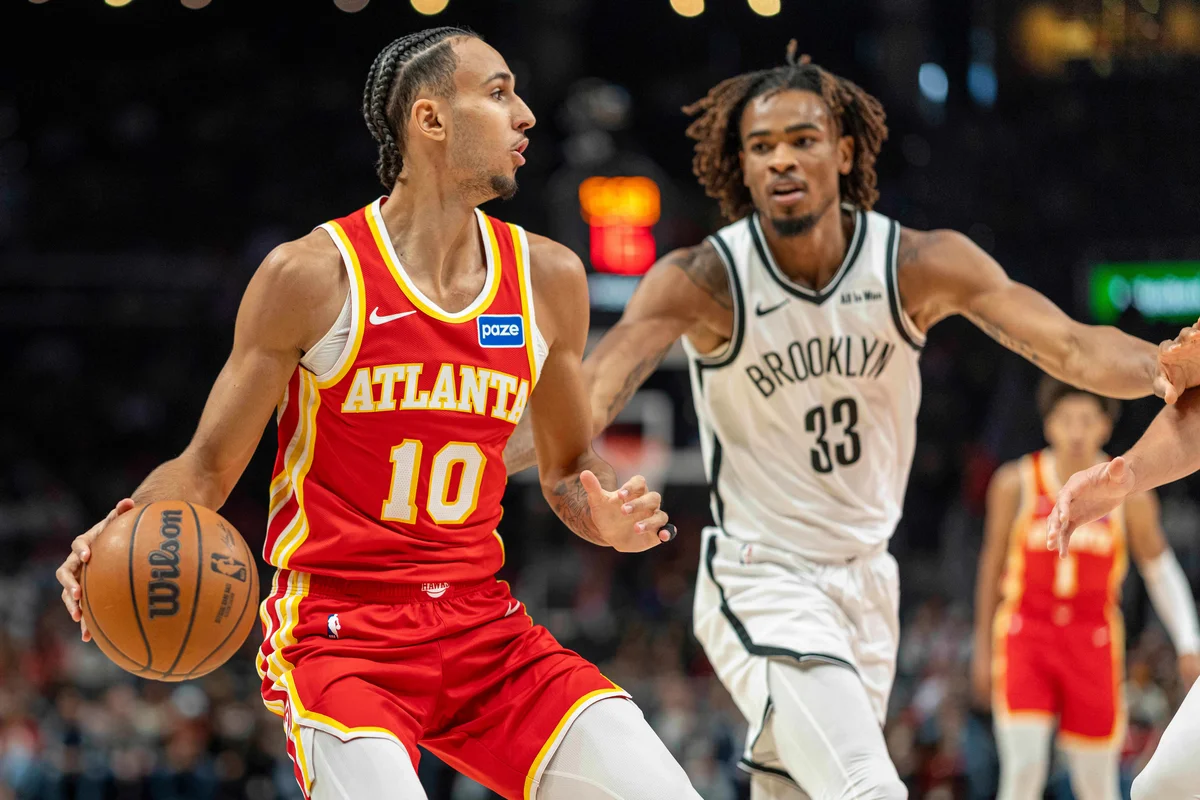
Dyson Daniels’ Potential Hinges on Improving His Shooting Consistency
The phrase often heard around NBA circles remains true for Daniels:
“If he could just develop a consistent jumper, he’d be great!”
This observation applies to many players, but in Daniels’ case, the gap between potential and performance feels particularly stark. If he could replicate the shooting efficiency he showed last season, many analysts argue that he would rank among the NBA’s most valuable role players.
Statistically, Daniels’ impact on the Atlanta Hawks is clear. Among Hawks players with at least 500 minutes played, he leads in on/off court differential. With Daniels on the floor, Atlanta posts a positive net rating of +0.6 over 1,700 minutes, whereas without him, the team’s rating plunges to -4.4 in roughly 800 minutes. This contrast underscores his defensive value and the difficulties the team faces without him.
Comparing Daniels’ Influence to Past Team Dynamics
This situation draws an analogy to the Philadelphia 76ers’ era with Ben Simmons, where his shooting limitations troubled fans but the team’s overall performance suffered in his absence. Simmons’ defensive presence was invaluable, a dynamic seen in Daniels’ contribution to the Hawks’ competitiveness despite his offensive woes.
Atlanta’s need for Daniels on the floor is unmistakable. The negative net rating without him reflects vulnerabilities in defending opposing offenses that he physically helps to contain. The Hawks’ success appears closely tied to his ability to regain form.
The Path Forward: Rebuilding Confidence and Skill
For the Hawks to remain competitive and position themselves as genuine title contenders, it is crucial that Daniels rediscovers his confidence and refines his shooting during the offseason. Fans and analysts alike suggest that with renewed focus and preparation, Daniels could return to or improve upon his 2024–2025 shooting levels, significantly boosting Atlanta’s prospects.
His journey will require resilience and hard work, but if successful, Daniels could transform from a liability on offense to a pivotal piece in the Hawks’ championship ambitions. The coming months will be a critical test of his ability to overcome these shooting struggles and meet the high expectations surrounding his role.
