
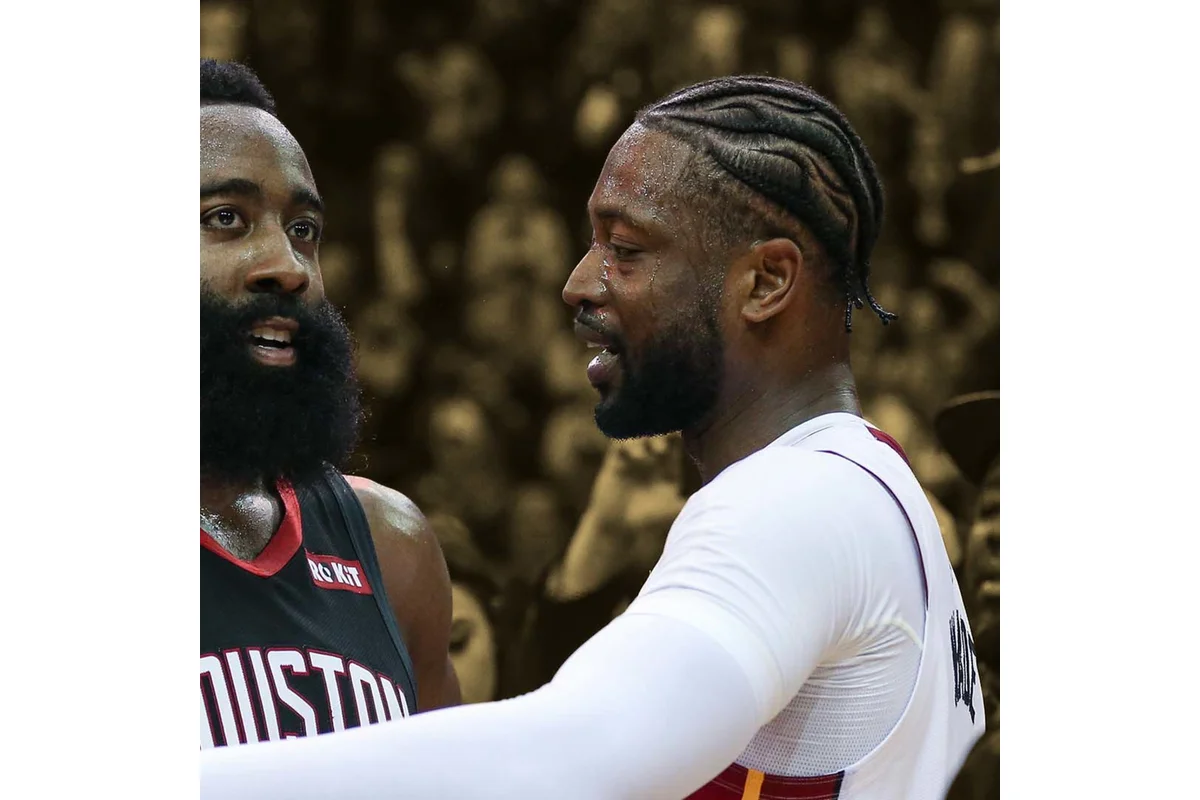
In the ongoing NBA debate between James Harden versus Dwyane Wade, former champion Iman Shumpert recently shared his perspective, placing Wade above Harden. The discussion highlights contrasting styles and career achievements of two guards who each defined their era, influencing how basketball is played today.
How Shumpert Sees Wade as a Unique Competitor
Iman Shumpert, a Chicago native and NBA veteran, openly favors Dwyane Wade, seeing elements of himself in Wade’s game and outlook. Shumpert views Wade as a distinct, aggressive player who embodied qualities he respects, unlike Harden, whose style contradicts the basketball values Shumpert grew up with. Wade’s fearless approach, especially his explosive slashing and mid-range game during his time at Marquette and early Miami Heat years, made a deep impression on Shumpert.
I ain’t goin’ to lie, it’s a preference for me. Like, D-Wade was a different type of animal. That was one of my favorite guys growing up,
Shumpert said.
Just because I watched him at Marquette, just some of the movements he did, it was just like, ‘I think like that.’
I have seen so much D-Wade film. Like, you got to think, a lot of James Harden’s whole s—t is shooting threes. That goes against everything I believe in in Chicago,
Shumpert added.
We were not allowed to shoot threes. if you lost ‘cuz you was shooting threes, everybody going to be, ‘We aint going to see him play. He ain’t got to no will to win.’
Wade’s college career peaked with a standout run to the NCAA Final Four in 2003, foreshadowing his physical and daring style that later dazzled the NBA. Quickly becoming Miami’s cornerstone, Wade posted averages of 24.1 points, 6.8 assists, and 5.2 rebounds per game in his second year, eventually climbing to 27.2 points per game by his third season, solidifying himself as one of the elite players worldwide.
Contrasting Harden’s Revolutionary Scoring Approach
James Harden, in contrast, transformed the NBA by popularizing a shift toward long-range shooting and isolation offense, with his signature step-back three-pointer becoming a symbol of modern guard play. Harden’s peak with the Houston Rockets was marked by historic offensive production, including his 2018 MVP season boasting a league-leading 36.1 points per game, the highest in the modern NBA era.
Despite Harden’s prolific scoring and efficiency in isolation play, Shumpert and many fans point to Wade’s more effective playoff performances. Harden’s inability to consistently elevate his game in postseason clashes is often cited as a significant drawback when weighed against Wade’s clutch scoring and three NBA championship titles.
Notably, Wade delivered an outstanding 34.7 points per game in the 2006 NBA Finals, leading Miami to their first-ever championship by defeating the Dallas Mavericks. He later secured two more titles alongside LeBron James and Chris Bosh as part of Miami’s “Big 3.”
Don’t get me wrong, James one of the top scorers to ever do this, but it’s like, if you going to show me a guy that drives and go get it out the mud that way, I want to watch him (Wade). And D-Wade a champion,
Shumpert pointed out.
The Shadow Cast over Wade’s Legacy Compared to His Contemporaries
Although Shumpert ranks Wade over Harden, he expresses concern that Wade’s legacy is sometimes diminished due to how his career ended, especially when compared to peers with lengthier playing tenures like LeBron James and Chris Paul. Wade retired in 2019 after 16 seasons, though his later years did not mirror the dominance of his prime.
I think it was because of Bron, CP —it was a bunch of guys that outlasted him. I think a lot of times, D-Wade’s greatness will get overshadowed because people have had extended careers,
Shumpert explained.
Wade’s earlier achievements and peak seasons showcase one of the most decorated careers in NBA history. While younger generations might remember a diminished Wade, his dominant performances when stakes were highest remain his true legacy, underscoring a player who thrived in pressure moments and led his team to victory.
Shumpert’s Personal Connections and Influences in the Debate
Shumpert’s closeness to Chicago basketball culture, mirrored in Wade’s early career and style, strongly influences his views. His commentary also hints at complex relationships in the league, such as his admitted initial opposition to LeBron James before becoming teammates on the Cleveland Cavaliers, and loyalties shaped by figures like Carmelo Anthony.
I’m not supposed to be your homie
– Shumpert reflecting on his early stance toward LeBron James before joining forces on Cleveland.
These personal narratives not only add layers to Shumpert’s preference for Wade but also highlight how player comparisons are often shaped by more than statistics and trophies; they involve cultural outlooks and individual basketball philosophies as well.
Why This Comparison Matters for Basketball History
The James Harden versus Dwyane Wade discussion captures a larger evolution in basketball styles—from Wade’s era of physical, mid-range, and slash-oriented play to Harden’s transformational mastery of isolation offense and perimeter shooting. As debates continue, Shumpert’s perspective emphasizes the enduring importance of playoff success and grit alongside scoring prowess.
Ultimately, this conversation impacts how future generations interpret legacies of two extraordinary players who each redefined their positions. Wade’s championships and clutch performances keep him deeply embedded in NBA lore, while Harden’s scoring revolution shapes modern offensive strategies.
As the league progresses, such debates push fans and analysts alike to consider not just raw numbers, but impact, style, and heart—the pillars that define true greatness in basketball.

