Houston Rockets Overview
The Houston Rockets are a professional basketball team based in Houston, Texas, that competes in the National Basketball Association (NBA) as a member of the Western Conference’s Southwest Division. The franchise plays its home games at the Toyota Center in downtown Houston and is owned by Tilman Fertitta, with Gretchen Sheirr serving as president and Rafael Stone as general manager. The Rockets are guided on the sideline by head coach Ime Udoka and feature the long-tenured mascot Clutch the Bear. The team’s identity is built on a red, black, gray, anthracite, and white color palette and a long list of franchise legends.
Across their history, the Rockets have won two NBA championships in 1994 and 1995, four Western Conference titles, and nine division crowns, establishing themselves as one of the league’s historic franchises. Their official NBA G League affiliate is the Rio Grande Valley Vipers, and Memorial Hermann serves as a primary sponsor. The Rockets are recognized for cultivating some of the most influential players and basketball minds of their era, including Hakeem Olajuwon, Moses Malone, Yao Ming, Tracy McGrady, James Harden, and Daryl Morey, who popularized the use of advanced analytics in roster construction.
Founding and Organizational Origins
The franchise was created in 1967 when San Diego businessman Robert Breitbard paid a $1.75 million expansion fee to bring the NBA to Southern California. Inspired by San Diego’s self-image as a city in motion and the local presence of General Dynamics’ Atlas missile program, a local naming contest selected the name Rockets. Breitbard hired Jack McMahon as the team’s first coach and general manager, and the club built its early roster through the 1967 expansion and college drafts, with Pat Riley selected as the franchise’s first-ever draft pick. Home games were played at the San Diego International Sports Arena.
The Rockets struggled in their early years on the court, finishing with the worst record in NBA history at the time while playing in front of sparse crowds. Off the court, Breitbard ran into serious financial trouble tied to a tax dispute surrounding the arena and the broader downturn in professional sports during the late 1960s. Despite community campaigns to keep the team in San Diego, Breitbard ultimately sold the franchise to a Houston-based investment group in June 1971. The sale, completed quickly to keep the team from folding, marked the end of the San Diego Rockets and the beginning of a new chapter in Texas.
Growth Into NBA Competition
After the relocation, Texas Sports Investments purchased the team for $5.6 million and rebranded it as the Houston Rockets, taking on a name that gained new meaning because of Houston’s ties to the United States space program. The franchise became the first NBA team based in Texas. In their first Houston seasons, the Rockets used several venues, including the Hofheinz Pavilion on the University of Houston campus, before moving into The Summit in 1975, a 16,611-seat arena that would serve as the team’s home for nearly three decades. The Summit era, paired with the rise of stars such as Elvin Hayes, Moses Malone, and later Hakeem Olajuwon, helped the organization establish itself as a stable NBA presence.
Ownership changes throughout the 1970s and 1980s reflected the team’s growing business profile, with figures such as Kenneth Schnitzer, the Maloof family, Charlie Thomas, Sidney Shlenker, and, in 1993, Leslie Alexander, who bought the franchise for $85 million, all helping shape the club’s direction. These decades also brought front-office hires and coaching appointments that would define the Rockets’ championship identity, most notably the selection of Olajuwon with the first overall pick in 1984 and the midseason promotion of Rudy Tomjanovich to head coach during the 1991-92 season.
Houston Rockets Competitive Journey
The Rockets’ competitive journey has unfolded in clearly defined eras, beginning with their San Diego expansion years, followed by Houston’s rebuilding phase led by Moses Malone in the late 1970s, a championship peak centered on Hakeem Olajuwon in the 1990s, a high-profile era featuring Yao Ming and Tracy McGrady in the 2000s, an analytics-driven resurgence behind James Harden in the 2010s, and a current young-core rebuild that has already returned the team to the postseason. Across all eras, the franchise has continued to develop elite talent and remain one of the league’s most recognizable brands.
Early Seasons and Development (1967-1976)
The Rockets’ first competitive years were defined by the growing pains typical of an expansion club. The 1967-68 team lost 67 games, an NBA record at the time. Selecting Elvin Hayes first overall in the 1968 NBA draft gave the franchise its first genuine star, and Hayes led the team to its first playoff appearance in 1969. After several losing seasons and the franchise’s relocation to Houston in 1971, the Rockets cycled through coaches such as Tex Winter and Johnny Egan while building a fan base in their new city.
The turning point of the early era came in the mid-1970s, when new ownership invested in The Summit arena and brought in Moses Malone from the American Basketball Association. Under coach Tom Nissalke, the additions of Malone and playmaker John Lucas lifted the 1976-77 Rockets to the Central Division title and a trip to the Eastern Conference finals, where they fell to Julius Erving’s Philadelphia 76ers. The team’s first playoff series victory followed soon after, signaling that the Rockets were ready to contend at a higher level.
Breakthrough in NBA (1977-2001)
The Moses Malone era established the Rockets as legitimate contenders. Following a realignment that returned the franchise to the Western Conference, the 1980-81 Rockets reached the NBA Finals with a sub-.500 regular-season record, a postseason run highlighted by a memorable win at the Boston Garden. Although Malone was later traded, the 1984 draft delivered Hakeem Olajuwon, who, paired with Ralph Sampson, formed the famed Twin Towers. The duo carried Houston back to the 1986 NBA Finals, where they again met the Boston Celtics.
Under Rudy Tomjanovich, the Rockets reached their championship peak. The 1993-94 team set a then-franchise record with 58 regular-season wins, rallied from a 2-0 deficit against the Phoenix Suns in the Western Conference semifinals, and earned the nickname Clutch City by capturing the franchise’s first NBA title over the New York Knicks. Olajuwon earned both regular-season MVP and Finals MVP honors. The following season, with Clyde Drexler joining the roster, the Rockets became the first team in NBA history to win a championship as a sixth seed by sweeping the Orlando Magic in the 1995 Finals. Late in the decade, the additions of Charles Barkley and Scottie Pippen produced a Western Conference finals appearance in 1997, but injuries and aging ended that era’s run, and Olajuwon was traded to the Toronto Raptors in 2001.
Modern Program and Current Direction (2001-Present)
The early 2000s ushered in the Yao Ming era, highlighted by a 22-game winning streak during the 2007-08 season and the franchise’s move into the Toyota Center in 2003. The pairing of Yao and Tracy McGrady captured global attention, though injuries limited their playoff success. After Yao’s retirement in 2011, general manager Daryl Morey began rebuilding the roster around advanced analytics, and the 2012 acquisition of James Harden launched the Rockets back into championship contention. With Harden leading a fast-paced, three-point-heavy offense, Houston won 65 games in 2017-18 and reached the Western Conference finals, losing to the Golden State Warriors.
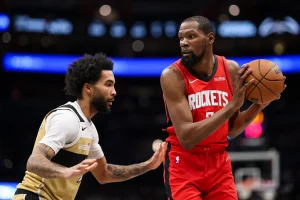
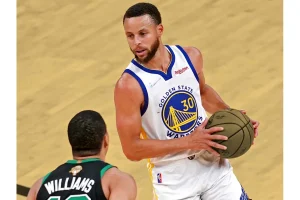
Following Harden’s 2021 trade to the Brooklyn Nets, the Rockets entered a multiyear rebuild focused on a young core that included Jalen Green, Kevin Porter Jr., Alperen Şengün, and Jabari Smith Jr. The 2023 offseason brought major change, as Ime Udoka was hired as head coach and veteran free agents Fred VanVleet and Dillon Brooks were signed. The 2024-25 Rockets finished 52-30 and returned to the playoffs, where they pushed the Golden State Warriors to seven games in the first round. In July 2025, the franchise executed a blockbuster trade for Kevin Durant, signaling a renewed push for championship contention. The current roster blends established stars with the continued growth of Şengün, who earned his first All-Star selection in 2024-25.
Philosophy and Competitive Strengths
Modern Rockets basketball has long emphasized player development, positionless offense, and analytical decision-making, traits that defined Daryl Morey’s front office and continue to influence the team’s current construction. Under Ime Udoka, the franchise has layered in a stronger defensive identity, leaning on versatile wings and a physical interior presence. The team’s biggest competitive strengths remain its depth of young talent, the playmaking of Alperen Şengün, and the scoring pedigree of Kevin Durant, giving Houston multiple options on both ends of the floor.
Key Milestones and Major Moments
Among the franchise’s defining moments are its first NBA championship in 1994, the historic 1995 Finals sweep, the 22-game winning streak in 2007-08, the 65-win season in 2017-18, the franchise-record 27 three-pointers made in a single game in 2019, the 2024-25 return to the playoffs, and the July 2025 acquisition of Kevin Durant. The retirement of Clutch the Bear-era traditions, the move into the Toyota Center, and the league-wide influence of the team’s analytics movement also stand as major organizational milestones.
Houston Rockets Achievements and Results
The Rockets’ trophy case features two NBA championships, four Western Conference titles, and nine division crowns, placing them among the most decorated franchises in the Western Conference. The franchise has produced multiple NBA MVPs, scoring champions, and Defensive Players of the Year, while regularly setting benchmarks for three-point shooting and offensive efficiency.
NBA Achievements
The Rockets have won two NBA championships, claiming back-to-back titles in 1994 and 1995. The 1994 championship run featured a franchise-record 58-win regular season and an unforgettable comeback from a 2-0 series deficit against the Phoenix Suns, an effort that gave birth to the Clutch City identity. The 1995 squad made history as the first team to win a championship as a number six seed, sweeping the Orlando Magic in the Finals and becoming the first team to defeat four 50-win teams in a single postseason.
Across the league, the Rockets have also earned recognition for regular-season excellence, including 65-win campaigns and multiple division titles. The franchise has seen three of its players earn the NBA’s Most Valuable Player award, Moses Malone, Hakeem Olajuwon, and James Harden, contributing to a total of four MVP trophies for the organization.
Conference Achievements
The Rockets have captured four Western Conference championships in 1981, 1986, 1994, and 1995. The 1981 run stands out as one of the most surprising in league history, with a 40-42 team advancing all the way to the NBA Finals. The 1994 and 1995 conference titles powered the franchise’s back-to-back championships, while the 1986 appearance marked the high point of the Twin Towers era, showcasing Olajuwon and Ralph Sampson on the league’s biggest stage.
Beyond the four titles, the Rockets have made frequent conference finals appearances, including runs in 1997 with Charles Barkley, in 2015 and 2018 with James Harden, and in 2025 with their young core. These appearances reflect the organization’s continued ability to build contenders around marquee talent.
Divisional Achievements
The Rockets have won nine division titles, with championships in 1977, 1986, 1993, 1994, 2015, 2018, 2019, 2020, and 2025. The franchise’s early divisional success coincided with the Moses Malone era, while the 1993-94 title helped set the stage for the championship run that followed. The 2015 crown was Houston’s first division title in more than two decades, signaling the arrival of the Harden era.
The 2018, 2019, and 2020 Southwest Division titles came during the most consistent regular-season stretch of the Harden era, when the Rockets routinely posted 50-plus win seasons. The 2025 division title reflected a swift turnaround under Ime Udoka, as the Rockets returned to contender status in just his second season at the helm.
Series Achievements
The Rockets have built several memorable playoff series across their history, including their 1981 upset run to the Finals, the 1986 championship rematch with the Celtics, the 1994 Clutch City comeback against Phoenix, and the 1995 sweep of the Orlando Magic. The 2009 playoff victory over the Portland Trail Blazers ended a long postseason series drought, and the 2015 Western Conference semifinals comeback from a 3-1 deficit against the Los Angeles Clippers demonstrated the franchise’s resilience.
More recently, the 2024-25 first-round series against the Golden State Warriors, which extended to seven games, marked the return of playoff basketball to Houston after a five-year absence and signaled the arrival of the team’s young core. The franchise’s analytics-driven style, three-point shooting records, and late-game comebacks have become defining series-level hallmarks over the past two decades.