Boston Celtics Overview
The Boston Celtics are a professional basketball team based in Boston, Massachusetts. The Celtics compete in the National Basketball Association (NBA) as a member of the Atlantic Division of the Eastern Conference. Founded in 1946 as one of the league’s original eight franchises, the Celtics play their home games at TD Garden, a shared arena with the National Hockey League’s (NHL’s) Boston Bruins. The Celtics are widely regarded as the most successful team in NBA history, holding the league record with 18 championships. Their team colors are green, white, black, gold, and brown, and their mascot is Lucky the Leprechaun, a tribute to Boston’s historically large Irish population and to the Original Celtics, a barnstorming basketball team of the early twentieth century.
The franchise is currently led by head coach Joe Mazzulla, with Brad Stevens serving as general manager and president of basketball operations, Rich Gotham as president, and Wyc Grousbeck as chief executive officer. In May 2025, the team was sold to private equity investor William Chisholm, alongside Aditya Mittal, in a transaction valued at $6.1 billion. The Celtics’ NBA G League affiliate is the Maine Celtics, and the team’s main sponsor is Amica Mutual Insurance. Boston’s longstanding rivalry with the Los Angeles Lakers is considered one of the defining matchups in North American professional sports.
Founding and Organizational Origins
The Boston Celtics were formed on June 6, 1946, by Boston Garden-Arena Corporation president Walter A. Brown as a team in the Basketball Association of America (BAA). The team was one of the league’s original eight charter franchises. In 1948, the Celtics earned their first playoff appearance, losing to the Chicago Stags. On August 3, 1949, the franchise became part of the National Basketball Association following the merger of the BAA and the rival National Basketball League.
From the outset, Brown built the organization around a clear goal: fielding a competitive team in Boston’s already saturated sports landscape. In 1950, the Celtics signed Chuck Cooper, becoming the first NBA franchise to draft a Black player. The early roster included original member Chuck Connors, later known for his role in The Rifleman. The team played its home games at the Boston Garden, sharing the historic venue with the Boston Bruins and establishing a foundation of tradition and fan loyalty that would define the franchise for decades.
Growth Into NBA Competition
The Celtics struggled during their early years until the hiring of coach Red Auerbach. Auerbach ran all practices, scouted opposing teams and college prospects, and scheduled road trips with little support. One of the first great players he brought in was Bob Cousy, whose contract became the property of the Chicago Stags before the franchise went bankrupt, sending Cousy to Boston in a dispersal draft.
After the 1955-56 season, Auerbach engineered a stunning trade, sending Ed Macauley and the draft rights to Cliff Hagan to the St. Louis Hawks for the second overall pick, which he used to select University of San Francisco center Bill Russell. Auerbach also acquired Holy Cross standout Tom Heinsohn, the 1957 NBA Rookie of the Year. Russell, Heinsohn, and Cousy formed the core around which Auerbach would build a champion for more than a decade, leading the Celtics to their first NBA title in 1957 and beginning the franchise’s rise into national prominence.
Boston Celtics Competitive Journey
From a perennial early loser, the Celtics developed into the NBA’s defining dynasty, accumulating titles across multiple eras under Hall of Fame leadership. The franchise has reached the NBA Finals 23 times, captured 11 conference championships, and claimed 35 or 36 regular-season division titles, depending on the source, establishing the deepest playoff résumé in league history.
Early Seasons and Development (1946-1956)
The Celtics’ first competitive years were marked by inconsistency. The team made the playoffs in 1948 but missed them in 1949, and the early roster included journeymen and prospects. In 1950, the selection of Chuck Cooper made history, but on-court success remained elusive. The franchise finished with losing records as Auerbach worked to construct a contending roster.
The arrival of Bob Cousy in 1950 transformed the team’s backcourt, but the true turning point came with the 1956 draft. By trading for the rights to draft Bill Russell and pairing him with Heinsohn, Auerbach laid the foundation for sustained excellence. With Russell anchoring the defense and Cousy directing the offense, the Celtics advanced to the 1957 NBA Finals and defeated the St. Louis Hawks in seven games to win their first NBA championship.
Breakthrough in the NBA (1957-1969)
The 1957 championship marked the beginning of the greatest dynasty in NBA history. Led by Bill Russell, Bob Cousy, and Tom Heinsohn, with a talented supporting cast that included Don Nelson, K. C. Jones, John Havlicek, Sam Jones, Satch Sanders, and Bill Sharman, the Celtics won eight consecutive NBA championships from 1959 to 1966. On December 26, 1964, the Celtics became the first NBA team to field an all African-American starting lineup. In 1968, Russell became the first African American head coach in any major United States professional sport when he succeeded Auerbach as player-coach, leading Boston to titles in 1968 and 1969 before retiring after the 1969 season with an unsurpassed 11 championships in 13 seasons.
After a brief rebuilding phase, the Celtics returned to contention in the mid-1970s. With Dave Cowens, Jo Jo White, and a veteran John Havlicek, the team won championships in 1974 and 1976 under head coach Tom Heinsohn. The 1976 Finals triple-overtime Game 5 against the Phoenix Suns, decided by Gar Heard’s turnaround jumper, is widely considered one of the greatest games in NBA history. Auerbach then selected junior Larry Bird of Indiana State with the sixth overall pick in the 1978 NBA draft, believing his potential justified the wait, a decision that would launch the next great Celtics era.
Breakthrough in the 1980s (1981-1986)
With Bird in the fold, the Celtics surged to a 61-21 record in 1979-80, a 32-game improvement. Auerbach then completed one of the most lopsided trades in NBA history, sending two first-round picks to the Golden State Warriors for center Robert Parish and the right to select University of Minnesota power forward Kevin McHale. Together, Bird, McHale, and Parish formed the celebrated “Big Three,” widely regarded as the best frontcourt in NBA history, and won three championships together.
Under head coach Bill Fitch, the Celtics won the 1981 NBA championship over the Houston Rockets, with Cedric Maxwell earning Finals MVP. In 1983-84, with K. C. Jones as coach, Boston went 62-20 and defeated the Los Angeles Lakers in the Finals for their 15th title. The Celtics won the 1986 NBA Finals against the Houston Rockets, with rookie Larry Bird having become a superstar. The 1986-87 season ended with a Finals loss to the Lakers, while the tragic death of second overall pick Len Bias from an accidental cocaine overdose in 1986 marked one of the franchise’s most difficult off-court moments.
Modern Program and Current Direction (2007-Present)
After years of rebuilding, general manager Danny Ainge assembled a new “Big Three” in the summer of 2007, acquiring Ray Allen from Seattle and Kevin Garnett from Minnesota to pair with Paul Pierce. In 2007-08, Boston completed the largest single-season turnaround in NBA history, improving by 42 games to a 66-16 record. Behind head coach Doc Rivers, the Celtics defeated the Lakers in six games in the 2008 NBA Finals, claiming their 17th championship and sending Garnett, Allen, Pierce, and Rivers into the annals of franchise history.
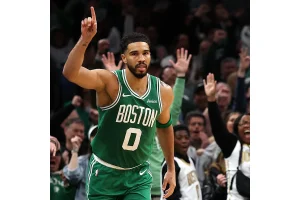
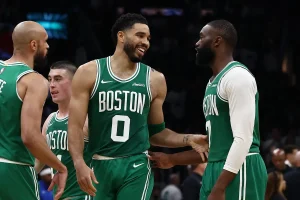
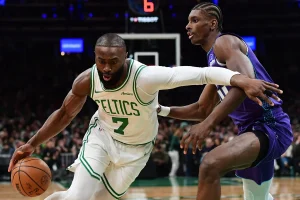
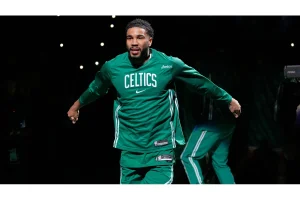
In 2021, Brad Stevens was named president of basketball operations, replacing Ainge, and later hired Ime Udoka as head coach. Following Udoka’s suspension in September 2022, assistant Joe Mazzulla took over and was named permanent head coach in February 2023. With Jayson Tatum and Jaylen Brown forming a new core, the Celtics added Kristaps Porziņģis and Jrue Holiday before the 2023-24 season, posted a league-best 64-18 record, and defeated the Dallas Mavericks in five games in the 2024 NBA Finals to capture a record 18th championship. Brown was named Eastern Conference Finals MVP, and ownership of the franchise transferred to William Chisholm in May 2025 in a $6.1 billion transaction.
Philosophy and Competitive Strengths
The Celtics have historically been defined by team-oriented play, elite defense, and disciplined execution. From the Russell era’s shot-blocking dominance to the Bird-era precision passing and the modern era’s switchable defensive schemes, Boston has built its identity on versatility, basketball intelligence, and a deep supporting cast surrounding one or two transcendent stars.
Key Milestones and Major Moments
The franchise’s most enduring milestones include Bill Russell’s 11 championships in 13 seasons, the 1957 and 1968 title runs that bookended the dynasty, the 1976 triple-overtime classic, the 1981 and 1986 championship years, the 2008 title that ended a 22-year drought, and the 2024 championship that set the all-time NBA record at 18. The 1946 founding, the 1950 selection of Chuck Cooper, and the 2025 record-setting sale round out the franchise’s landmark organizational moments.
Boston Celtics Achievements and Results
The Boston Celtics hold the NBA record with 18 championships, the most in league history. They have made 23 appearances in the NBA Finals, captured 11 conference titles, and earned 35 or 36 regular-season division crowns. The franchise’s trophy case reflects sustained excellence across eight distinct decades.
NBA Achievements
The Celtics have won 18 NBA championships, the most in league history, in 1957, 1959, 1960, 1961, 1962, 1963, 1964, 1965, 1966, 1968, 1969, 1974, 1976, 1981, 1984, 1986, 2008, and 2024. The 1959-1966 run of eight consecutive titles remains the longest championship streak in United States professional sports history. The 2008 title marked the franchise’s first championship in 22 years, and the 2024 title set a new league record, breaking a tie with the Los Angeles Lakers.
Conference Achievements
The Celtics have won 11 Eastern Conference championships, in 1974, 1976, 1981, 1984, 1985, 1986, 1987, 2008, 2010, 2022, and 2024. Boston’s conference dominance has been punctuated by legendary playoff battles with the Philadelphia 76ers, Detroit Pistons, Miami Heat, and Cleveland Cavaliers, with the 2008 and 2024 conference titles standing as defining moments in two distinct eras of Celtics basketball.
Divisional Achievements
Boston has captured 35 regular-season Atlantic Division championships, in 1957, 1958, 1959, 1960, 1961, 1962, 1963, 1964, 1965, 1972, 1973, 1974, 1975, 1976, 1980, 1981, 1982, 1984, 1985, 1986, 1987, 1988, 1991, 1992, 2005, 2008, 2009, 2010, 2011, 2012, 2017, 2022, 2023, 2024, and 2025. The Celtics’ divisional dominance stretches across nearly every era of the franchise and reflects consistent regular-season excellence throughout the NBA’s modern era.
Series Achievements
Beyond the NBA Finals, the Celtics’ most storied playoff series have come against the Los Angeles Lakers, a rivalry that has seen the teams meet 12 times in the Finals, with Boston winning nine. The 1985 NBA Finals marked the first time the Lakers defeated the Celtics in the championship series, and the only time the team won a championship at Boston Garden. Boston’s other signature playoff rivalries include the Philadelphia 76ers, against whom the Celtics have won 15 of 22 playoff series, and the New York Knicks, against whom Boston holds a 276-236 regular-season advantage across 512 meetings.