

The Atlanta Hawks continue to exemplify an almost unparalleled level of sustained mediocrity in NBA history, maintaining an almost perfectly balanced win-loss record over thousands of games. Currently standing at 31–31 this season, this record aligns closely with decades of performance, illustrating a rarity in professional basketball where teams typically fluctuate between peaks and valleys.
Statistical Evidence Showcases Remarkable Win-Loss Symmetry
When examining win-loss totals across various spans, the Hawks reveal a striking consistency. Over their last 90 games, they hold a 45–45 record; stretching to 134 games, it is 67–67. Further extending this sample to 348 games shows a perfectly even 174–174, while 420 games reflect a 210–210 mark. The pattern persists at historic scales: 785–785 over 1,570 games, 1,940–1,940 across 3,880 games, and an almost symmetrical 2,894–2,896 over 5,790 games. Even when rounded to 6,000 games, the franchise’s record remains nearly level at 2,997 wins to 3,003 losses.
This near .500 track record defines the Hawks’ identity as a team rarely experiencing major winning streaks or long losing skids.’
Recent Seasons Reinforce Franchise’s Near-Perfect Equilibrium
The recent years underline this trend with the Hawks finishing 40–42 in the 2024–25 season, 36–46 the year before, followed by a 41–41 campaign in 2022–23 and 43–39 in 2021–22. Their brief surge in the 2020–21 season, going 41–31 and reaching the Eastern Conference Finals, hinted at potential growth but ultimately did not disrupt the consistent mediocrity reflected in the historical pattern.
This Season Highlights Team’s Balanced Competitive Nature
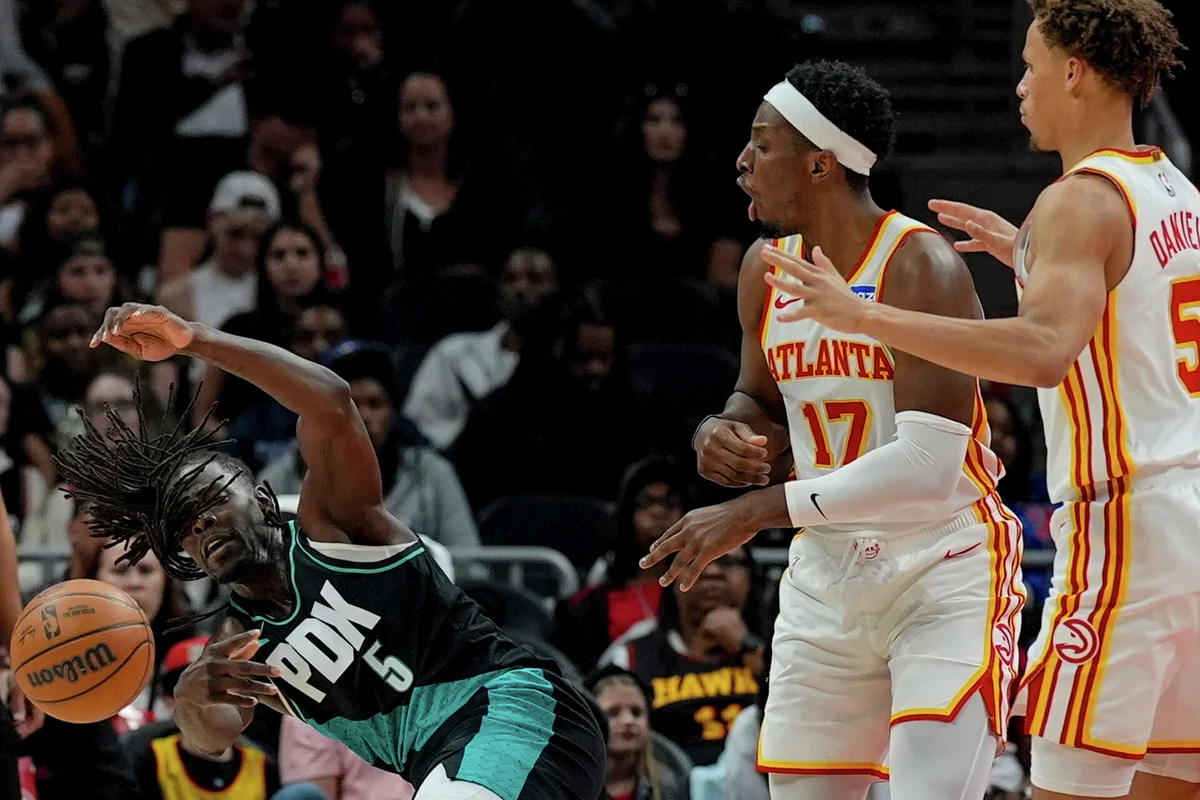
Through 62 games this season, Atlanta’s performance exemplifies this balance: scoring 7,278 points while allowing 7,277, a margin of just one point. This statistical parity points to a team that rarely dominates opponents yet avoids being overwhelmed, reflecting consistent competitiveness without significant swings.
Roster Shifts Signal Organizational Transition Amid Continuity
The franchise is now navigating a transitional phase highlighted by moving on from long-time star Trae Young. The current roster features emerging players like Jalen Johnson, who has begun to establish himself as a central figure, alongside Nickeil Alexander-Walker, CJ McCollum, and Dyson Daniels. McCollum provides experienced leadership, Daniels contributes defensive versatility, and Alexander-Walker adds depth, as Atlanta attempts to find a new direction.
Despite these changes, results remain largely unchanged, as the Hawks continue to hover around the middle of the Eastern Conference standings. The franchise has not committed entirely to rebuilding but also struggles to rise into the upper echelon and challenge elite teams consistently.
Statistical Rarety amid an NBA Designed for Fluctuation
In a league built on cycles powered by draft lotteries, salary cap management, and superstar windows, such prolonged equilibrium is unexpected. Teams frequently experience years of rebuilding or championship contention, but Atlanta remains steadfastly average. This enduring balance presents unique difficulties for the front office, which must determine if the current rebuild will break this historical pattern or simply perpetuate it.
The Future Hinges on Talent Development and Strategic Decisions
Atlanta boasts young talent and some financial flexibility, but success depends heavily on developing these players and making sound roster decisions. What lies ahead for the Hawks is an open question: whether they can leverage their assets and create a competitive window or continue to occupy the NBA’s middle ground.
Ultimately, their record over thousands of games encapsulates a franchise identity rooted in balance without dominance, a rare and unique narrative within professional basketball’s changing landscape.
