
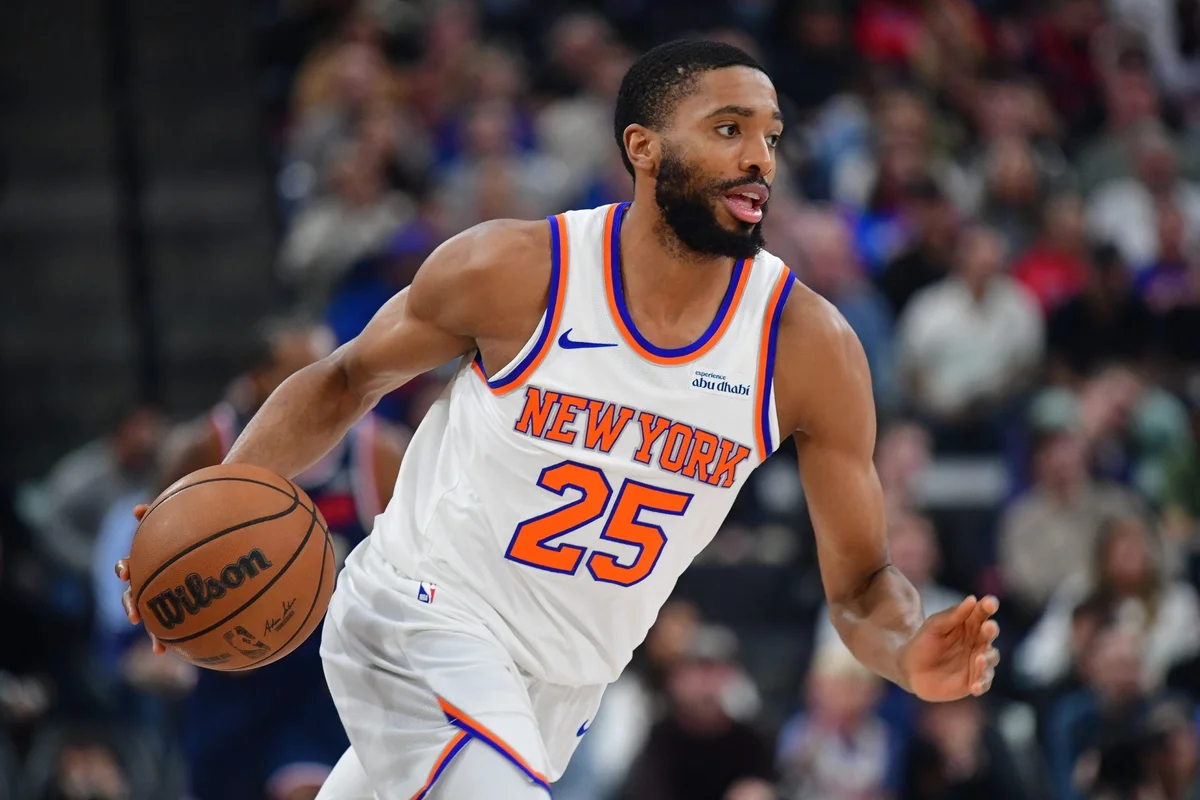
During the 2025-26 season, New York Knicks guard Mikal Bridges has emerged as a controversial figure despite showing measurable improvement across most statistical categories. Although his scoring output has dipped, Bridges’ overall contributions continue to influence the team’s performance in both offense and defense in complex ways.
Statistical Growth in Most Areas Except Scoring
Mikal Bridges has advanced in almost every key statistical area compared to the previous season. His averages per 36 minutes have risen by 1.3 rebounds, 0.6 assists, 0.6 steals, 0.4 blocks, and 0.2 made three-pointers. Furthermore, his shooting efficiency has seen notable gains, with a 2.6 percent increase in three-point shooting and a 1.3 percent improvement at the free throw line. Bridges is on track to record his best three-point shooting percentage since the 2022-23 season. He is also posting his highest assist totals ever, alongside career highs in steals and blocks per 36 minutes.
Despite these positive shifts, Bridges’ decreased scoring numbers have fueled skepticism about his overall value. Fans and analysts alike often scrutinize his impact through the lens of point production, creating a nuanced debate over his role with the Knicks.
Adjusting to a Unique Role Amidst Talented Teammates
The team context surrounding Bridges affects his individual stats significantly. The Knicks’ roster includes dominant scorers such as All-NBA players Jalen Brunson and Karl-Anthony Towns, as well as an emerging offensive talent in OG Anunoby. This abundance of scoring options places Bridges in a supporting role where he is often tasked with focusing on defense or other facets of the game over individual scoring.

On the defensive end, Bridges has helped establish the Knicks as one of the NBA’s top defensive teams recently, but he has done so by playing somewhat outside his preferred position. According to James L. Edwards III of The Athletic, Bridges frequently must defend primary ball handlers rather than taking advantage of his strength as an off-ball defender. Edwards explains:
“However, because the bulk of Bridges’ minutes come as part of a starting lineup that has an elite off-the-ball defender in OG Anunoby and a roamer in Josh Hart, who is best at mucking things up for offenses, Bridges often takes on the role of guarding the primary ballhandler to fill the gap as the premier on-ball defender. That responsibility can highlight some of Bridges’ weaknesses, such as asserting himself as a physical presence while teams look to initiate their offense on that end of the court.” – James L. Edwards III, Basketball Analyst
Even with these defensive assignments pushing him beyond his comfort zone, Bridges continues to provide positive value by adapting to the team’s needs.
Contributions to Knicks’ Success Despite Critiques
Bridges’ influence on the Knicks’ winning formula is evident despite perceptions of underperformance. While his personal scoring numbers have dropped, the Knicks’ net points per 100 possessions are 3.9 points higher when he is on the court. Since January 20, following a difficult stretch where the team lost nine of eleven games, the Knicks have posted a league-best defensive rating of 105.2 with Bridges playing a central role in the rotation.
The tension arises because Bridges does not often produce headline-grabbing scoring feats or spectacular defensive plays that typically draw widespread media attention. This mismatch between visible excitement and actual team impact complicates the public’s evaluation of him, especially considering the high cost paid to secure Bridges in a trade involving five future first-round picks and a pick swap.
Bridges’ Critical Role in Key Moments Defines His Value
The magnitude of the trade package exchanged for Bridges has placed extra scrutiny on his performance. Some critics question whether sacrificing multiple draft picks limited the Knicks’ ability to pursue other star players, such as Giannis Antetokounmpo. However, the fundamental question remains whether New York could have broken its 25-year drought from reaching the Conference Finals without Bridges’ presence.
Bridges has repeatedly risen to the occasion during high-pressure playoff moments, asserting his value beyond regular season metrics. He made decisive defensive stops late in close contests against the Boston Celtics and Detroit Pistons and delivered key scoring performances, including 20 points to take a 2-1 lead over Detroit and 25 points to close out that series. Against Boston, Bridges contributed 23 points and four steals in Game 4 to help secure a 3-1 lead and then added 22 points to finish the series in six games.
His pattern of stepping up when the stakes are highest challenges the narrative that the trade was unbalanced based solely on draft capital or scoring averages. Instead, Bridges exemplifies a player whose impact extends into the moments that matter most, reinforcing the Knicks’ recent successes despite external doubts.
Moving forward, Knicks supporters and analysts must weigh historical cost against current contributions, deciding whether they can appreciate Bridges for the steady and often understated ways he elevates the team’s performance on both ends of the court.
