
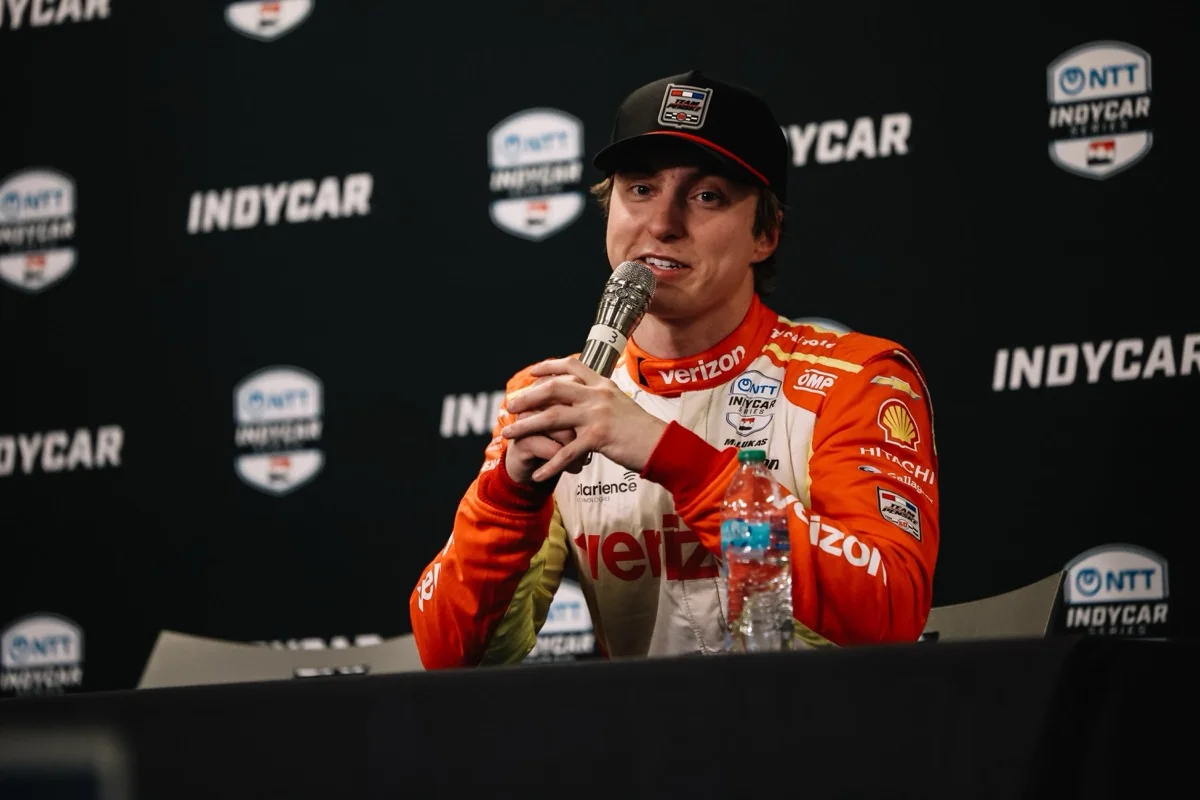
David Malukas of Team Penske emerged as the fastest driver during the initial day of IndyCar testing at Phoenix Raceway, clocking a lap speed of 172.605 mph on Tuesday. The testing session took place on the mile-long dogleg oval in Avondale, Arizona, in preparation for the upcoming Good Ranchers 250 scheduled for March 7. Malukas’s pace narrowly surpassed his teammate Josef Newgarden and Andretti Global newcomer Will Power, signaling a strong start for the Penske driver with his new team.
Top Performers and Testing Conditions at Phoenix Raceway
During the last hour of the testing session, Malukas surged ahead on the leaderboard, recording the top speed just ahead of Newgarden, who posted 172.021 mph. Will Power, now with Andretti Global, took third place with a lap time of 171.706 mph. Testing was conducted amid moderate temperatures in the mid to upper 60s Fahrenheit, providing adequate but variable track conditions ahead of the scheduled race weekend, which also features NASCAR’s GovX 200 and the Straight Talk Wireless 500.
Malukas Shares Enthusiasm for Phoenix Raceway Track Characteristics
Malukas expressed a high level of enthusiasm after the first day of testing. He described Phoenix Raceway as capable of generating substantial grip and already ranks it among his favorite circuits.
“I love it—very, very nice. It can take a lot of grip. It’s definitely already one of my favorite tracks,”
Malukas said, after completing the initial run of the Unser IndyCar Open Test.
“I feel confident. Was it what we were aiming for? No. We just ran through our test plan, and we managed to get a time on the board.”
Rookie Incident and Field’s Unfamiliarity With Phoenix Raceway
Rookie driver Caio Collet, representing A.J. Foyt Racing, encountered minor contact with the Turn 4 wall shortly before the final hour of testing, but he was quickly cleared by medical personnel with no injuries. The presence of only a handful of drivers with prior experience at Phoenix contributed to the collective eagerness of the field to maximize track time. Chevrolet drivers Josef Newgarden and Alexander Rossi and Honda competitors Scott Dixon and Will Power remain the only participants with previous starts at this circuit.
Veteran Drivers Reflect on Phoenix Raceway and Testing Strategy
Four-time and defending series champion Alex Palou highlighted the challenge of preparing for this relatively unfamiliar venue.
“It’s exciting, although it’s a new track. So we’re starting from zero. But at least tomorrow we’ll be able to do a lot of changes. You always want to go fast, even if you are not trying to go, like, quick. You just want to feel fast.”
He also noted the distinction between testing and race conditions at Phoenix:
“It’s just a lot easier, I feel, here when it comes to testing to get a super big lap, compared to when you come here on the race weekend and you only have two qualifying laps and then the race [with] everybody on the same fuel, setup, and everything. I just want to feel confident with the car.”
Palou’s rival, Pato O’Ward from Arrow McLaren, added insight on oval track setups and comfort requirements:
“The ovals, you would think, would be more of a caution whenever the car isn’t really to your liking. You obviously need something that is under you to be able to just be running out there. Like what Alex said, you have to be comfortable. You have to be happy with what you have, and this will be a huge opportunity to see the car in every aspect rather than just a performance run and then kind of guessing what the car is going to be like in the first stint.”
Evaluations of Phoenix Raceway’s Layout and Comparisons to Other Circuits
Prior to testing, O’Ward characterized Phoenix Raceway as a hybrid of other notable tracks such as Gateway and Iowa, remarking on the old-school feel representative of IndyCar ovals. Such feedback is echoed by Kyle Kirkwood, an Andretti Global driver who posted the fourth fastest time Tuesday at 171.423 mph. Kirkwood described the track as
“very, very smooth and very fast”
but acknowledged its quirks.
Alexander Rossi, another experienced driver, reflected on his past experiences at Phoenix, expressing enthusiasm about returning to the venue after a break since 2018:
“I was bummed when we left after ’18 because I had one of the best oval races of my life that year [he finished third], then we never went back again. I’m excited to get back there. It’s a cool track. It’s a great part of the world. Having a doubleheader with Cup is awesome. Having done the Firestone test out there in November, I think they found a pretty great tire which will make it an amazing show.”
Impact of Tire Changes on Race Dynamics and Lane Utilization
The introduction of a harder right front tire drew approval from multiple drivers, including Palou, who believes the tire will help promote grip and enable racing in the upper groove, essential for multi-lane competition. This second lane is critical to enhancing race excitement by preventing processional runs along the bottom groove.
“My understanding is that it’s wider, the front right tire. I think it’s actually what we need at some of these ovals, just to get more grip from the tire itself so we are able to go in the second lane when it’s not so grippy and just kind of still be able to run it.”
Insights on Race Conditions, Traffic Interaction, and Setup Variability
Josef Newgarden stressed the importance of simulating real-race scenarios during testing to understand how Phoenix Raceway will evolve once all cars are competing closely. He remarked on the unique characteristics and demands of each oval track throughout the season:
“The only way you’re going to learn how the thing is going to race is when everybody is there and they’re trying to run in some sort of race situation.”
“They’re all different. What works at Iowa doesn’t work at Gateway doesn’t work at Nashville.”
“There’s no perfect science to this. You can’t just say, ‘This worked at this track, so take this.’ They’re all different. What works at Iowa doesn’t work at Gateway doesn’t work at Nashville. They all need a specific tuning to it as far as the downforce and tire package.”
Scott Dixon, reflecting on his limited testing at Phoenix last fall, indicated the possibility of the second lane becoming usable with a full field on track.
“It became usable. I think if you get a full field doing it, it could transition pretty quickly.”
“The other thing, too, is how the Cup tire reacts to Firestone is really a big unknown, as well. That could be good for us if they’re on the bottom, then it’s going to make us move higher. We want it to be a great race.”
O’Ward agreed, noting the influence NASCAR’s Goodyear tires have on track conditions for IndyCar cars and how the interaction between the tire compounds could change race dynamics.
“The NASCAR rubber [tires by Goodyear] sometimes affects the IndyCars a little bit differently than if it’s just all Firestone rubber for us. Sometimes it varies from track to track, so you just have to wait for the race weekend and see if it decides to throw the balance upside down or not.”
Technical Challenges Posed by Phoenix Raceway’s Unique Dogleg Configuration
Phoenix Raceway is distinct among IndyCar ovals for its dogleg design, a subtle curve in the backstretch that recalls the track’s original road course layout. This feature poses an additional challenge to drivers, as Scott Dixon explained:
“It’s a tricky circuit, especially without being able to use the dog leg. It kind of makes that big straight single lane a little bit just with how you can place the car and nobody can go around you. But if that second lane comes in, it would be a game-changer.”
Unlike NASCAR drivers, IndyCar competitors are prohibited from using the wider apron area through the dogleg to pass. Palou noted experimentation with this approach on simulators but emphasized its impracticality in real racing conditions:
“Because I thought it would have been great. It’s very tough on IndyCars. But on top of that, they don’t allow us. So even if it was doable in IndyCar, you’re not going to be able to see it, because it’s forbidden to go there.”
Palou expressed support for the strict enforcement of this rule, citing safety concerns due to the rough track surface in the apron area.
“For sure. I think honestly, with our cars, it’s actually good. For the show, it would be if you could have a couple of cars spinning on the straights because they bottom out. But it’s very rough. What I saw today during the track walk, it doesn’t look very nice. It’s very—I think there would be a big crash if somebody tries it.”
Limited Transferability Between Phoenix Raceway and the Indianapolis 500
Although the Phoenix race is scheduled early in the season, drivers agreed it offers little direct preparation for the Indianapolis 500. Scott Dixon characterized Indianapolis Motor Speedway as a distinct challenge with unique package demands:
“There’s nothing really that aero package-wise or mechanical grip or anything that really passes on to Indy. No, Indy is really its own thing.”
O’Ward reinforced this, highlighting the unpredictability of the IndyCar experience at Indianapolis:
“Indy is Indy—like, Indy is very different. Even when we had Texas before Indy, it doesn’t fully translate. Indy just decides what it wants, and obviously the car can be good one day, and then the other day it’s like, ‘What’s going on with it?’ Indy is its own beast.”
“I would say it really doesn’t have too much of a comparison if we were to start with an oval or not.”
Looking Ahead: Preparations and Challenges Before Race Weekend
The data gathered during these early test sessions are expected to have limited application when teams return for the official race in March, as weather conditions may differ significantly, with temperatures potentially rising into the 80s. Nonetheless, drivers are utilizing this opportunity to build familiarity with the track and optimize car setups ahead of the Good Ranchers 250.
As IndyCar gears up for a complex season, with Phoenix Raceway testing setting the tone, Team Penske’s David Malukas has already made a statement by topping the timing charts. The evolving track conditions, tire interplay, and the search for a sustainable second racing groove all point to an unpredictable and competitive race weekend on the western outskirts of Phoenix.
