
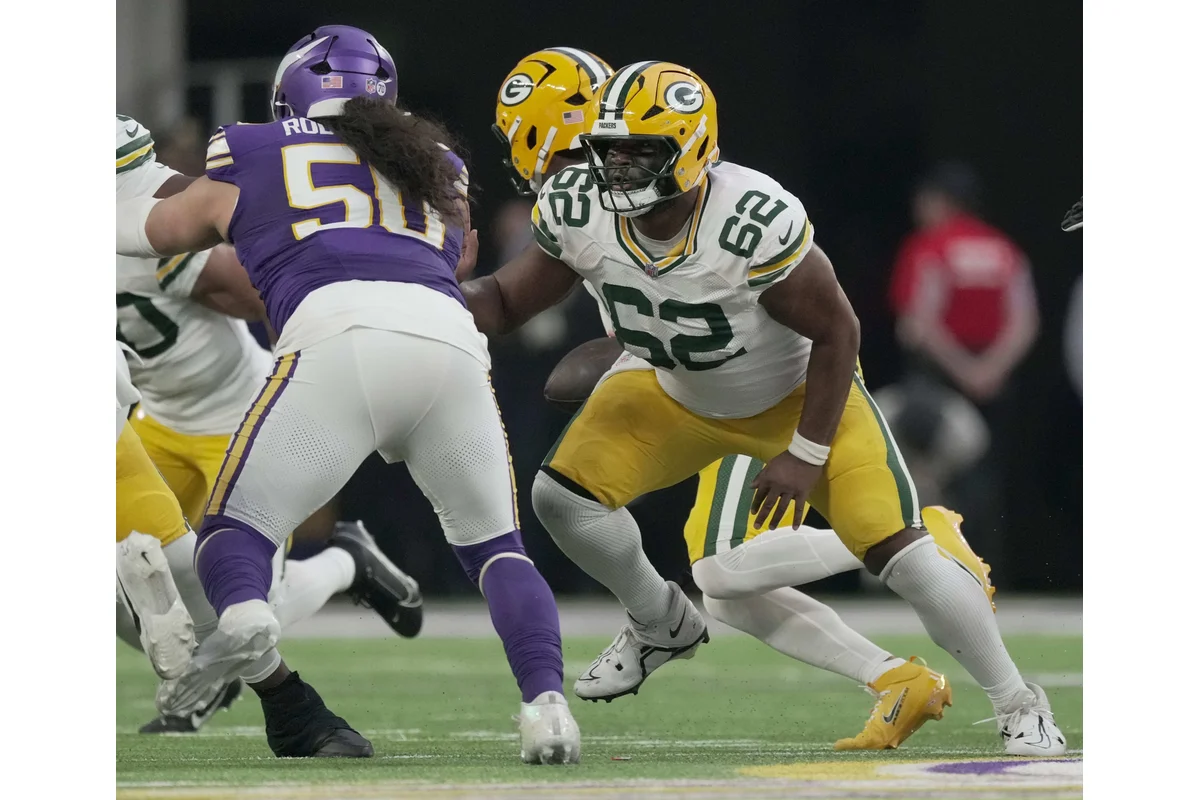
The Green Bay Packers face challenging decisions as they approach the new league year, particularly concerning several players who will become free agents or carry substantial salary cap burdens into 2026. Among these, Rashan Gary and Elgton Jenkins are widely considered prime trade candidates, but doubts linger over whether any team will be willing to take on their contracts given recent performances and injury histories.
Evaluating Potential Trade Moves Involving Key Packers Players
Rashan Gary and Elgton Jenkins stand out as two players whose futures with the Packers are uncertain due to their expensive contracts and uneven seasons. Gary, a pass rusher, will have a cap hit approaching $28 million in 2026 but struggled to live up to expectations during the 2025 campaign, recording only 7.5 sacks and none after late October. Jenkins, who shifted to center this season but suffered a significant injury midway through 2025, carries an even higher cap number near $24.3 million, raising concerns about his on-field contributions relative to his salary.
Sports analyst Alex Ballentine recently identified Gary, Jenkins, and defensive lineman Lukas Van Ness as the Packers’ top trade assets in a league-wide evaluation of trade prospects. He noted,
“Parsons ACL injury does mean the Packers could use additional depth early in the 2026 season. However, Rashan Gary could still find himself in trade talks. Trading him would create $11 million in cap space and his production has not matched his lofty price tag.
That being said, he plays a premium position, and there could be teams out there who would make a bet on him improving their own pass rush.
If the Packers feel like they need Gary to carry them through whatever time Parsons misses next season, then Luka Van Ness could be a tradeable asset. The 24-year-old has not lived up to expectations over the first three seasons of his career, but he still has the draft pedigree of a first-rounder.” ?Alex Ballentine, NFL analyst
Regarding Jenkins, Ballentine added,
“Offensive line help is always in demand. Elgton Jenkins is set to carry a cap hit of $24.3 million, which doesn’t match up with his move to center this season. Jenkins’ versatility could make him appealing to many teams, and the Packers would save $19.5 million in cap space by trading him.” ?Alex Ballentine, NFL analyst
Obstacles to Trading Gary, Jenkins, and Van Ness
Despite being named as trade candidates, Gary and Jenkins face significant challenges in attracting trade offers. Their large cap hits mean any acquiring team would have to absorb costly contracts poorly aligned with recent production or injury concerns. While trading Gary might save the Packers $11 million in cap space, his $28 million hit for next season and inconsistent 2025 performance make him an unlikely target for teams unwilling to shoulder a $17 million salary for a pass rusher demonstrating diminished impact. Similarly, Jenkins’ $24.3 million cap figure combined with his injury history and age over 30 make teams hesitant to absorb his contract despite his positional versatility.
Compounding this, both Gary and Jenkins are expected by many to become salary cap casualties, potentially being released rather than traded. This limits the incentive for other teams to part with draft picks to acquire them when they might be signed later for less if released outright.
As for Lukas Van Ness, the Packers are unlikely to include him in trade discussions since he remains under his rookie contract. Green Bay’s organizational philosophy traditionally avoids trading young players on cost-controlled deals, which further diminishes Van Ness’s status as a trade asset at this point.
Broader Team Considerations and Depth Needs for 2026
The injury to Micah Parsons has intensified pressure on the Packers to secure depth early in the 2026 season, particularly in pass rush positions. While Gary could theoretically fill this need, his cost and output raise questions regarding the team’s willingness to rely on him. Conversely, Van Ness, despite underwhelming results so far, retains potential due to his draft pedigree, yet remains an unlikely trade candidate.
The Packers face salary cap constraints that necessitate tough choices on which players to retain or release, influencing roster composition heading into the next season. The inability to trade high-priced veterans like Gary and Jenkins effectively limits flexibility, with the organization possibly forced to absorb some financial burdens or release players to create cap space.
Fan Reactions and What Lies Ahead for the Packers’ Roster
Green Bay Packers fans are left in a state of uncertainty and frustration as the front office navigates these complex trade and salary cap decisions. The prospect of losing veteran players without compensation and the challenge of balancing a competitive roster amid financial limitations create tension around the team’s immediate future. The outcomes of these decisions could heavily influence the Packers’ competitiveness in 2026 and beyond.
While some players may depart in free agency or be cut for cap relief, the Packers must also focus on developing younger talent and addressing critical positional needs with limited resources. How the organization approaches these challenges will be crucial in maintaining their status in the NFL amid a rapidly evolving roster landscape.
