
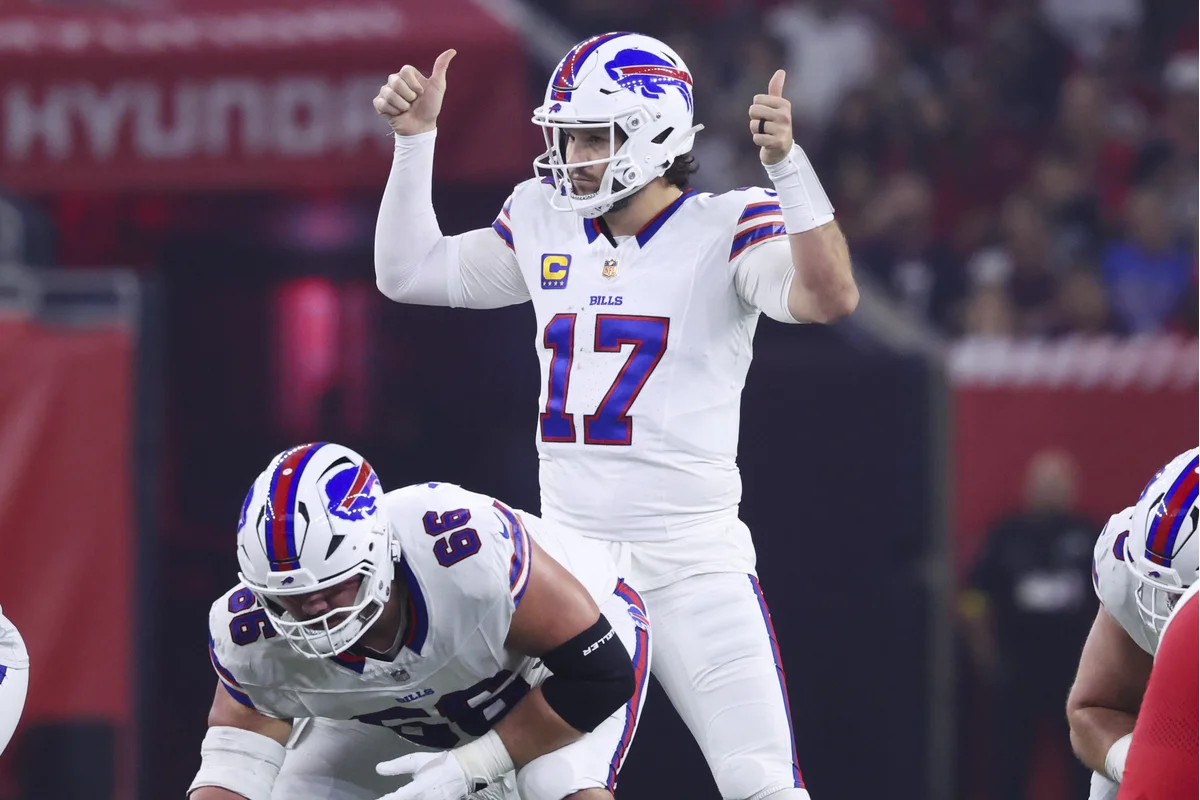
At the NFL Scouting Combine in Indianapolis on Tuesday, Buffalo Bills head coach Joe Brady discussed his plans for building the team’s roster and coaching staff during his first offseason in charge. Brady outlined how he is balancing acquiring the right talent with adapting to the team’s philosophy and long-term goals for the 2026 season.
He touched on the staffing process, scouting prospects at the combine, and the approach to shaping Buffalo’s offense and defense heading into the new NFL campaign.
Constructing a Strong Coaching Staff with Veteran Leadership
Shortly after being hired, Brady dedicated extensive hours to assembling a coaching team that could bring his vision to life. He described the time he spent on calls as relentless during those early days.
“I’m rarely on my phone. That was one of those times where there wasn’t a moment I wasn’t on my phone,”
Brady said.
Before officially taking the helm, he identified the types of coordinators and assistants he wanted to join his staff. He successfully brought in Pete Carmichael as offensive coordinator, Jim Leonhard to oversee the defense, and Jeff Rodgers to lead special teams. By February 17, barely three weeks into his tenure, Brady had completed adding over 20 assistant coaches covering various positions and quality control roles.
“They set the standard, and they’re going to be the ones that are with the players,”
he noted, praising the collective coaching group.
A significant addition was longtime NFL figure John Fox, who joined as a senior defensive assistant, offering experience and as a resource during Brady’s first year as head coach.
“He’s been through it all, and someone that I can lean on in those moments,”
Brady remarked.
Drew Terrell was another noteworthy hire as the wide receivers coach, coming over from the Arizona Cardinals where he also served as passing game coordinator. Brady said Terrell’s background as a former Stanford player and experience in the quarterback room made him a unique asset.
“He’s a guy from Stanford, extremely bright,”
Brady explained.
“He’s been in the QB room. There’s something so valuable about a guy that coaches wide receivers, but that also can teach them from a quarterback’s perspective.”
Terrell expressed a desire to eventually become a quarterbacks coach and offensive play caller, ambitions that impressed Brady.
“I need you on the staff,”
Brady told him.
“We have a vision for him and the way that he thinks, his mindset, his personality. I was so fired up to get him,”
Brady added.
While many new coaches arrive, two defensive staff members remain in Buffalo. Joe Danna earned a promotion from safeties coach to secondary coach, and Jason Rebrovich advanced to senior defensive assistant.
“Joe Danna has done an incredible job in the back end. He’s extremely bright, been a lot of different systems. And then ‘Rebs’. It’s his second time in Buffalo, he loves Buffalo. He had opportunities to go other places and to have even more of an elevated role, and he chose to be here. That means a lot to me,”
Brady detailed.
Evaluating Prospects Holistically during Combine Meetings
This combine marks Brady’s first as a head coach, where his involvement extends beyond purely physical evaluations. He stressed focusing on selecting the best football players while being flexible with his systems.
“We want the best football players that we can get, … our systems might look different year to year, and there’s some little tweaks, but it’s not going to be – offense or defense – ‘This is what we’re doing no matter what we have.'”
Although an ideal player prototype exists at each position, Brady acknowledged the need to adapt based on the strengths and traits of the players available, combining skill assessment with cultural fit.
Brady prefers to actively engage with prospects during their short interviews rather than leaving the process to others.
“You got 20 minutes and the reality of it is – and that’s not to diminish the importance of it – but you got to be mindful of what you’re trying to get out of these 20 minutes,”
he explained.
“A lot of guys are hoping that their 20 minutes are going to be strictly about maybe their background where they’re rehearsed on it, where I think it’s a better process to [just] talk football … let’s talk through some play. Let’s talk football.”
On the field, he wants to witness a mix of natural quickness and overall athleticism in drills, understanding different players excel in varying areas.
“There’s some guys that are naturally quicker. Well, I hope to see that quickness in some of the drills. And some guys are straight line speed, they might struggle on a shuttle drill or whatnot,”
Brady said.
Equally critical to physical skills is evaluating players’ personalities—how they interact, lead, and motivate teammates during the process.
“Anytime that you can have contract with a player and get to know them, see them in settings, uncomfortable settings, see them talking football … I don’t know why you wouldn’t take advantage of that,”
he said.
“I just want football players that love ball … trying to get opportunities [and] connect with them, understand that … You can test really well, and I hope these guys do that. But you are what you put on tape as well and I’m going to take that way more into consideration.”
Emphasizing Versatility and Weather Resilience in Building the 2026 Roster
With his coaching staff now in place, Brady turns full attention to assembling the 2026 roster, balancing talent with a strategic fit for the team’s envisioned schemes. He recognizes the importance of versatile players who can perform various roles and excel in Buffalo’s demanding late-season weather.
“We have to have an offense and defense that can be built to be able to play in those crazy conditions, right?”
Brady stated.
“And we have to be able to run the ball, we have to be able to stop the run, so that at the forefront is what we’re focused on.”
On defense, the Bills plan to shift from a 4-3 base to a 3-4 scheme, but Brady emphasized flexibility rather than strictly seeking players who fit one mold.
“We have an idea of what we want, and we think we have the pieces to do that, but we want to make sure that we’re versatile in what we’re doing,”
Brady remarked.
“And saying, ‘Hey, we want to be a 3-4.’ But if we don’t have certain guys that fit those pieces, where we might have a true inside linebacker playing outside. Everything’s on the table is what I mean here, as we kind of continue to build this. But we have a clear vision for what we want and what we want it to look like.”
Defensive end Greg Rousseau will adapt to this new system, though his exact role remains to be determined. Brady believes that positioning Rousseau correctly will allow him to continue showcasing his talent.
“What is a 4-3, what is a 3-4? Defining the different type of D-ends or outside linebackers, I think there’s so much more that goes into it,”
Brady said.
“And then some of it has to do with also tell me who the counterpart is with Greg, and the different type of skill sets, and as we balance it and kind of come together, and that’s part of the process that we’re going through now. As we go into free agency, there’s a lot of different avenues that we can kind of go. But we know how great of a player he is and can be if we continue to put him in positions where he can show the type of player that he is.”
Finding a suitable nose tackle is critical for a 3-4 defense, and Brady believes Buffalo’s roster already contains players fitting that profile. However, his priority is a flexible defensive line with athletes capable of playing several roles.
“We do have nose tackles on our roster that honestly fit the prototype that we have,”
he said.
“But the big thing is if we can have flexibility across the defensive line, having guys that can play the nose and play a 4i, play outside and be able to move inside. We want flexibility with what we’re doing because then it makes a little tougher on them knowing exactly where our guys are going to be.”
On offense, Brady is focused on expanding the roles of dynamic players like wide receiver Khalil Shakir, who led the team with 719 receiving yards last season. Brady envisions Shakir as a multi-dimensional asset.
“Khalil can play inside and outside and there’s really not a lot of things Khalil can’t do,”
Brady said.
“And as we watch cutups and as we go through things and put it all together, there’s definitely ways to get the ball in his hands in different ways. And we have to continue to grow his game cause he’s such a huge component to our offense. He’s one of our best football players, and when the ball is in his hands, good things are happening.”
Ultimately, passion for football is at the heart of what Brady seeks, whether through skill, versatility, or personality. This holistic approach is shaping Buffalo’s 2026 roster blueprint.
Joe Brady Immerses Himself in Defensive Strategy and Collaboration
Adjusting to the responsibilities of head coach and shifting the team toward a new defensive base, Brady has prioritized deep involvement in defensive meetings. Collaborating closely with defensive coordinator Jim Leonhard is helping him build knowledge and confidence on that side of the ball.
“I’ve never sat in the defensive meetings as much as I am right now,”
Brady shared.
“I want to be able to speak the language to our guys. I want to be able to coach them and talk to them, and not just, when games on the line. If Jim’s calling the defense, I want at least know what he’s calling.”
His last extended stint in defensive meetings was in 2013-14 as a linebackers coach at William & Mary. Brady sees this renewed focus as a way to become a more complete coach and to forge stronger relationships with defensive players.
The experience is also influencing his offensive play-calling.
“It’s cool that the collaboration because I’m getting the feel of also, it’s helping me as an offense play caller too,”
he said.
“I’ve purposely stayed out the offensive meetings right now so they can be critical of the room that we need for growth … So, I’ve been sitting in the defensive meetings really trying to get a feel of how we do things, what puts them in stress because it helps me. Because a lot of people are going to be studying probably a lot of the top defenses, and those are the elements that we’re going to do.”
Leonhard and Brady are excited about the defensive roster’s potential.
“There are a lot of pieces on our team that are exciting to him,”
Brady said.
“… There are some guys that might have been used in some roles in the past that we think they can do some other things, but a lot of it is projections right now. You got to go do it and so that’s where we’re kind of at right now is figuring out what some of the base defense kind of looks like and moving some of the guys in some of those different roles and skill sets. That’s what’s also exciting.”
First Free Agency Move: Re-signing Offensive Lineman Alec Anderson
As the free agency period approaches, Buffalo made its initial roster move by re-signing offensive lineman Alec Anderson to a one-year contract. Anderson, who joined the Bills as an undrafted free agent in 2022, has proven himself as a flexible and reliable lineman.
In 2024, he was frequently utilized in jumbo packages as the sixth offensive lineman. His role shifted somewhat last season as tight end Jackson Hawes was used more, but Anderson still earned a Week 13 start at right tackle when Spencer Brown was sidelined.
“You want guys like Alec Anderson on your football team,”
Brady said.
“Like the type of edge he plays with … so excited to get him back.”
If left guard David Edwards or center Connor McGovern depart in free agency, Anderson may compete for more prominent starting opportunities.
Buffalo also secured defensive tackle Phidarian Mathis with a new one-year deal, maintaining key depth along the defensive front.
Staying in Buffalo ‼️
We have re-signed OL Alec Anderson and DT Phidarian Mathis each to one year contracts.
📰: https://t.co/vmt10BnlAK pic.twitter.com/OBXHEfMeIr
— Buffalo Bills (@BuffaloBills) February 23, 2026
