
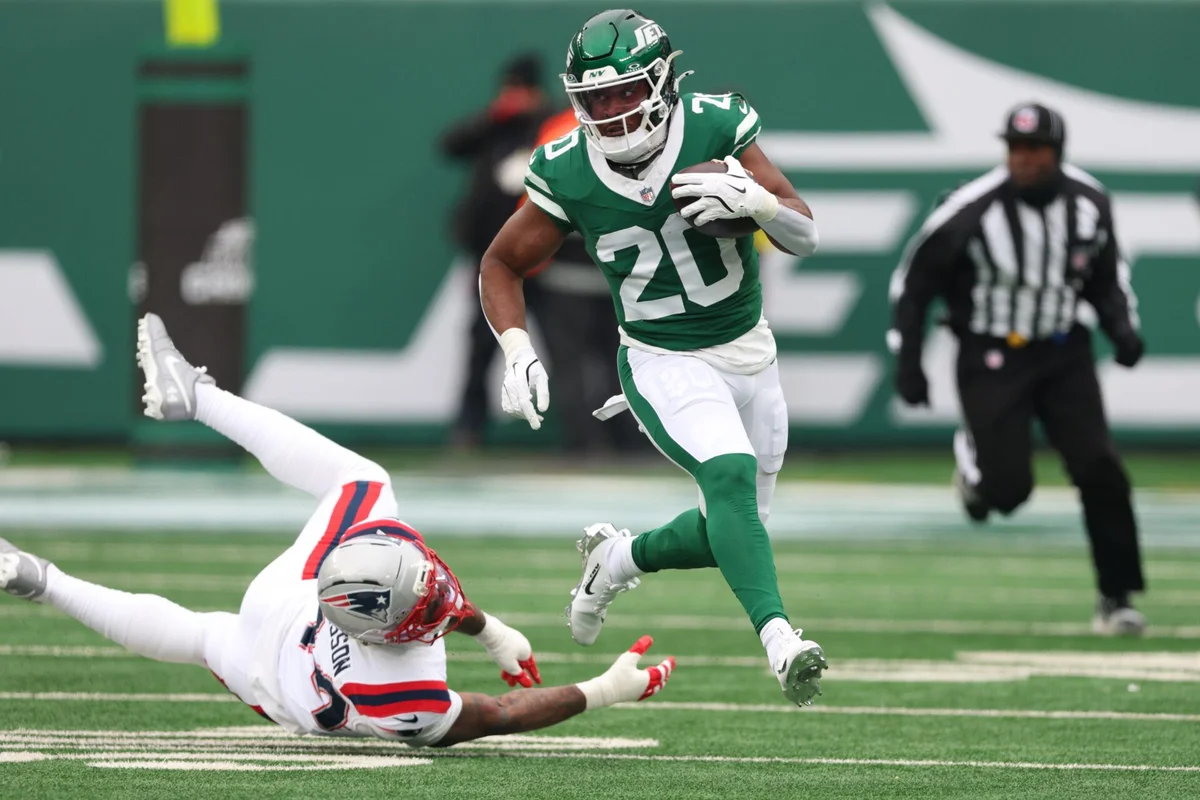
Breece Hall, a standout running back for the New York Jets, faces a major decision as the franchise approaches the NFL’s March 2 deadline to either secure a multiyear contract extension or apply a franchise or transition tag. General Manager Darren Mougey confirmed at the NFL Scouting Combine that the Jets and Hall have until 4 p.m. Tuesday to resolve Hall’s contract status, a critical step as the team continues its rebuild and Hall emerges as one of its top contributors. This decision will impact not only Hall’s future earnings but also the Jets’ strategy heading into the 2026 season.
Comparing the Franchise and Transition Tags: What They Mean for Hall
The Jets have two tagging options to retain Hall if no extension is agreed upon: the franchise tag or the transition tag. The franchise tag carries a one-year salary of approximately $14.3 million and effectively removes Hall from the free agent market by requiring any team pursuing him to surrender two first-round draft picks to the Jets. This high cost makes a trade or signing by another team extremely unlikely.
Alternatively, the transition tag, valued near $11.3 million, allows the Jets the right of first refusal, meaning they can match any offer Hall receives from another team to keep him. Should the Jets decline to match, they receive no compensation. Notably, the transition tag is seldom used; only six players have been designated this way in the past decade, and none have attracted offers from other teams since 2018.

How Tagging Affects Negotiation Dynamics Between Hall and Jets
If Hall is tagged, the salary attached to the tag will act as a salary floor during contract talks, possibly reducing the urgency for either side to finalize a long-term deal. An NFL agent explained to The Post that being restricted to a one-year tender alters leverage, as the Jets would be guaranteed Hall’s services for at least one season, while Hall gains time to evaluate market developments.
The restricted nature of the tags means Hall may wait to observe contract settlements for other top running backs before committing, allowing him to benchmark his value. The Jets expect Hall to consider how the market shifts following deals with peers such as Kenneth Walker, Jahmyr Gibbs, Bijan Robinson, and Devon Achane.
Running Back Market Shaping Contract Expectations
Joel Corry, a CBS Sports contracts analyst and former NFL agent, advised Hall to hold off on his decision to watch free-agent deals for his contemporaries, noting,
“Wait to see what free agent Kenneth Walker gets done. We will likely see a couple of first-round draft picks fundamentally change the running back market: Jahmyr Gibbs (Lions) and Bijan Robinson (Falcons) are going to be looking at extensions at Saquon Barkley’s contract. And Devon Achane (Dolphins) is going to be looking to be up there. I let those guys redefine the running back market under the theory that a rising tide lifts all boats.”
An agent familiar with contract negotiations shared that the two tag figures — $14.3 million for the franchise tag and $11.3 million for the transition tag — represent the realistic top and bottom of the salary range for the 24-year-old Hall. If negotiations landed in the middle, Hall’s average annual value would be approximately $12.8 million.
Contract Structure and Guarantees Under Consideration
Most significant running back contracts extend three or four years with strong guarantees upfront. Corry outlined a preferred structure saying,
“It would be something to seriously consider depending on the structure and the cash flow. I’ll take the first two years fully guaranteed, some conditional guarantees in the third year or a March roster bonus, and I’m going to want 70 to 73 percent through the first two years, including 40 to 45 percent in the first year.”
If Hall is franchise-tagged, his contract would rank as the third highest average annual value among running backs, while a transition tag would place him eighth; a midpoint deal would put him fifth. Currently, Saquon Barkley ($20.6 million), Christian McCaffrey ($19 million), Derrick Henry ($15 million), and Jonathan Taylor ($14 million) are the NFL’s top-paid running backs.
Options Available to Hall and Risks for the Jets
Being tagged does not guarantee Hall will sign the tender immediately. He could skip offseason workouts without incurring penalties to increase leverage. However, the Jets retain the right to rescind an unsigned tag at any time, although this move risks disruption in the locker room.
Franchise-tagged players have until July 15 to negotiate extensions, while the signing deadline for transition-tagged players arrives slightly later. After these deadlines, players can only play under the one-year tender contracts.
Potential Interest from Other Teams If Transition-Tagged
While the transition tag offers theoretical opportunities for rival teams to make offers, none have materialized for transition-tagged players recently. Teams such as the Kansas City Chiefs, New Orleans Saints, and Washington Commanders have been identified as potential suitors for Hall should he be transition-tagged. The Chiefs reportedly pursued Hall around last year’s trade deadline.
Hall’s Performance and Comparisons to Draft Peers
Hall’s career earnings of $9 million over four seasons pale in comparison to draft classmates like the Buffalo Bills’ James Cook, who signed a four-year, $46 million extension, and the Los Angeles Rams’ Kyren Williams, with a three-year, $33 million deal. Hall acknowledged this gap, stating in August,
“They’ve done much more in the league than I have. They’ve been in better situations, and they are both very good players. For me, I feel like I’m just as talented as anyone, but those guys are really good running backs, and they deserve their payday.”
Last season, Hall earned his first 1,000-yard rushing season and ranked 14th in yards from scrimmage with 1,415, while leading the Jets with five offensive touchdowns despite the team’s overall offensive struggles.
Jets’ Salary Cap and Future Team Strategy
The Jets currently hold $88.7 million in salary cap space, ranking third in the NFL behind the Tennessee Titans and Las Vegas Raiders. This financial flexibility provides the team avenues for roster changes and contract negotiations while navigating the second year of Darren Mougey and head coach Aaron Glenn’s regime.

